Tag Archives: Keystone XL

Ten ways that the Obama administration could lower gas prices right now

From the Heritage Foundation.

Here’s the list:

  1. Lift offshore and onshore exploration and drilling bans
  2. Approve Keystone XL
  3. Require timely environmental review
  4. Permitting process
  5. Issue leases on time
  6. Allow development of oil shale
  7. Stop the land grab
  8. Implement 50/50 revenue sharing
  9. Prohibit greenhouse gas and Tier 3 gas regulations
  10. Repeal the Renewable Fuel Standard (RFS)

Here’s the detail on #3 and #6 and #9:

3. Require timely environmental review: Environmental review requirements for oil and gas projects to commence on federal lands under the National Environmental Policy Act (NEPA) take too long. Congress should place a reasonable 270-day time limit on NEPA reviews.

6. Allow development of oil shale: Oil shale production in the U.S. could be a global game changer since we hold the largest known reserves in the world. However, 70 percent of those reserves lie beneath federal lands. The Obama Administration has introduced new regulations, time frames, and significantly reduced the land available for leases. Congress should make permanent the 2008 guidelines for oil shale development in order to provide regulatory certainty.

9. Prohibit greenhouse gas and Tier 3 gas regulations: In 2010, Interior suspended 61 leases in Montana alone because environmental groups charged that the energy production would contribute to climate change, demonstrating the need to permanently prohibit any federal agency from unilaterally regulating greenhouse gas emissions. Additionally, the proposed Tier 3 gas regulations to lower the amount of sulfur in gasoline are costly with no measurable benefits. Congress should prohibit the implementation of these regulations. Unelected bureaucrats should not hold such power over the economy.

Are these steps unreasonable?

Well, Canada already streamlined their environmental review process. Canada also doesn’t let global warming socialism block job creation in the energy sector. Canada’s government strongly opposes global warming socialism. They’ve even pulled out of the Kyoto treaty. Their energy industry is booming, and taking their economy with it. Can’t we do the same? Why is the Democrat Party’s energy policy all about giving money to green energy firms and imposing burdensome regulations on energy companies who do create jobs?
The ten worst energy policies of the Obama administration

Heritage Foundation put this list together.

Here are a few examples:

5) The EPA’s Regulatory Train Wreck: The Environmental Protection Agency’s (EPA) ream of new regulations will adversely affect existing power plants, requiring them to be retrofitted or in many cases shut down because it will be too costly to install emission-reduction controls The most recent announcement of the President’s ongoing campaign against carbon-based fuel, the EPA released a new rule to regulate CO2 emissions from power plants, which would effectively ban new coal power plants, as its emissions standards are too low to be met by conventional coal-fired facilities. That will result in higher energy costs, fewer jobs, a less prosperous economy and no discernible difference in global temperatures.

6) Cap-and-Trade and the Clean Energy Standard: When he came into office, President Obama latched on to the notion of cap-and-trade — a system of energy taxes and credits designed to reduce carbon emissions. The end result would have been disastrous for American businesses and the economy. When that legislation failed, the President proposed a Clean Energy Standard mandating that the power industry  meet government-determined goals with respect to renewable energy production. The effect, though, is the same.  Both serve as a draconian energy tax that burdens businesses and consumers – with no environmental benefits.

8Terminating the Nuclear Waste Repository at Yucca Mountain, Nevada.  The Obama Administration   says it wants to pursue nuclear power, but its rhetoric does not match its nuclear policy.  Its decision to abandon the Yucca Mountain nuclear waste repository project without any technical or scientific data is a case in point.  With nearly $15 billion spent on the project, the data indicates that Yucca would be a safe place to store America’s used nuclear fuel.  Yet purely for political reasons the Obama administration decided to terminate the program without having anything to replace it. Absent any nuclear waste disposal options, the United States simply will not significantly expand nuclear energy.

9) Green Jobs Stimulus: With the U.S. economy struggling to recover from a recession, President Obama turned to a trillion dollars in stimulus spending in an attempt to spend America out of the economic doldrums. A significant part of that stimulus was directed toward a new “green” economy with taxpayer dollars directed toward creating alternative energy jobs. Obama promised to create five million green jobs over 10 years. The trouble is that his plan didn’t work, and the jobs didn’t materialize. As The New York Times reported, it was nothing more than “a pipe dream.” Further, these are taxpayer-funded jobs that destroy jobs elsewhere in the economy. When the government gives money to build a windmill, for example, those resources cannot simultaneously be used to build other products. The net effect is job and income losses.

10) Job-Killing CAFE Standards: Obama’s EPA has imposed a corporate average fuel economy (CAFE) standard requiring auto makers to hit an average 54.5 miles per gallon by 2025—a 40 percent reduction in fuel consumption compared to today. The Center for Automotive Research warned that overly stringent standards could add $10,000 to the cost of a new car, decreasing sales and thereby reducing production, destroying as many as 220,000 jobs, according to a report by the Defour Group. And a 2002 National Academy of Sciences study concludes that CAFE’s downsizing effect makes cars less safe and contributed to between 1,300 and 2,600 deaths in a single representative year.

Do you wonder why the unemployment rate is more than double what it was in during the Bush administration? Or why we are running deficits four times higher than what we had in the Bush administration? Or why gas prices have tripled compared to what they were under the Bush administration? Well, when you look at a list like this, you will realize that it is all the deliberate result of incompetence in policy making by the Obama administration. They did everything wrong, and now we are paying the price for it.

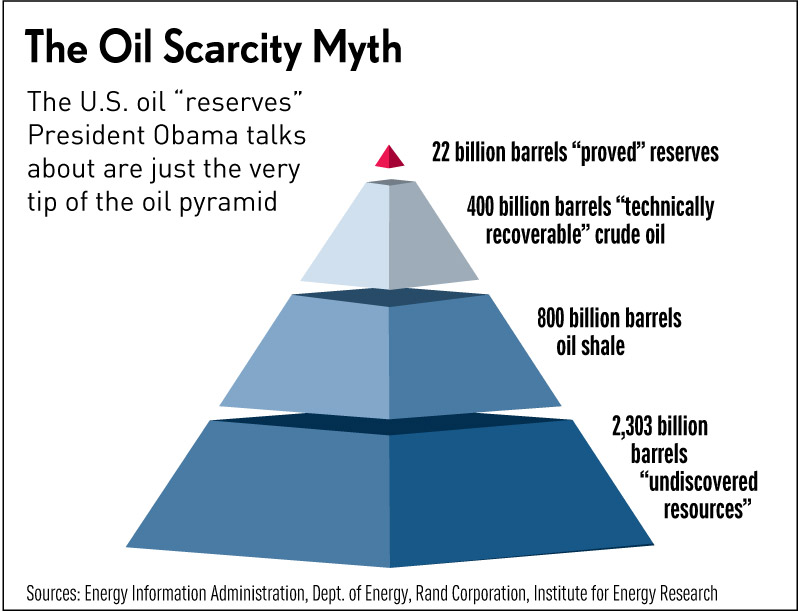
Is Obama telling the truth about U.S. oil reserves?

The Department of Energy's own figures

The Department of Energy’s own figures

Investors Business Daily explains. (H/T Master Resource)

Excerpt:

When he was running for the Oval Office four years ago amid $4-a-gallon gasoline prices, then-Sen. Barack Obama dismissed the idea of expanded oil production as a way to relieve the pain at the pump.

“Even if you opened up every square inch of our land and our coasts to drilling,” he said. “America still has only 3% of the world’s oil reserves.” Which meant, he said, that the U.S. couldn’t affect global oil prices.

It’s the same rhetoric President Obama is using now, as gas prices hit $4 again, except now he puts the figure at 2%.

“With only 2% of the world’s oil reserves, we can’t just drill our way to lower gas prices,” he said. “Not when we consume 20% of the world’s oil.”

The claim makes it appear as though the U.S. is an oil-barren nation, perpetually dependent on foreign oil and high prices unless we can cut our own use and develop alternative energy sources like algae.

But the figure Obama uses — proved oil reserves — vastly undercounts how much oil the U.S. actually contains. In fact, far from being oil-poor, the country is awash in vast quantities — enough to meet all the country’s oil needs for hundreds of years.

The U.S. has 22.3 billion barrels of proved reserves, a little less than 2% of the entire world’s proved reserves, according to the Energy Information Administration. But as the EIA explains, proved reserves “are a small subset of recoverable resources,” because they only count oil that companies are currently drilling for in existing fields.

When you look at the whole picture, it turns out that there are vast supplies of oil in the U.S., according to various government reports. Among them:

At least 86 billion barrels of oil in the Outer Continental Shelf yet to be discovered, according to the government’s Bureau of Ocean Energy Management.

About 24 billion barrels in shale deposits in the lower 48 states, according to EIA.

Up to 2 billion barrels of oil in shale deposits in Alaska’s North Slope, says the U.S. Geological Survey.

Up to 12 billion barrels in ANWR, according to the USGS.

As much as 19 billion barrels in the Utah tar sands, according to the Bureau of Land Management.

Then, there’s the massive Green River Formation in Wyoming, which according to the USGS contains a stunning 1.4 trillion barrels of oil shale — a type of oil released from sedimentary rock after it’s heated.

[…]All told, the U.S. has access to 400 billion barrels of crude that could be recovered using existing drilling technologies, according to a 2006 Energy Department report.

When you include oil shale, the U.S. has 1.4 trillion barrels of technically recoverable oil, according to the Institute for Energy Research, enough to meet all U.S. oil needs for about the next 200 years, without any imports.

Please share this article, because it is unlikely that Obama’s Solyndra-supporting buddies in the mainstream media will report the facts on domestic energy production.