
Tag Archives: John Calvin

Reformation Day celebrates the supremacy of Scripture and reason in theology

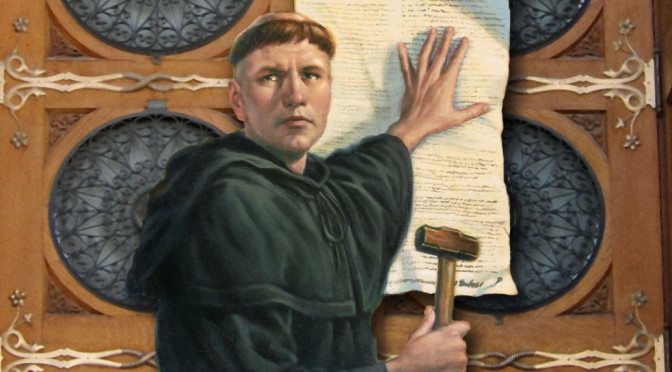
Martin Luther defies the Roman Catholic hierarchy with his 95 Theses

The Ligonier Ministries web site has a summary of the event that kicked off the Reformation.

Excerpt:

On October 31, 1517, Martin Luther tacked up 95 theses on the church door at Wittenberg. With this act, he hoped to provoke a discussion among the scholars about the abuses of the indulgences by the Roman Catholic Church. He was not trying to create a public furor by any means, but within a fortnight, these theses had spread through the country like wildfire. The last thing Luther had in mind was to start some kind of major controversy, but nevertheless major controversy did begin.

From the discussions at Wittenberg, the disputations began to accelerate and escalate. Copies of the theses reached Rome and critical meetings were scheduled with the young monk. In these debates, Luther was maneuvered into proclaiming publicly that he had questions about the infallibility of church councils and also that he thought that it was possible that the pope could err. In 1520 a papal encyclical was issued which condemned Martin Luther as a heretic. Luther burned the document in a public bonfire and his defiance before the church was now a matter of record.

In response, Martin Luther picked up his pen to challenge the entire penitential system of the Roman Catholic Church, which undermined in principle the free remission of sins that is ours in the gospel. By doing so, he was unswervingly advocating his commitment to sola fide, the doctrine of justification by faith alone.

In 1521, Luther was summoned to the Imperial Diet, an authoritative meeting that involved the princes of the church, called by the Emperor of the Holy Roman Empire to be held in the city of Worms in Germany. Luther was an outlaw. For him to appear at the Diet was to risk his very life; therefore, he was given safe conduct by the Emperor to attend. With a few friends, Luther traveled from Wittenberg to Worms. The eyewitnesses of that episode tell us that when Luther’s little covered wagon appeared around the corner of the bend, there were lookouts posted in the church tower at Worms. All the people were agog waiting for the arrival of this notorious person. When Luther’s caravan was sighted, people were throwing their hats in the air, blowing trumpets, and creating all the fanfare of the arrival of the hero. It was the 16th century answer to a ticker-tape parade.

Things, however, became very solemn in a hurry because the next day he appeared before the Diet. His books were stacked on a table in the room, and he was asked and ordered to recant of his writings. This surprised Luther because he thought he was going to have an opportunity to defend his writings; but the only question really of any importance that was asked of him was this: “Are these your writings?” And when he said yes, they said, “Are you ready to recant of them?”

Hollywood has their version of Luther standing there boldly with his fist in the air saying, “Here I stand!” and so on. But instead he dropped his chin on his chest and muttered something that nobody could understand, so they asked him to speak up. “What did you say?” He said, “May I have 24 hours to think about it.” And so Luther was granted a reprieve of 24 hours to return to his room to contemplate the seriousness of this occasion.

The prayer that Luther wrote in that ensuing 24-hour period was one of the most moving prayers I have ever read in my life. In that prayer, Luther cried out for God in his sense of total loneliness fearing that God had abandoned him, and proclaimed, “O Lord, I am Thine, and the cause is Thine, give me the courage to stand.”

And on the morrow, Luther was called once again back to the court and was told to reply to the question. He said to the Diet, “Unless I am convinced by sacred Scripture or by evident reason, I cannot recant, for my conscience is held captive by the Word of God, and to act against conscience is neither right nor safe. Here I stand. I can do no other. God help me.” And with that there was an instant uproar.

The Protestant Reformation emphasizes the responsibility of each person to become familiar with what the Bible teaches for themselves and to make sense of it using the laws of logic for themselves. There is an enormous focus on the individual’s responsibility to puzzle theology out for himself, using the tools available to him: reason, science, Scripture, and history. When doing theology, Protestants do not accept the authority of someone who has a fancy title, fancy hat, fancy robe or fancy staff. Everyone is responsible to read the Bible, read systematic theology, consult history, and determine what the truth is based on evidence, not authority.

The Reformation put forward the famous five Solas: “Sola Scriptura” (Scripture Alone); “Sola Gratia” (Grace Alone); “Sola Fide” (Faith Alone); “Solus Christus” (Christ Alone); and “Soli Deo Gloria” (To God Alone Be Glory). The vertical relationship with God is seen as more important than making people feel good here and now. True beliefs about God are deemed to be more important than being a good social worker. And that’s why Jesus said that the most important commandment is to love God, then secondly, to love your neighbor. It’s important to get that in the right order, because true beliefs about God’s existence, God’s character, and God’s actions in history are the most important things.

The Reformation was the beginning of evangelical Protestantism, which is really the view that the Christian religion ought to be rooted in actual historical events that are documented in the Bible.

Jerry Walls lectures on objections to Reformed theology

Sherlock Holmes and John Watson are going to take a look at the data

WARNING: This lecture is a very sharp and pointed critique of Calvinist theology. Viewer discretion is advised. 

In Protestant Christianity, there is a division between people who accept Calvinist doctrines and those who don’t. Both groups think that the other group are genuine Christians, but the debate has more to do with the human free will, human responsibility and who God loves.

About Dr. Jerry Walls:

  • BA in Religion and Philosophy, Houghton College
  • MDiv, Princeton Seminary
  • STM, Yale Divinity School
  • PhD in Philosophy, Notre Dame

He is a professor at Houston Baptist University.

Dr. Walls is Protestant (like me). He is a substance dualist (like me). And he believes in a real eternal Hell (like me). And he is very, very assertive. Definitely no confidence problems here. And you’re not going to have a problem keeping your attention on this lecture!

Note that I do not agree with or endorse Dr. Walls on all of his views.

Here’s the lecture: (64 minutes)

Summary:

  • What are the main doctrines of Calvinism? (TULIP)
  • A look at the Westminster Confession
  • The nature of freedom and free will
  • Calvinist doctrine of freedom: compatibilism
  • The implications of compatibilism
  • Who determines what each person will desire on Calvinism?
  • Who does God love on Calvinism?
  • The law of non-contradiction
  • Does God make a genuine offer of salvation to all people on Calvinism?
  • Does God love “the elect” differently than the “non-elect” on Calvinism?

He quotes at least a half-dozen Calvinist theologians in this lecture, including John Piper, J.I. Packer and D.A. Carson. And he also mentions 3 videos at the end of the lecture where he goes over specific Bible verses that seem to support Calvinism (part 4, part 5, part 6 are the ones he mentioned).

This lecture is very strong stuff, and I think that he could have been nicer when presenting it, but he hit on every single objection that I have to Calvinism, and he worked through my reasoning too! So I really liked that he validated all of my concerns about Calvinism. I’m not as bothered about the problems with Calvinism as he is, though. I don’t think it’s a big divisive issue. I almost always read Calvinist theologians when I am reading theology. I just conjoin Calvinism with middle knowledge and resistible grace, and it’s fine. You get divine sovereignty AND human responsibility, and without having to swallow determinism and double-predestination (doctrines which cannot be separated from 5-point Calvinism). Calvinists are some of the best theologians, but I think that they are just wrong on the things he discusses in his lecture.

Calvinists who are interested in this issue would do well to read a book on the other side of the fence, like “Salvation and Sovereignty” by Kenneth Heathley. That’s a good defense of the middle knowledge perspective.

Reformation Day celebrates the supremacy of Scripture and reason in theology

Martin Luther defies the Roman Catholic hierarchy with his 95 Theses

The Ligonier Ministries web site has a summary of the event that kicked off the Reformation.

Excerpt:

On October 31, 1517, Martin Luther tacked up 95 theses on the church door at Wittenberg. With this act, he hoped to provoke a discussion among the scholars about the abuses of the indulgences by the Roman Catholic Church. He was not trying to create a public furor by any means, but within a fortnight, these theses had spread through the country like wildfire. The last thing Luther had in mind was to start some kind of major controversy, but nevertheless major controversy did begin.

From the discussions at Wittenberg, the disputations began to accelerate and escalate. Copies of the theses reached Rome and critical meetings were scheduled with the young monk. In these debates, Luther was maneuvered into proclaiming publicly that he had questions about the infallibility of church councils and also that he thought that it was possible that the pope could err. In 1520 a papal encyclical was issued which condemned Martin Luther as a heretic. Luther burned the document in a public bonfire and his defiance before the church was now a matter of record.

In response, Martin Luther picked up his pen to challenge the entire penitential system of the Roman Catholic Church, which undermined in principle the free remission of sins that is ours in the gospel. By doing so, he was unswervingly advocating his commitment to sola fide, the doctrine of justification by faith alone.

In 1521, Luther was summoned to the Imperial Diet, an authoritative meeting that involved the princes of the church, called by the Emperor of the Holy Roman Empire to be held in the city of Worms in Germany. Luther was an outlaw. For him to appear at the Diet was to risk his very life; therefore, he was given safe conduct by the Emperor to attend. With a few friends, Luther traveled from Wittenberg to Worms. The eyewitnesses of that episode tell us that when Luther’s little covered wagon appeared around the corner of the bend, there were lookouts posted in the church tower at Worms. All the people were agog waiting for the arrival of this notorious person. When Luther’s caravan was sighted, people were throwing their hats in the air, blowing trumpets, and creating all the fanfare of the arrival of the hero. It was the 16th century answer to a ticker-tape parade.

Things, however, became very solemn in a hurry because the next day he appeared before the Diet. His books were stacked on a table in the room, and he was asked and ordered to recant of his writings. This surprised Luther because he thought he was going to have an opportunity to defend his writings; but the only question really of any importance that was asked of him was this: “Are these your writings?” And when he said yes, they said, “Are you ready to recant of them?”

Hollywood has their version of Luther standing there boldly with his fist in the air saying, “Here I stand!” and so on. But instead he dropped his chin on his chest and muttered something that nobody could understand, so they asked him to speak up. “What did you say?” He said, “May I have 24 hours to think about it.” And so Luther was granted a reprieve of 24 hours to return to his room to contemplate the seriousness of this occasion.

The prayer that Luther wrote in that ensuing 24-hour period was one of the most moving prayers I have ever read in my life. In that prayer, Luther cried out for God in his sense of total loneliness fearing that God had abandoned him, and proclaimed, “O Lord, I am Thine, and the cause is Thine, give me the courage to stand.”

And on the morrow, Luther was called once again back to the court and was told to reply to the question. He said to the Diet, “Unless I am convinced by sacred Scripture or by evident reason, I cannot recant, for my conscience is held captive by the Word of God, and to act against conscience is neither right nor safe. Here I stand. I can do no other. God help me.” And with that there was an instant uproar.

The Protestant Reformation emphasizes the responsibility of each person to become familiar with what the Bible teaches for themselves and to make sense of it using the laws of logic for themselves. There is an enormous focus on the individual’s responsibility to puzzle theology out for himself, using the tools available to him: reason, science, Scripture, and history. When doing theology, Protestants do not accept the authority of someone who has a fancy title, fancy hat, fancy robe or fancy staff. Everyone is responsible to read the Bible, read systematic theology, consult history, and determine what the truth is based on evidence, not authority.

The Reformation put forward the famous five Solas: “Sola Scriptura” (Scripture Alone); “Sola Gratia” (Grace Alone); “Sola Fide” (Faith Alone); “Solus Christus” (Christ Alone); and “Soli Deo Gloria” (To God Alone Be Glory). The vertical relationship with God is seen as more important than making people feel good here and now. True beliefs about God are deemed to be more important than being a good social worker. And that’s why Jesus said that the most important commandment is to love God, then secondly, to love your neighbor. It’s important to get that in the right order, because true beliefs about God’s existence, God’s character, and God’s actions in history are the most important things.

The Reformation was the beginning of evangelical Protestantism, which is really the view that the Christian religion ought to be rooted in actual historical events that are documented in the Bible.