
Tag Archives: Job Creation

Eight years of socialism: more debt, more regulation, fewer Americans working:

Has the economy been doing well lately? When I ask Democrats that question, they often point me to the stock market. I know that the stock market has done very well in the last 8 years. But I really question which Democrat policies have been responsible for this winfall.

Certainly, policies like Obamacare, Dodd-Frank, green energy subsidies, blocking Keystone XL, creating a student loan bubble, and even loosening mortgage lending again to create another housing bubble, cannot cause any economics growth. My personal opinion is that all the growth came from adding over $10 trillion dollars to the debt – a process that started with the election of Nancy Pelosi and Harry Reid to the House and Senate majorities, respectively, in 2007.

Look at the national debt:
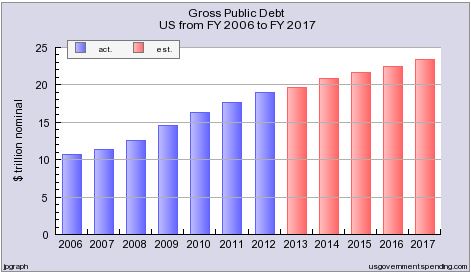
Gross public debt, Democrats control spending in 2007
Gross public debt, Democrats control spending starting in 2007

If you add $10 trillion to the national debt in 8 years then OF COURSE the stock prices will go up. You would look richer too if you took your credit card balance from $8,500 to $18,500. But what is behind all this consumer spending and government spending? Just trillions of dollars of new debt.

I think a better measure of how the economy is doing is to ask job creators how it is doing. For example, we can ask small businesses, since they are responsible for so much of the job creation in this economy.

Here’s an article from the Daily Signal about that.

It says:

More than five years after the end of the “Great Recession,” only 21 percent of small businesses* say they have fully recovered. During the recession, lack of sales ranked as the top problem small business faced. Taxes placed second, and “government regulations and red tape” placed third. And since 2012, at least one in five small business owners identify government regulations as their most important problem.

The reason for this is simple—small business owners directly feel the impact of federal regulation in the daily life of their businesses. The small business owner is often the main person in a business who bears the burden of complying with regulations and paperwork requirements. According to a 2010 study, small businesses spend $10,585 per employee on regulation, which amounts to 36 percent more per employee than larger companies spend.

With that as a backdrop, it is easy to see how small business owners continue to wonder why Washington just does not get it when it comes to regulation. For decades, Congress has sought to solve societal problems through mandates on business. Too many Americans without health insurance? Congress tries to solve that by requiring businesses to provide health insurance to their employees (regardless of whether or not they can afford it) or pay hefty penalties. Too many Americans unable to care for a sick relative? Congress seeks to address that by mandating that a business keep a position open three months out of every year for qualified employees, using a cumbersome reporting system.

Always entrepreneurial, with a keen focus on the bottom line, the American small business owner looks for ways to minimize the time and money spent on things other than running his or her business. Since many of these regulations wisely exempt the smallest of small businesses, some employers purposefully do not increase hiring because they do not want to have to comply with the regulatory regimes that await businesses that expand to 10, 15, and 50 or more employees.

This might be why the labor force participation rate is at a 38-year low.

CNS News explains:

A record 94,031,000 Americans were not in the American labor force last month — 261,000 more than July — and the labor force participation rate stayed stuck at 62.6 percent, a 38-year low, for a third straight month in August, the Labor Department reported on Friday, as the nation heads into the Labor Day weekend.

[…]In August, according to BLS, the nation’s civilian noninstitutional population, consisting of all people 16 or older who were not in the military or an institution, reached 251,096,000. Of those, 157,065,000 participated in the labor force by either holding a job or actively seeking one.

The 157,065,000 who participated in the labor force equaled only 62.6 percent of the 251,096,000 civilian noninstitutional population — the same as it was in July and June. Not since October 1977, when the participation rate dropped to 62.4, has the percentage been this low.

So… do you still think that the economy is in good shape? Any economy is going to look better if you take an $8.5 trillion debt and run it up to $18.5 trillion. But if you look a little closer, you see that small businesses are hard-pressed, and it’s affected the real unemployment rate.
New study: federal control of land hurts job growth in oil and gas industry

The Daily Signal reports on a new study from the Heritage Foundation.

They write:

Current government regulations imposed by the Bureau of Land Management are harming energy production and holding back the U.S. economy, a new study reveals.

“While federally owned lands are also full of energy potential, a bureaucratic regulatory regime has mismanaged land use for decades,” write The Heritage Foundation’s Katie Tubb and Nicolas Loris.

The report focuses on the Federal Lands Freedom Act, introduced by Rep. Diane Black, R-Tenn., and Sen. James Inhofe, R-Okla. It is designed to empower states to regain control of their lands from the federal government in order to pursue their own energy goals. That is a challenge in an oil-rich state like Colorado.

“We need to streamline the process as there are very real consequences to poor [or nonexistent] management,” Tubb, a Heritage research associate, told The Daily Signal.

“Empowering the states is the best solution. The people who benefit have a say and can share in the benefits. If there are consequences, they can address them locally with state and local governments that are much more responsive to elections and budgets than the federal government.”

Emphasizing the need to streamline the process, Tubb pointed to the findings in the new report.

“The Bureau of Land Management estimates that it took an average of 227 days simply to complete a drill application,” Tubb said.

That’s more than the average of 154 days in 2005 and more than seven times the state average of 30 days, according to the report.

The report blames this increase in the application process on the drop in drilling on federal lands.

“Since 2009,” Tubb and Loris write, “oil production on federal lands has fallen by nine percent, even as production on state and private lands has increased by 61 percent over the same period.”

Despite almost “43 percent of crude oil coming from federal lands,” government-owned lands have seen a 13-point drop in oil production, from 36 percent to 23 percent.

So, if we were interested in more job creation (and lower gas prices) then what we would be doing is letting oil and gas companies hire more people and extract more oil. Streamlining the process for new new drilling permits would help a lot. Right now, we still have a very low level of labor force participation. If we want companies to hire more people, we need to make it easier for them to do it. That means a less anti-business climate.

New study: EPA carbon emission regulations eliminate 586,000 manufacturing jobs

Why don’t we build anything in America any more?

Well, we do build many things, but if the question is changed to “why aren’t we building more?” then the answer is that the costs of building things in America are much higher than building them elsewhere. One reason is that we have the highest corporate tax rate in the world. Another reason is that we pass regulations that make it expensive to make anything here.

Here is a report from the Daily Signal about a new study by the Heritage Foundation.

They write:

A new study predicts that more than a half million manufacturing jobs will be eliminated from the U.S. economy as a result of the Obama administration’s proposed regulations to curb carbon dioxide emissions.

“Every state would experience overwhelming negative impacts as a result of these regulations, but especially those with higher-than-average employment in manufacturing and mining,” said Nick Loris, a co-author of study, which was completed by energy experts at The Heritage Foundation—the parent organization of The Daily Signal.

The researchers projected how many manufacturing jobs would be eliminated in each state and congressional district as a consequence of the carbon plan, which is the centerpiece of President Obama’s effort to combat climate change.

The results show that 34 states would lose three to four percent of manufacturing jobs by 2023, and nine other states would lose more.

In Ohio alone, 31,747 jobs would be lost.

The study predicts that the Midwest would be hit the hardest, with Illinois, Indiana, Michigan, Ohio and Wisconsin losing more than 20,000 jobs each.

[…]The analysis comes just months before the Environmental Protection Agency is set to finalize its carbon regulations covering new, existing and modified/reconstructed power plants by mid summer of 2015.

Heritage’s study looked at the totality of the Obama administration’s efforts to limit carbon dioxide emissions—from motor vehicles and power plants, both new and existing.

The EPA’s plan forces states to cut power-industry emissions by 30 percent in 2030 from 2005 levels.

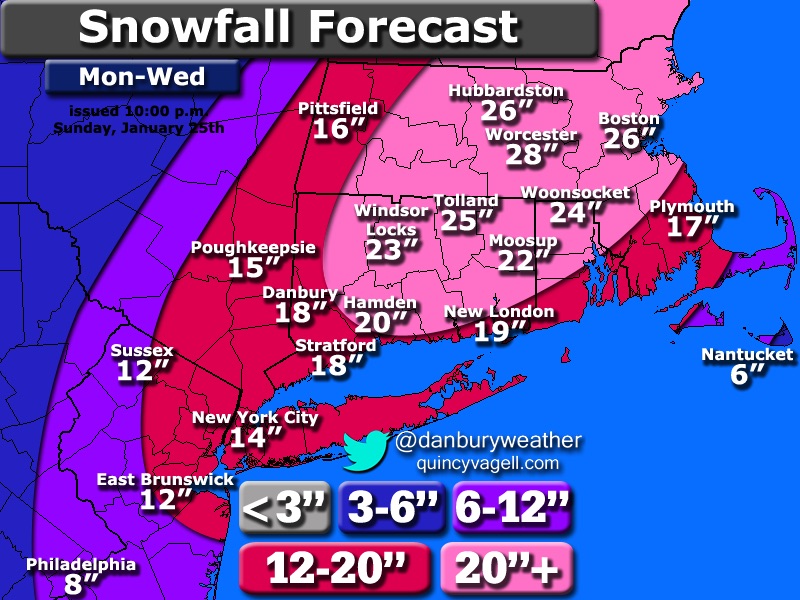
We have to save the planet!!!1!!

Meanwhile, in Boston:

It's global warming! The EPA must save us!
It’s global warming! The EPA must save us!

So, the next time anyone asks you why we don’t build anything anymore, tell them it’s because they voted for Democrats, and how this resulted in higher taxes and more burdensome regulations. Higher taxes and more regulation causes companies to close down here at home and move elsewhere, or they just scale back here and expand elsewhere. Democrats cause American jobs to go overseas, raising the unemployment rate. That’s why our labor force participation hasn’t been this low for decades. It’s basic economics.