Tag Archives: Jim Demint

Jim Demint introduces bill to halt funding for European bailouts

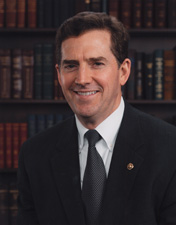
Senator Jim Demint

The Wall Street Journal reports on the Republican effort to halt taxpayer-funded bailouts for socialist European nations.

Excerpt:

A group of Republican senators plan to renew their attempts at stopping the U.S. from funding International Monetary Fund loans to Greece and other countries after the Senate failed to vote on their proposal last week.

A spokesman for Sen. Jim DeMint (R., S.C.), who is leading the effort, said the GOP senators plan to soon introduce stand-alone legislation that would direct the U.S. Treasury to vote against any IMF assistance to European Union nations for the foreseeable future. If enacted into law, it could halt U.S. participation in any future IMF attempts to stabilize the sovereign debt crisis in Europe.

The proposal comes as finance ministers work towards a political agreement committing to provide financing to meet a growing gap in Greece’s funding needs beyond the current EUR110 billion, which in turn would allow the IMF to release a delayed tranche of cash in early July.

[…]Attempts by GOP lawmakers to block IMF loans failed to gain traction in Congress last year. And President Barack Obama has asserted in a signing statement after a House vote on an IMF provision that he doesn’t recognize Congress’ ability to tell the administration how to vote at the IMF.

Greece embraced socialism, and now they have to face the music.
Republicans introduce national right-to-work legislation

Sen. James Demint

From the Hill.

Excerpt:

Eight Republican Senators introduced a bill Tuesday giving workers a choice as to whether to join labor unions, which they argue will boost the nation’s economy and provide an increase in wages.

Sen. Jim DeMint (R-S.C.), introduced the National Right to Work Act to “reduce workplace discrimination by protecting the free choice of individuals to form, join, or assist labor organizations, or to refrain from such activities,” according to a statement.

Seven other Republicans signed onto the effort: Sens. Tom Coburn (Okla.), Orrin Hatch (Utah), Mike Lee (Utah), Rand Paul (Ky.), James Risch (Idaho), Pat Toomey (Pa.) and David Vitter (La.).

“Facing a steady decline in membership, unions have turned to strong-arm political tactics to make forced unionization the default position of every American worker, even if they don’t want it,” Hatch said. “This is simply unacceptable. At the very least, it should be the policy of the U.S. government to ensure that no employee will be forced to join a union in order to get or keep their job.

“Republicans cited a recent poll they said shows that 80 percent of union members support having their policy and that “Right to Work” states outperform “forced-union” states in factors that affect worker well being.

From 2000 to 2008, about 4.7 million Americans moved from forced-union to right to work states and a recent study found that there is “a very strong and highly statistically significant relationship between right-to-work laws and economic growth,” and that from 1977 to 2007, right-to-work states experienced a 23 percent faster growth in per capita income than states with forced unionization.

“To see the negative impacts of forced unionization, look no further than the struggling businesses in states whose laws allow it,” Vitter said. “It can’t be a coincidence that right-to-work states have on balance grown in population over the last 10 years, arguably at the expense of heavy union-favoring states.”

DeMint blamed the problems faced by U.S. automakers on the unions.

“Forced-unionism helped lead to GM and Chrysler’s near bankruptcy and their requests for government bailouts as they struggled to compete in a global marketplace,” he said. “When American businesses suffer because of these anti-worker laws, jobs and investment are driven overseas.”

If you want to attract businesses, then you need to have pro-business laws. That’s where jobs come from – businesses.

Here’s an article about states who are trying to pass these laws to attract more employers.

Excerpt:

Currently 14 states beyond Indiana and Wisconsin are considering legislation that would limit union benefits and/or collective bargaining power. They are: Alaska, Hawaii, Maine, Michigan, Minnesota, Missouri, Montana, New Hampshire, New Mexico, Ohio, Pennsylvania, Virginia, Washington (state) and West Virginia. In any number of these states, supporters have planned or held rallies against the measures. But public support might be less than deep. According to a Rasmussen Poll conducted late last week and released Monday, 48 percent of likely U.S. voters sided with Wisconsin Governor Walker whereas only 38 percent sided with his union opponents; the other 14 percent were undecided. And 50 percent of the respondents favored reducing their home state’s government payroll by one percent a year for 10 years either by reducing the work force or reducing their pay. Only 28 percent opposed such action.

This is how we are going to turn the recession around. Cut off the spending on left-wing special interests – NPR, PBS, ACORN, Planned Parenthood, Unions. They all will have to pay their own way, just like the grown-ups do.

House Republicans set to unveil $2.5 TRILLION in spending cuts

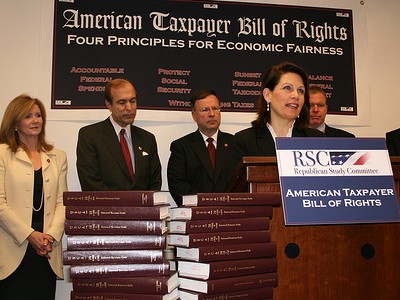
Republican Study Committee

(Michele Bachmann and Marsha Blackburn are members of the RSC)

From the Daily Caller. (H/T Gateway Pundit)

Excerpt:

A number of the House GOP’s leading conservative members on Thursday will announce legislation that would cut $2.5 trillion over 10 years, which will be by far the most ambitious and far-reaching proposal by the new majority to cut federal government spending.

Jordan’s bill, which will have a companion bill introduced in the Senate by Sen. Jim DeMint, South Carolina Republican, would impose deep and broad cuts across the federal government. It includes both budget-wide cuts on non-defense discretionary spending back to 2006 levels and proposes the elimination or drastic reduction of more than 50 government programs.

Jordan’s “Spending Reduction Act” would eliminate such things as the U.S. Agency for International Development and its $1.39 billion annual budget, the $445 million annual subsidy for the Corporation for Public Broadcasting, the $1.5 billion annual subsidy for Amtrak, $2.5 billion in high speed rail grants, the $150 million subsidy for the Washington Metropolitan Area Transit Authority, and it would cut in half to $7.5 billion the federal travel budget.

But the program eliminations and reductions would account for only $330 billion of the $2.5 trillion in cuts. The bulk of the cuts would come from returning non-defense discretionary spending – which is currently $670 billion out of a $3.8 trillion budget for the 2011 fiscal year – to the 2006 level of $496.7 billion, through 2021.

Going back to 2006 levels would reduce spending by $2.3 trillion over ten years. It is a significantly more drastic cut than the one proposed by House Republican leadership in the Pledge to America last fall, which proposed moving non-defense, non-mandatory spending for the current fiscal year back to 2008 levels, which was $522.3 billion. Jordan’s proposal includes the recommendation from the Pledge for the current fiscal year, which ends in September.

The proposal would cut the federal work force by 15 percent and freeze automatic pay raises for government employees for five years.

You’ll remember that 2006 was the last year when the Republicans were in control of the House and Senate. Remember what life was like at the beginning of 2007? Unemployment was around 4% and the budget deficit was around 200 billion dollars. Then Nancy Pelosi and Harry Reid came along and the spending started. Cutting spending can be a positive thing when you take money away from unions. And think of the jobs when companies realize that there will be an end to all this spending and they won’t be on the hook for it. And children will have a standard of living that isn’t worse than the ones that their parents had.

But now the Republican Study Committee wants to put a stop to all of that. The Republican Study Commitee is the conservative wing of the House Republican caucus and that’s where all the good policies come from.