
Tag Archives: Jesus of Nazareth

What do ancient non-Christian sources tell us about the historical Jesus?

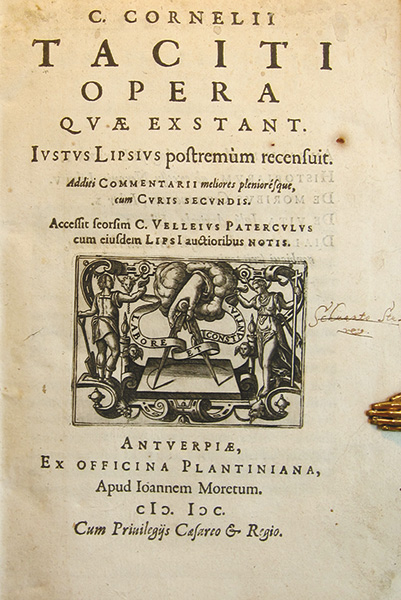
The Annals, by Roman historian Tacitus

This article from Biblical Archaeology covers all the non-Christian historical sources that discuss Jesus.

About the author:

Lawrence Mykytiuk is associate professor of library science and the history librarian at Purdue University. He holds a Ph.D. in Hebrew and Semitic Studies and is the author of the book Identifying Biblical Persons in Northwest Semitic Inscriptions of 1200–539 B.C.E. (Atlanta: Society of Biblical Literature, 2004).

Here are the major sections:

  • Roman historian Tacitus
  • Jewish historian Josephus
  • Greek satirist Lucian of Samosata
  • Platonist philosopher Celsus
  • Roman governor Pliny the Younger
  • Roman historian Suetonius
  • Roman prisoner Mara bar Serapion

And this useful excerpt captures the broad facts about Jesus that we get from just the first two sources:

We can learn quite a bit about Jesus from Tacitus and Josephus, two famous historians who were not Christian. Almost all the following statements about Jesus, which are asserted in the New Testament, are corroborated or confirmed by the relevant passages in Tacitus and Josephus. These independent historical sources—one a non-Christian Roman and the other Jewish—confirm what we are told in the Gospels:31

1. He existed as a man. The historian Josephus grew up in a priestly family in first-century Palestine and wrote only decades after Jesus’ death. Jesus’ known associates, such as Jesus’ brother James, were his contemporaries. The historical and cultural context was second nature to Josephus. “If any Jewish writer were ever in a position to know about the non-existence of Jesus, it would have been Josephus. His implicit affirmation of the existence of Jesus has been, and still is, the most significant obstacle for those who argue that the extra-Biblical evidence is not probative on this point,” Robert Van Voorst observes.32 And Tacitus was careful enough not to report real executions of nonexistent people.

2. His personal name was Jesus, as Josephus informs us.

3. He was called Christos in Greek, which is a translation of the Hebrew word Messiah, both of which mean “anointed” or “(the) anointed one,” as Josephus states and Tacitus implies, unaware, by reporting, as Romans thought, that his name was Christus.

4. He had a brother named James (Jacob), as Josephus reports.

5. He won over both Jews and “Greeks” (i.e., Gentiles of Hellenistic culture), according to Josephus, although it is anachronistic to say that they were “many” at the end of his life. Large growth
in the number of Jesus’ actual followers came only after his death.

6. Jewish leaders of the day expressed unfavorable opinions about him, at least according to some versions of the Testimonium Flavianum.

7. Pilate rendered the decision that he should be executed, as both Tacitus and Josephus state.

8. His execution was specifically by crucifixion, according to Josephus.

9. He was executed during Pontius Pilate’s governorship over Judea (26–36 C.E.), as Josephus implies and Tacitus states, adding that it was during Tiberius’s reign.

Some of Jesus’ followers did not abandon their personal loyalty to him even after his crucifixion but submitted to his teaching. They believed that Jesus later appeared to them alive in accordance with prophecies, most likely those found in the Hebrew Bible. A well-attested link between Jesus and Christians is that Christ, as a term used to identify Jesus, became the basis of the term used to identify his followers: Christians. The Christian movement began in Judea, according to Tacitus. Josephus observes that it continued during the first century. Tacitus deplores the fact that during the second century it had spread as far as Rome.

I remember reading the 1996 book by Gary Habermas entitled “The Historical Jesus: Ancient Evidence for the Life of Christ“. This book is a little before the time of most of you young Christian apologists, but back before the time of Lee Strobel and J. Warner Wallace, this is the stuff we all read. Anyway, in the book he makes a list of all that can be known about Jesus from external sources. And fortunately for you, you don’t have to buy the book because you can read chapter 9 of it right on his web site.

From Tacitus he gets this:

From this report we can learn several facts, both explicit and implicit, concerning Christ and the Christians who lived in Rome in the 60s A.D. Chronologically, we may ascertain the following information.

(1) Christians were named for their founder, Christus (from the Latin), (2) who was put to death by the Roman procurator Pontius Pilatus (also Latin), (3) during the reign of emperor Tiberius (14 37 A.D.). (4) His death ended the “superstition” for a short time, (5) but it broke out again, (6) especially in Judaea, where the teaching had its origin.

(7) His followers carried his doctrine to Rome. (8) When the great fire destroyed a large part of the city during the reign of Nero (54 68 A.D.), the emperor placed the blame on the Christians who lived in Rome. (9) Tacitus reports that this group was hated for their abominations. (10) These Christians were arrested after pleading guilty, (11) and many were convicted for “hatred for mankind.” (12) They were mocked and (13) then tortured, including being “nailed to crosses” or burnt to death. (14) Because of these actions, the people had compassion on the Christians. (15) Tacitus therefore concluded that such punishments were not for the public good but were simply “to glut one man’s cruelty.”

And from Josephus he gets this:

(1) Jesus was known as a wise and virtuous man, one recognized for his good conduct. (2) He had many disciples, both Jews and Gentiles. (3) Pilate condemned him to die, (4) with crucifixion explicitly being mentioned as the mode. (5) The disciples reported that Jesus had risen from the dead and (6) that he had appeared to them on the third day after his crucifixion. (7) Consequently, the disciples continued to proclaim his teachings. (8) Perhaps Jesus was the Messiah concerning whom the Old Testament prophets spoke and predicted wonders. We would add here two facts from Josephus’ earlier quotation as well. (9) Jesus was the brother of James and (10) was called the messiah by some.

So when you are reading the New Testament, these facts are the framework that you read within. It’s a good starting point when dealing with people who have never looked into who Jesus was and what he taught and what his followers believed about him, right from the start.

Fred Sanders reviews a book that makes the case for the deity of Christ

Putting Jesus in His Place

From Touchstone magazine, a review of “Putting Jesus in His Place: The Case for the Deity of Christ” by Biola University professor Fred Sanders.

Excerpt:

The case as perceived by scholars for the deity of Christ is stronger now than it has been for a long time, and those who went through seminary more than a decade ago should take a moment to update their notes. Though the New Testament is clear about the deity of Christ, generations of modern critical scholars have picked away at the standard proofs. Here a verse, there a verse, the arguments that Christians have always relied on to demonstrate that the New Testament teaches that Jesus is God have been rendered dubious.

Putting Jesus in His Place does not simply reclaim those lost passages, revisit the standard debates, and bolster the old arguments (though in many cases it does that, and persuasively); it publicizes new arguments for demonstrating the deity of Christ, which have previously been available only to scholars.

The authors are ideal popularizers, each with one foot in the library and one in the local church. Robert Bowman is manager of apologetics and interfaith evangelism for the Southern Baptist Convention’s North American Mission Board, while Ed Komoszewski is the founder of the educational ministry Christus Nexus and a director of Reclaiming the Mind Ministries.

To help readers remember the arguments, they organize the book around the acronym “HANDS,” arguing that Jesus shares God’s Honor, Attributes, Names, Deeds, and Seat. The text breezes along in straightforward, popular prose—it paraphrases the Nicene homoousios as “Jesus: The Right Stuff,” for example, and explains pre-existence as being “Older Than Dirt—Literally!”—with more technical matters referred to the endnotes.

If you are looking to make a case for the divinity of Jesus, you should go to the earliest sources, and try to see if Jesus has a divine self-understanding, whether he is acting in the place of God.

The book is basically one-stop shopping at a popular level for the best scholarly arguments:

Jesus didn’t so much verbalize his claim to deity, for example; he enacted it. The people of God were waiting for the Lord to show up in person to bring reconciliation; Jesus walked among men, healing, forgiving, and doing everything that God was supposed to do. When, on occasion, he also claimed to be more than a prophet, his claim made sense because it put into words what he was doing in the flesh.

Jesus does what God does. This is the foundation for his claim to deity. N. T. Wright has recently helped his readers see this with his massive narrative arguments, and Bowman and Komoszewski boil a lot of Wright down to a manageable size.

[…]Readers alert to the scholarly scene will recognize that the authors reproduce at an accessible level the arguments of Richard Bauckham (particularly in God Crucified: Monotheism and Christology in the New Testament) and Larry Hurtado (in Lord Jesus Christ: Devotion to Jesus in Earliest Christianity), among others. (Bauckham and Hurtado are among the book’s many endorsers.)

Wright, Bauckham and Hurtado are three of the leading historical Jesus scholars in the world. I got the book because I wanted to know about the latest research from these experts – but without having to comb through an academic book!

I have some good news, too. The book is on sale in the Kindle edition for under $2 for a limited time. If you don’t have a single book on the divinity of Jesus, you cannot go wrong with this book. It’s good to have one book on this issue, because it comes up a lot in conversations with skeptics. You see annoying documentaries all the time claiming that Jesus was initially viewed as just a man, and then was embellished into a divine figure later. This book helps you to answer that objection.

Rob Bowman reviews new book that refutes Bart Ehrman’s “How Jesus Became God”

A very good, but very long, review of skeptical historian Bart Ehrman’s new book. It’s written by Rob Bowman, co-author of “Putting Jesus in his Place“.

Here are some of the really bad mistakes made by Bart Ehrman, according to the review.

#2: Ehrman thinks that Jesus didn’t think he was the “Son of Man” figure from Daniel:

A second notable weakness in Ehrman’s theory is his claim that Jesus expected to fill the role of the Messiah but not of the Son of Man. This interpretation gets its initial plausibility from the fact that Jesus routinely referred to the Son of Man in the third person. However, even in most of the Synoptic Son of Man sayings, it is quite clear in the immediate context that Jesus is referring to himself (Matt. 8:20; 9:6; 11:19; 12:8; 16:13; 17:22-23; 20:18-19, 28; 26:2, 24, 45; Mark 2:10; 8:31; 9:31; 10:33; 14:21, 41; Luke 5:24; 7:34; 9:22, 44, 58; 19:10; 22:22, 48). The Messiah and the Son of Man are both understood as eschatological figures that receive an eternal kingdom on behalf of God’s people; it is simply not plausible that Jesus, who used the title Son of Man incessantly and rarely used the title Messiah or Christ, claimed to be the latter but not the former.

#3: Ehrman can’t explain the early church’s proclamation that Jesus was divine:

Ehrman’s main thesis on its face appears completely lacking in credibility. According to Ehrman, whereas Jesus did not view himself as anything more than a man and did not expect to become anything more than a glorious earthly king, within a few weeks or months of Jesus’ death his original followers were sincerely proclaiming that Jesus was a divine figure ruling over all creation at God’s right hand in heaven. Keep in mind that in Ehrman’s mind, Jesus did not rise from the dead and did not actually speak to his disciples after his death. Nor does Ehrman suggest that the disciples thought Jesus had made these stupendous claims about himself during his appearances to them. Rather, Ehrman credits the disciples with inferring these things about Jesus by interpreting their visionary experiences in the light of the apocalyptic worldview he had taught them before his death (205-206). What all this means is that Ehrman’s view requires that Jesus’ original disciples, who had walked all over Galilee and Judea with him and listened to him teach for hours on end, simply discounted Jesus’ own self-image as nothing more than the future human Messiah.

#4: Ehrman denies the burial of Jesus, which makes him one of a handful of ancient historians who do:

To make his theory work, Ehrman has abandoned his earlier view that the burial of Jesus in a tomb just outside Jerusalem was historically likely. He now accepts something like John Dominic Crossan’s view that Jesus received no decent burial at all. In a way, denying the tomb is a smart move on Ehrman’s part. As long as he acknowledged both the tomb and the appearances, he remained vulnerable to the vise grip of the historical argument for the Resurrection. Accept the empty tomb and discount the appearances, and you can postulate that the body was moved or stolen or lost. Accept the appearances and reject the empty tomb, and you can speculate that the disciples had hallucinations or “bereavement visions.” Accept both the empty tomb and the appearances and you have to come up with a blatantly ad hoc explanation like Greg Cavin’s identical-twin theory (what William Lane Craig mischievously labeled “the Dave theory”) or strain credulity by accepting two unrelated explanations for the evidence (e.g., the body was stolen and the disciples had hallucinations). So Ehrman, who knows he cannot deny that at least some of the disciples had experiences in which they thought they saw Jesus alive from the dead, has gone the more sensible skeptical route and questioned the burial in the tomb. But this move, while sensible enough from his agnostic perspective, lands him in evidential hot water, because the evidence that the Gospels are telling the truth about the empty tomb is very good.

#5: Ehrman discounts Paul’s resurrection appearance, which he speaks about in 1 Cor 15:

Ehrman’s attempts to explain the appearances of Jesus naturalistically ignore entirely the testimony of the apostle Paul that Jesus had appeared to him when Paul was still a persecutor of Christians. Ehrman quietly omits any mention of Paul’s experience throughout his treatment of the resurrection appearances in the fifth chapter of his book. Then, having finished with the subject of Jesus’ resurrection, at the beginning of chapter 6 Ehrman says only that Paul, after converting to faith in Jesus, “later claimed that this was because he had had a vision of Jesus alive, long after his death” (214, emphasis added). That is all he says—and it is difficult even to take his statement seriously. That Paul sincerely thought he had a vision of the risen Christ is really beyond debate. That fact is a stubborn datum that Ehrman failed to incorporate into his account of the origins of the Christian movement.

The post mentions a new book out that challenges Ehrman’s book, and describes all of the responses to Ehrman’s views. It is edited by well-known Australian scholar Michael F. Bird, whom I have blogged about before.

Here’s one snippet:

Craig Evans’s treatment on the burial of Jesus is the stand-out chapter of the book. Evans rightly criticizes Ehrman’s argument from silence regarding the omission of the name of Joseph of Arimathea from the pre-Pauline confession of Jesus’ death, burial, and resurrection in 1 Corinthians 15:3-5 (90-91). Evans shows, against Ehrman, that rabbinical and Qumran texts attest to the Sanhedrin taking responsibility for the burial of executed criminals (80-81, 88-89). This means that the supposed discrepancy between Acts 13:29 and the Gospel accounts of Jesus’ burial (even Luke’s account!) evaporates. Evans is especially in his element when he documents painstakingly from both literary and archaeological evidence that burial in a tomb was not, as Ehrman had argued at length, inconsistent with Roman policies and practices regarding criminals who were crucified (73-80, 83-86). This chapter alone is worth the price of the book.

You really can’t deny the burial – it’s in 1 Cor 15:3-7, and that’s early eyewitness testimony. I really am not sure what has gone wrong with Bart. You can’t say the things he says in this book and maintain your respect as a historian, in my opinion. His views are fringe, and worse, they are in conflict with evidence that is undeniable, historically speaking. He’s reaching, because something other than history is making him reach.

Here’s a video about the new book, featuring Craig Evans:

He talks about the evidence for the burial. That video is 20 minutes, but worth watching. If you want to get a full treatment of the divinity of Jesus, then click here and buy Robert M. Bowman Jr. and J. Ed Komoszewski, Putting Jesus in His Place: The Case for the Deity of Christ (Grand Rapids: Kregel, 2007), for $1.99 (Kindle edition).

You can also view a debate on Youtube between William Lane Craig and Bart Ehrman here. (Transcript here)