

From Life Site News. (H/T Jeanie)
Excerpt:
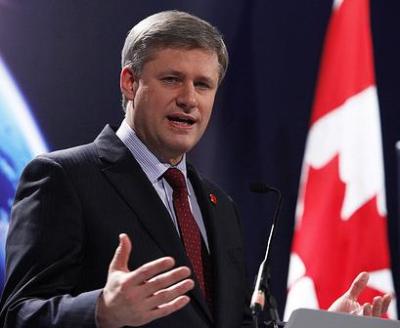
On the campaign trail Monday, Prime Minister Stephen Harper announced a family income-splitting plan that pro-family groups are saying would correct a tax system that unjustly discriminates against single-income families or those where one spouse earns significantly more than the other.
Harper said the current tax system treats married couples like “roommates,” because spouses are taxed individually. He is proposing a Family Tax Cut that would allow families with children under 18 to share up to $50,000 of their household income for federal tax purposes.
But the catch is that the change won’t take effect until the budget is balanced, which the Conservatives aren’t promising until at least 2015-2016.
Speaking in Saanich, B.C., the Prime Minister said the proposal will make the income tax system fairer for families and will provide tax relief to about 1.8 million families who will save, on average, $1,300 per year.
The plan is projected to cost $2.5 billion per year.
“There’s a tax unfairness that exists right now. This will move towards a more fair analysis,” said Dave Quist, executive director of the Institute of Marriage and Family Canada, which has been pushing the income-splitting idea for five years.
Under the current tax system, two families with the same household income can end up paying different amounts of tax. For example, a family with parents earning $60,000 and $20,000 would pay $1,292 more in tax than where each spouse earns $40,000. And a family with one parent earning $70,000 and the other staying at home will pay $1,992 more than a family where each spouse earns $35,000.
Quist pointed out that when families seek a loan or mortgage, the lender’s decision will be based on household income, not individual, so the tax system should operate the same way. “It’s only fair that when we’re looking at income tax levels, that we look at household incomes and household tax levels as well. That’s the real benefit,” he said.
Some are complaining that the move encourages women to stay at home, but Quist says his organization’s research consistently shows that most families want one parent to stay home with the kids. In fact, child care always comes up as their last option.
“Why don’t we afford the tax breaks to families so they can choose how to best use the money to suit their unique family needs?” he said.
Read the rest here. This policy is directly targeting single-earner families for tax benefits, while families with two working parents get nothing. That is a clear message being sent to couples. Being a stay-at-home mother and wife is a valuable contribution to society.
Let me be clear. My candidate for president in 2012 is Congresswoman Michele Bachmann. But there was a time when Congresswoman Michele Bachmann stopped her career in order to homeschool her five children. She didn’t think that the public schools were doing a good enough job. She also took in 23 foster children into her home at various times. And all I am saying is this: Michele Bachmann did not make a mistake by putting her family first. And what we need is a government that recognizes the high calling of wife and mother. Yes, I hope that Michele Bachmann will be President in 2012. But I don’t want her to feel guilty about staying home to raise and educate her own children. We need to put in place financial incentives for all women to raise and educate their own children if they choose to. And then they can go on from there to run for President (or Prime Minister) – just like Michele Bachmann.
Back to Harper’s policy. There are policies that have nothing to do with abortion and same-sex marriage that are socially conservative. The more money that families keep away from government, the better off the children will be. This plan by Harper, a social conservative who does what he can do, will strengthen marriages and encourage mothers to stay home with their young children during the crucial early years. It makes marriage an even better deal financially, and will encourage couples to get married and stay married. There are policies that incentivize social liberalism, like government-run day care, taxpayer-funded abortion or single mother welfare. And then there are policies like Stephen Harper’s policies which incentivize stronger families and healthier, happier children. This is what you get when you elect a socially conservative economist. Pro-family policy. Pro-marriage policy. Pro-child policy.
Do you know what he should tackle next? A federal right-to-work law (or a federal law making the payment of union dues voluntary), and a federal choice in education law, (i.e. – vouchers). But maybe he’ll need a majority to do that.
The latest federal election poll is here. Harper leads the Liberals 41-24.
Related posts
- Conservatives lead Liberals by 19 points in latest 2011 election poll
- Stephen Harper’s Conservatives up to 43% in latest federal election poll
- Poll finds 68% of Canadians positive on Canadian economy
- Canada created twice the number of jobs as the United States in January
- Canadian prime minister Stephen Harper vows to end long-gun registry
- Stephen Harper makes a stand against North Korean aggression
- Fiscally conservative Canada campaigns against global bank tax
- Federal conservatives in Canada aim to cut spending and waste from budget
- Canada’s finance minister proposes changes to mortgage lending laws
- Supreme Court sides with Conservative Party against price-fixing monopoly
- Canadian prime minister Stephen Harper seeks increased trade with India
- Canadian Evangelicals and Catholics more opposed to secularism and socialism
- Members of Canadian socialist parties oppose child sex-trafficking crime bill
- Harper instructs foreign minister to denounce Libyan dictator
- Canadians to walk out of Ahmadinejad’s speech at UN
- Canada signs free trade deal with Panama
- Harper pays surprise visit to troops in Afghanistan
- Investors Business Daily says Harper better leader than Obama
- Round-up of US news media interviews with Stephen Harper

 WINTERY KNIGHT