
Tag Archives: Israel

Ron Paul in Iowa debate: Iran should be allowed to develop nuclear bomb

The best clip from the Thursday night Republican primary debate.

From NewsMax.

Excerpt:

Iran should be allowed to have a nuclear bomb, Republican candidate Ron Paul suggested during Thursday’s presidential debate.

The maverick Texas Congressman also said it was time to stop the half-century old embargo on Cuba and all troops should be brought home.

His comments brought scorn from rival candidates. Michele Bachmann said she would do everything in her power to prevent Iran becoming nuclear.

Rick Santorum said “Iran is not Iceland, Ron. “It’s been at war with us since 1979.

“Anyone who suggests Iran is not a threat to this country is not seeing the world very clearly.”

Paul said it is natural for Iran to want a bomb as it is surrounded by countries such as India, Pakistan and Israel which all have one and with China, the United States and Russia all involved in the region. He said the U.S. should not get involved in the country’s internal affairs.

Consider this recent article on Iran’s weapons development, from Investors Business Daily.

Excerpt:

Tehran’s navy deploys ships to the Atlantic capable of launching long-range missiles. This is not a joke. This is a dress rehearsal for the day an EMP attack ends our way of life.

‘Is it possible for us to witness a world without America and Zionism?” Iran’s Mahmoud Ahmadinejad asked at “The World Without Zionism” Tehran conference in 2005. “But you had best know that this slogan and this goal are attainable, and surely can be achieved.” He added that Iran had a “war preparation plan” for, as he put it, “the destruction of Anglo-Saxon civilization.”

Electromagnetic pulse, or EMP, is not a subject familiar to most Americans. But it’s quite familiar to the Iranian military.

It’s been practicing for the day when an Iranian missile tipped with a nuclear warhead lifts off from a vessel parked in international waters off our shores, the warhead detonating high above the American heartland, sending electromagnetic waves rippling across the American landscape, frying every electronic circuit within range.

In a July 18 statement, Rear Adm. Habibollah Sayyari said the Iranian navy plans on deploying warships in the Atlantic Ocean as part of a program to ply international waters.

Two days later, another Iranian rear admiral, Seyed Mahmoud Mousavi, revealed for the first time that his navy has equipped a number of its logistic vessels and units with long-range missiles.

The squadron will be equipped with the Nur missile, which is based on China’s long-range Silkworm C-802 anti-ship cruise missile and has a 125-mile range and 365-pound warhead.

It is not these ships and their missiles that threaten us, but what comes later as they use these forays to gain experience operating far from Iranian shores.

A simple Scud missile, with a nuclear warhead, could be fired from an inconspicuous freighter in international waters off our coast and detonated high over the U.S.

It would wreak devastation on America’s technological, electrical and transportation infrastructure. Masked as a terrorist attack, Iran would have plausible deniability of any responsibility.

Iran has practiced launching and detonating Scuds in midflight, launched from ships in the Caspian Sea. It’s also tested high-altitude explosions of its Shahab-3 ballistic missile, a test consistent with an EMP attack.

The warhead need not be of a staggeringly high yield — nor must the missile have an intercontinental range.

“One nightmare scenario posed,” according to Peter Vincent Pry, an expert on EMP who sits on a congressional panel looking into the threat of such a weapon, “was a ship-launched EMP attack against the U.S. by Iran, as this would eliminate the need for Iran to develop an ICBM to deliver a nuclear warhead against the U.S. and could be executed clandestinely, taking the U.S. by surprise.”

Iran has previously called for Israel, our ally, to be “wiped off the map“.

Excerpt:

Leaders around the world on Thursday condemned a call by Iranian President Mahmoud Ahmadinejad that Israel be “wiped off the map,” and a top Iranian official said that mass demonstrations in his country on Friday would rebuff the rising criticism from abroad.

“I have never come across a situation of the president of a country saying they want to . . . wipe out another country,” British Prime Minister Tony Blair said at a summit outside London of the 25 leaders of the European Union’s member states.

Blair said Ahmadinejad’s comment was “completely and totally unacceptable.”

In a joint statement, the E.U. leaders “condemned in the strongest terms” the Iranian president’s call, saying it “will cause concern about Iran’s role in the region and its future intentions.” President Jacques Chirac of France told reporters that Ahmadinejad risked Iran “being left on the outside of other nations.”

Russia’s foreign minister, Sergei Lavrov, in Israel, called the Iranian president’s statement “unacceptable.”

The statement was widely reported in the Arab world; leaders there reacted for the most part with silence. Most Arab countries have no diplomatic relations with Israel. But the Palestinian negotiator, Saeb Erekat, said, according to the Associated Press: “We have recognized the state of Israel and we are pursuing a peace process with Israel, and . . . we do not accept the statements of the president of Iran. This is unacceptable.”

U.S. and European leaders have grown increasingly worried about the bellicose attitude of Iran at a time when it is pursuing a nuclear program that they have said may be intended to produce a nuclear weapon.

Iran is also sharing weapons technology with North Korea.

Is Ron Paul right to want to let Iran have nuclear weapons and long-range missiles? Does he understand modern weapon systems? Is he aware of the threats that Achmadinejad has made to Israel and the United States? Is he aware of Iran’s military interference in Iraq? Does he understand how Iran influences Syria, which is now imitating Iran in shooting innocent people in the streets? Is he letting facts influence his ideology?
Did Obama’s foreign policy make America more respected abroad?

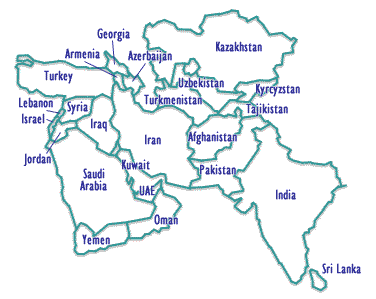
Map of the Middle East

From Investors Business Daily.

Excerpt:

In the Middle East, where U.S. military involvement and diplomacy are most closely watched, President Obama is held in lower regard in the Arab world than President Bush was in the last year of his presidency.

Obama is not only less liked than the supposedly hated Bush, he can’t even hold a candle to Iran’s grubby, menacing Mahmoud Ahmadinejad. Zogby reports that in Egypt, 31% of Egyptians agree with Iran’s policies compared with 3% for Obama’s, with similar figures in Jordan. Among Egyptians, just 5% hold a favorable attitude toward the U.S. compared with 9% in 2008.

[…]Clinton will do no better in bilateral talks with the Turks — a nation that has moved so far away from its long alliance with the U.S. it can only be called a former ally — on Syria, Iran and Israel/Palestine.

In these countries, Obama’s policy can be summed up in a litany of ineffectual maneuvers.

On Syria, the first move was to succor, then to scold as the dictatorship indifferently sheds streams of blood in the streets of Damascus — showing the fundamental disconnect between what the brutal Syrian regime is and what the Obama administration thinks it is.

After throwing Tunisia and Egypt, two pro-Western allies, overboard, the administration ineffectually grasps a problem in Syria as the bodies pile up.

On Iran, Obama policy shows even more weakness. The president wasted two years coddling the monster regime that threatens a region of more than a billion people. He missed a chance to support a student uprising in 2009 and now watches as Iran’s illegal nuclear program speeds ahead with little fear of consequences, more brazen and closer to realization.

Whatever this learning-curve policy amounts to, it garners no international respect.

Then there’s the stance the White House has taken on Israel, abusively telling its ally to retreat to 1967 borders. It emboldened provocations from Palestinian terrorist groups and showed the rest of the Arab world that it pays more to be America’s enemy than its friend. Now the Arab League is moving to recognize Palestine.

It turns out that what foreign powers respect is strength, not weakness.

Exceptional speech on foreign policy by Tim Pawlenty

Tim Pawlenty delivered this must-read speech on foreign policy to the Council on Foreign Relations today.

Excerpt:

President Obama has failed to formulate and carry out an effective and coherent strategy in response to these events.  He has been timid, slow, and too often without a clear understanding of our interests or a clear commitment to our principles.

And parts of the Republican Party now seem to be trying to out-bid the Democrats in appealing to isolationist sentiments.  This is no time for uncertain leadership in either party.  The stakes are simply too high, and the opportunity is simply too great.

No one in this Administration predicted the events of the Arab spring – but the freedom deficit in the Arab world was no secret.  For 60 years, Western nations excused and accommodated the lack of freedom in the Middle East.  That could not last.  The days of comfortable private deals with dictators were coming to an end in the age of Twitter, You Tube, and Facebook.  And history teaches there is no such thing as stable oppression.

President Obama has ignored that lesson of history.  Instead of promoting democracy – whose fruit we see now ripening across the region – he adopted a murky policy he called “engagement.”

“Engagement” meant that in 2009, when the Iranian ayatollahs stole an election, and the people of that country rose up in protest, President Obama held his tongue.  His silence validated the mullahs, despite the blood on their hands and the nuclear centrifuges in their tunnels.

While protesters were killed and tortured, Secretary Clinton said the Administration was “waiting to see the outcome of the internal Iranian processes.”  She and the president waited long enough to see the Green Movement crushed.

“Engagement” meant that in his first year in office, President Obama cut democracy funding for Egyptian civil society by 74 percent.  As one American democracy organization noted, this was “perceived by Egyptian democracy activists as signaling a lack of support.”  They perceived correctly.  It was a lack of support.

“Engagement” meant that when crisis erupted in Cairo this year, as tens of thousands of protesters gathered in Tahrir Square, Secretary Clinton declared, “the Egyptian Government is stable.”  Two weeks later, Mubarak was gone.  When Secretary Clinton visited Cairo after Mubarak’s fall, democratic activist groups refused to meet with her.  And who can blame them?

The forces we now need to succeed in Egypt — the pro-democracy, secular political parties — these are the very people President Obama cut off, and Secretary Clinton dismissed.

The Obama “engagement” policy in Syria led the Administration to call Bashar al Assad a “reformer.”  Even as Assad’s regime was shooting hundreds of protesters dead in the street, President Obama announced his plan to give Assad “an alternative vision of himself.”  Does anyone outside a therapist’s office have any idea what that means?  This is what passes for moral clarity in the Obama Administration.

By contrast, I called for Assad’s departure on March 29; I call for it again today.  We should recall our ambassador from Damascus; and I call for that again today.  The leader of the United States should never leave those willing to sacrifice their lives in the cause of freedom wondering where America stands.  As President, I will not.

I blogged quite a bit about the peaceful protestors in Iran. Remember Neda Soltan who was shot down in the streets? And yet Obama had almost nothing to say about the pro-democracy movements. And Obama was on the wrong side in the Honduras election, as well – he backed Manuel Zelaya. It’s good that Tim Pawlenty has something to say about it.

And a bit more  of his speech:

The third category consists of states that are directly hostile to America.  They include Iran and Syria.  The Arab Spring has already vastly undermined the appeal of Al Qaeda and the killing of Osama Bin Laden has significantly weakened it.

The success of peaceful protests in several Arab countries has shown the world that terror is not only evil, but will eventually be overcome by good.  Peaceful protests may soon bring down the Assad regime in Syria.  The 2009 protests in Iran inspired Arabs to seek their freedom.  Similarly, the Arab protests of this year, and the fall of regime after broken regime, can inspire Iranians to seek their freedom once again.

We have a clear interest in seeing an end to Assad’s murderous regime.  By sticking to Bashar al Assad so long, the Obama Administration has not only frustrated Syrians who are fighting for freedom—it has demonstrated strategic blindness.  The governments of Iran and Syria are enemies of the United States.  They are not reformers and never will be.  They support each other.  To weaken or replace one, is to weaken or replace the other.

The fall of the Assad mafia in Damascus would weaken Hamas, which is headquartered there.  It would weaken Hezbollah, which gets its arms from Iran, through Syria.  And it would weaken the Iranian regime itself.

To take advantage of this moment, we should press every diplomatic and economic channel to bring the Assad reign of terror to an end.  We need more forceful sanctions to persuade Syria’s Sunni business elite that Assad is too expensive to keep backing.  We need to work with Turkey and the Arab nations and the Europeans, to further isolate the regime.  And we need to encourage opponents of the regime by making our own position very clear, right now:  Bashar al-Assad must go.

When he does, the mullahs of Iran will find themselves isolated and vulnerable.  Syria is Iran’s only Arab ally.  If we peel that away, I believe it will hasten the fall of the mullahs.  And that is the ultimate goal we must pursue.  It’s the singular opportunity offered to the world by the brave men and women of the Arab Spring.

The march of freedom in the Middle East cuts across the region’s diversity of religious, ethnic, and political groups.  But it is born of a particular unity.  It is a united front against stolen elections and stolen liberty, secret police, corruption, and the state-sanctioned violence that is the essence of the Iranian regime’s tyranny.

So this is a moment to ratchet up pressure and speak with clarity.  More sanctions.  More and better broadcasting into Iran.  More assistance to Iranians to access the Internet and satellite TV and the knowledge and freedom that comes with it.  More efforts to expose the vicious repression inside that country and expose Teheran’s regime for the pariah it is.

And, very critically, we must have more clarity when it comes to Iran’s nuclear program.  In 2008, candidate Barack Obama told AIPAC that he would “always keep the threat of military action on the table to defend our security and our ally Israel.”  This year, he told AIPAC “we remain committed to preventing Iran from acquiring nuclear weapons.”  So I have to ask: are all the options still on the table or not?  If he’s not clear with us, it’s no wonder that even our closest allies are confused.

The Administration should enforce all sanctions for which legal authority already exits.  We should enact and then enforce new pending legislation which strengthens sanctions particularly against the Iranian Revolutionary Guards who control much of the Iranian economy.

Here’s a clip from the discussion with CFR after the speech:

You know, I was listening to a fiscal conservative being interviewed on the radio the other day and the person was saying that he had more fear of Obama’s foreign policy than of Obama’s economic policy. This was after he had laid out a gloomy economic picture.