
Tag Archives: Iraq

John Bolton: U.S. deal with Iran is an “abject surrender”

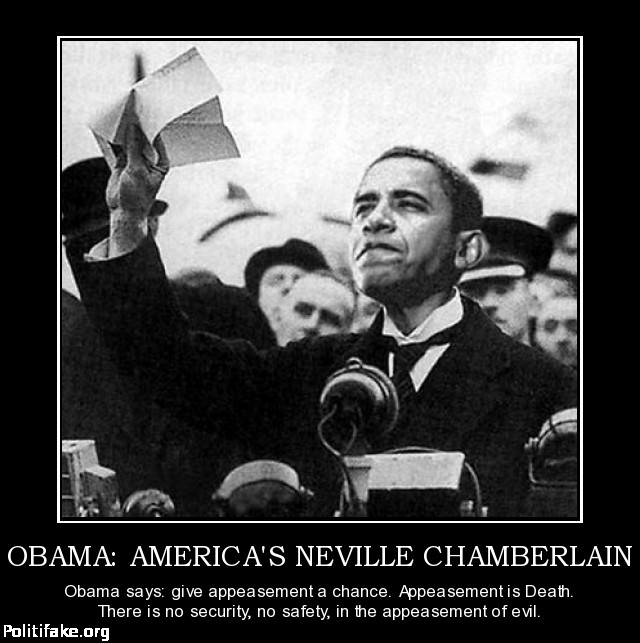
Neville Chamberlain Obama: peace in our time

The Weekly Standard featured a column by foreign policy heavyweight John Bolton.

Excerpt:

Negotiations for an “interim” arrangement over Iran’s nuclear weapons program finally succeeded this past weekend, as Security Council foreign ministers (plus Germany) flew to Geneva to meet their Iranian counterpart.  After raising expectations of a deal by first convening on November 8-10, it would have been beyond humiliating to gather again without result.  So agreement was struck despite solemn incantations earlier that “no deal is better than a bad deal.”

This interim agreement is badly skewed from America’s perspective.  Iran retains its full capacity to enrich uranium, thus abandoning a decade of Western insistence and Security Council resolutions that Iran stop all uranium-enrichment activities. Allowing Iran to continue enriching, and despite modest (indeed, utterly inadequate) measures to prevent it from increasing its enriched-uranium stockpiles and its overall nuclear infrastructure, lays the predicate for Iran fully enjoying its “right” to enrichment in any “final” agreement.  Indeed, the interim agreement itself acknowledges that a “comprehensive solution” will “involve a mutually defined enrichment program.”  This is not, as the Obama administration leaked before the deal became public, a “compromise” on Iran’s claimed “right” to enrichment. This is abject surrender by the United States.

In exchange for superficial concessions, Iran achieved three critical breakthroughs. First, it bought time to continue all aspects of its nuclear-weapons program the agreement does not cover (centrifuge manufacturing and testing; weaponization research and fabrication; and its entire ballistic missile program). Indeed, given that the interim agreement contemplates periodic renewals, Iran may have gained all of the time it needs to achieve weaponization not of simply a handful of nuclear weapons, but of dozens or more.

Second, Iran has gained legitimacy. This central banker of international terrorism and flagrant nuclear proliferator is once again part of the international club.  Much as the Syria chemical-weapons agreement buttressed Bashar al-Assad, the mullahs have escaped the political deep freezer.

Third, Iran has broken the psychological momentum and effect of the international economic sanctions. While estimates differ on Iran’s precise gain, it is considerable ($7 billion is the lowest estimate), and presages much more.  Tehran correctly assessed that a mere six-months’ easing of sanctions will make it extraordinarily hard for the West to reverse direction, even faced with systematic violations of Iran’s nuclear pledges.  Major oil-importing countries (China, India, South Korea, and others) were already chafing under U.S. sanctions, sensing President Obama had no stomach either to impose sanctions on them, or pay the domestic political price of granting further waivers.

Seven billion dollars in funding for a nation that is a known sponsor of anti-American terrorism. What kind of moron makes a deal with a regime that is on record for wanting to attack Israel with nuclear weapons? Some sort of reincarnation of Neville Chamberlain, that’s who.

Previously, the Obama administration had been accuesed of leaking details of a strike plan by Israel against Iranian nuclear facilities.

From ABC News.

Excerpt:

Two reports today about Iran’s nuclear program and the possibility of an Israeli military strike have analysts in Israel accusing the Obama administration leaking information to pressure Israel not to bomb Iran and for Iran to reach a compromise in upcoming nuclear talks.

The first report in Foreign Policy quotes anonymous American officials saying that Israel has been given access to airbases by Iran’s northern neighbor Azerbaijan from which Israel could launch air strikes or at least drones and search and rescue aircraft.

The second report from Bloomberg, based on a leaked congressional report, said that Iran’s nuclear facilities are so dispersed that it is “unclear what the ultimate effect of a strike would be…” A strike could delay Iran as little as six months, a former official told the researchers.

“It seems like a big campaign to prevent Israel from attacking,” analyst Yoel Guzansky at the Institute for National Security Studies told ABC News. “I think the [Obama] administration is really worried Jerusalem will attack and attack soon. They’re trying hard to prevent it in so many ways.”

[…]Thursday’s reports come a week after the results of a classified war game was leaked to the New York Times which predicted that an Israeli strike could lead to a wider regional war and result in hundreds of American deaths. In a column this afternoon titled “Obama Betraying Israel?” longtime defense commentator Ron Ben-Yishai at Yedioth Ahronoth newspaper angrily denounced the leaks as a “targeted assassination campaign.”

“In recent weeks the administration shifted from persuasion efforts vis-à-vis decision-makers and Israel’s public opinion to a practical, targeted assassination of potential Israeli operations in Iran,” Ben-Yishai writes. “The campaign’s aims are fully operational: To make it more difficult for Israeli decision-makers to order the IDF [Israeli Defense Forces] to carry out a strike, and what’s even graver, to erode the IDF’s capacity to launch such strike with minimal casualties.”

Maybe in the next election, Jewish-American voters will think a little more about who to vote for, in view of these facts. Or maybe it will take the actual nuclear destruction of Israel by Iran to get over their prejudices. As a supporter of peaceful democracies like Israel, I hope it doesn’t come to that.
Intelligence reports show Islamic extremists dominate Syrian opposition

Reuters reports on it with the headline “Kerry portrait of Syria rebels at odds with intelligence reports”.

Excerpt:

Secretary of State John Kerry’s public assertions that moderate Syrian opposition groups are growing in influence appear to be at odds with estimates by U.S. and European intelligence sources and nongovernmental experts, who say Islamic extremists remain by far the fiercest and best-organized rebel elements.

At congressional hearings this week, while making the case for President Barack Obama’s plan for limited military action in Syria, Kerry asserted that the armed opposition to Syrian President Bashar al-Assad “has increasingly become more defined by its moderation, more defined by the breadth of its membership, and more defined by its adherence to some, you know, democratic process and to an all-inclusive, minority-protecting constitution.

“And the opposition is getting stronger by the day,” Kerry told the Senate Foreign Relations Committee on Tuesday.

U.S. and allied intelligence sources and private experts on the Syrian conflict suggest that assessment is optimistic.

While the radical Islamists among the rebels may not be numerically superior to more moderate fighters, they say, Islamist groups like the al Qaeda-aligned Nusra Front are better organized, armed and trained.

Kerry’s remarks represented a change in tone by the Obama administration, which for more than two years has been wary of sending U.S. arms to the rebels, citing fears they could fall into radical Islamists’ hands.

As recently as late July, at a security conference in Aspen, Colorado, the deputy director of the Pentagon’s Defense Intelligence Agency, David Shedd, estimated that there were at least 1,200 different Syrian rebel groups and that Islamic extremists, notably the Nusra Front, were well-placed to expand their influence.

“Left unchecked, I’m very concerned that the most radical elements will take over larger segments” of the opposition groups, Shedd said. He added that the conflict could drag on anywhere “from many, many months to multiple years” and that a prolonged stalemate could leave open parts of Syria to potential control by radical fighters.

U.S. and allied intelligence sources said that such assessments have not changed.

As an aside, the mainstream media has not been reporting on these intelligence reports.

Excerpt:

A new survey of the coverage of the Syrian civil war and the U.S. response to it by the big three networks, ABC, CBS, and NBC, shows that 94 percent of their stories have not mentioned that some of the rebel forces include America’s enemy, al Qaeda.

The survey, reported by the Media Research Center’s Dan Gainor, finds that since August 21, 171 stories about the conflict have aired on the networks. Of those, only 11 stories mentioned the al Qaeda element of the war.

ABC, for instance, has aired 51 stories about the Syrian conflagration but only mentioned al Qaeda in 3 of those reports. NBC was worse: out of its 64 stories, only 3 mentioned the notorious terrorist group. NBC was a little better, mentioning al Qaeda 5 times in its 56 stories.

Al Qaeda is not yet ubiquitous among the rebel forces, but its presence is growing, something the networks should be warning their viewers about.

Now, I was initially in favor of a targeted strike aimed at the leadership of the Syrian regime, assuming two things were cleared up first. 1) We had to be sure that Assad was responsible for the use of the chemical weapons. Despite what the Obama administration says, we are still not sure who used the chemical weapons. 2) We had to be sure that there were moderate elements in the leadership of the Syrian opposition. Well, we now know that this is not the case. So, my position has changed, and now I am in favor of not launching a strike at the leaders of the Assad regime. (Note: this option was not what Obama was suggesting, anyway – his strike was not targeted at the leaders).

I do think that it is important to deter the use of chemical weapons. That is a valid concern, and a strike at leaders who use chemical weapons is a valid way of achieving that goal of saving civilians from future attacks. But we have to be sure that we don’t do more harm, and right now it doesn’t look like that will happen.

Heritage Foundation recommends no military action in Syria

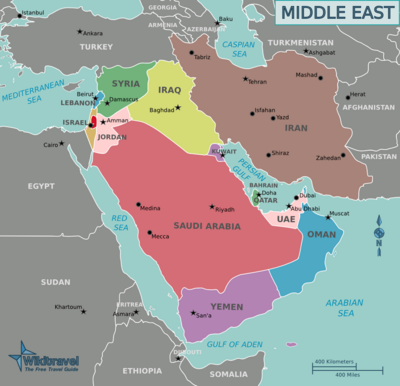
Map of Middle East
Map of Middle East

I posted earlier in the week about how our best option was a targeted strike (SSM or standoff) to the top level of the Assad regime, but it looks like there is another viable conservative view on what to do about Syria.

Here’s the post from the Heritage Foundation, my favorite conservative think tank.

Five reasons:

  1. The Responsibility to Protect (R2P) doctrine is not adequate justification for direct military intervention.
  2. A vital U.S. interest is not at stake.
  3. It would not be a wise use of military force.
  4. Missile attacks would only make President Obama look weaker.
  5. It would distract from what the U.S. should be doing.

Here’s the detail on Number 4:

4. Missile attacks would only make President Obama look weaker. Much like President Clinton’s ineffective cruise missile strikes on Osama bin Laden’s terrorist camps, strikes would only be seen as a sign that the U.S. is lacking a clear, decisive course of action. The Middle East would see this as another effort from the Obama Administration to look for an “easy button” and lead from behind rather than exercise real, constructive leadership.

The other concern that people have is the opposition is even more penetrated by Al Qaeda than I first thought.

More Heritage Foundation:

What should America be doing?

We should not be doing missile strikes, as many reports have indicated could be a possibility.

Al-Qaeda and other Islamist groups have been the principal beneficiaries of Obama’s passive, “hands-off” approach to the worsening Syria crisis. The Obama Administration urgently needs to develop a strategy not only to counter Assad’s use of chemical weapons but prevent those weapons from falling into the hands of al-Qaeda, Hezbollah, or other Islamist terrorist groups that have flocked to Syria.

Rather than attempting to intervene directly in the conflict, the U.S. should be working with other countries in the region to hasten the end of the Assad regime and deal with the refugee crisis and terrorist strongholds.

I don’t think that Heritage is responding to the idea of a targeted strike against the key people in the Assad regime as much as they are opposed to a general military strike against military targets. Everyone agrees on that, though. The strike option I presented (from Bret Stephens of the Wall Street Journal) was aimed at Assad and his henchmen.

The other concern that’s emerged (in the Associated Press, no less) is that it’s not 100% certain that the Assad regime was responsible for the use of chemical weapons. (H/T ECM)

Excerpt:

 The intelligence linking Syrian President Bashar Assad or his inner circle to an alleged chemical weapons attack is no “slam dunk,” with questions remaining about who actually controls some of Syria’s chemical weapons stores and doubts about whether Assad himself ordered the strike, U.S. intelligence officials say.

[…]A report by the Office of the Director for National Intelligence outlining that evidence against Syria includes a few key caveats — including acknowledging that the U.S. intelligence community no longer has the certainty it did six months ago of where the regime’s chemical weapons are stored, nor does it have proof Assad ordered chemical weapons use, according to two intelligence officials and two more U.S. officials.

[…]A three-page report released Thursday by the British government said there was “a limited but growing body of intelligence” blaming the Syrian government for the attacks. And though the British were not sure why Assad would have carried out such an attack, the report said there was “no credible intelligence” that the rebels had obtained or used chemical weapons.

Like the British report, the yet-to-be-released U.S. report assesses with “high confidence” that the Syrian government was responsible for the attacks that hit suburbs east and west of Damascus, filled with a chemical weapon, according to a senior U.S. official who read the report.

The official conceded there are caveats in the report and there is no proof saying Assad personally ordered the attack. There was no mention in the report of the possibility that a rogue element inside Assad’s government or military could have been responsible, the senior official said.

ECM wonders why the Assad regime would try to hasten their own demise by using chemical weapons, especially when they are winning. Still, I think it’s more likely than not right now that Assad is responsible for using the chemical weapons.

Ed Morrissey at Hot Air notes that Obama has not presented a comprehensive case for intervention in Syria. Who says? Donald Rumsfeld! Morrissey says that Bush administration’s case for war was much more thorough and had more support than Obama’s case against Syria.

My reasons for initially supporting the strike at the top level of the regime was to deter the future use of chemical weapons. I still favor that course of action, but on the condition that we clear up these uncertainties *first* and get Congressional approval *first*. You can’t just do these things willy-nilly, especially when there are uncertainties.