
Tag Archives: Iran

The top 10 foreign policy failures of the Obama administration

This well-footnoted list of Obama’s top 10 foreign policy blunders is from the Romney/Ryan campaign.

The list:

  1. No Results In Slowing Or Stopping Iran’s Nuclear Weapons Program
  2. Endangering Our Mission In Afghanistan And Weakening Our Relationship With Pakistan
  3. “Unconscionable” Leaks Of Classified Counterterror Information From The White House That Have Been “Devastating”
  4. “Devastating” Defense Cuts That Will Cede Our Status As A “Global Power”
  5. A Damaged Relationship With Israel And A Moribund Peace Process
  6. No Coherent Policy To Stem The Humanitarian And Strategic Disaster In Syria
  7. A “Reset” With Russia That Has Compromised U.S. Interests & Values
  8. Emboldening The Castros, Chávez & Their Cohorts In Latin America
  9. Getting Beaten Badly By Competitors On Trade
  10. Putting Our Interests At Risk By Mismanaging The Transition In Iraq

Each of these would devastating to Obama’s re-election effort on their own. Taken together, you have to wonder whose side he is really on.

Here’s my favorite:

Failure #1: No Results In Slowing Or Stopping Iran’s Nuclear Weapons Program

Today, Iran is on the cusp of nuclear weapons capability. Such a capability in the hands of the world’s top terrorist sponsoring state poses the greatest threat facing the United States and our friends and allies, and it risks sparking a nuclear arms race across the Middle East.

Despite promising to “do everything in his power” to stop Iran, four years of President Obama’s irresolute policies have failed to slow the progress of Iran’s program. In fact, that progress has sped up:

  • Fastest Rate Of Enrichment Ever. In 2009, Iran’s enrichment rate of low-enriched uranium was 56 kilograms per month.  That jumped to 116 kilograms per month from November 2011 to February 2012. The enrichment rate now stands at 158 kilograms per month, the fastest rate ever.[1]
  • More Spinning Centrifuges. The total number of spinning centrifuges has gone from 3,936 to 10,477 during Obama’s term. The growth rate of spinning centrifuges went from 112 centrifuges per month before Obama came into office to 152 centrifuges per month during his term.[2]
  • Fordow Underground Enrichment Facility Nearing Completion. The fortified underground facility is 70 percent complete. The number of centrifuges installed has gone from 1,064 in May to 2,140 today. The facility’s limit is 3,000 centrifuges.[3]

The Iranian program has gotten to this point because President Obama has squandered all credibility with the ayatollahs:

  • A Failed Engagement Policy. President Obama offered the ayatollahs “no preconditions” talks, which were rebuffed. The latest round of multilateral talks has produced no results.
  • Refrained From Supporting The Green Movement. When asked during a press conference, President Obama shamefully refused to voice support for Iranian dissidents in 2009 as they were being killed in the streets, saying he did not want to “meddle” in Iran’s affairs.
  • A Weak Sanctions Policy. President Obama opposed and sought to water down crippling sanctions on Iran’s Central Bank until he was forced into them by Congress and our European partners.[4] He then undermined those sanctions by issuing waivers to 20 of the top importers of Iranian oil, including China.[5]
  • Abandoned Missile Defense. He abandoned a European missile defense system meant to protect against Iranian missiles.
  • Undermined The Credibility Of The Military Option. His administration has given the Iranians no reason to believe it is serious about a military option. The administration has repeatedly talked down the effectiveness and advisability of the military option, and seems to have devoted more energy toward preventing an Israeli strike on Iran than toward preventing an Iranian nuclear weapons capability. Obama officials leaked that the administration has focused its efforts on explaining to Israel “the dangers of an Israeli attack” on Iran and has attempted to “make the decision to attack as hard as possible for Israel.”[6] And the President himself, after boldly stating to AIPAC that the United States “has Israel’s back,” changed his tune two days later by saying his statement was “not a military doctrine.”

In the face of such irresolution, the ayatollahs are pressing forward toward nuclear weapons capability without fear of repercussion because they do not believe we are serious.

And another:

Failure #3: “Unconscionable” Leaks Of Classified Counterterror Information From The White House That Have Been “Devastating”

The Obama White House has released a torrent of leaks of classified counterterror information that has compromised our national security by revealing covert sources and methods. The pace of the leaks quickened as the November election drew nearer, raising the question of whether they were politically motivated. But whether the leaks were politically motivated and intentional or the result of bad management and sloppiness in neither here nor there.  Either case is unacceptable and injurious to the intelligence operatives and uniformed men and women in the field.

Criticism of the leaks has been bipartisan:

  • John Brennan, President Obama’s own counterterror chief and Deputy National Security Adviser, has called the leaks “unconscionable,” “damaging,” and “devastating.”[10]
  • Senator Dianne Feinstein, the Democratic Chairman of the Senate Select Committee on Intelligence, has criticized the leaks and stated that they are coming from the White House. She said, “Each disclosure puts American lives at risk, makes it more difficult to recruit assets, strains the trust of our partners, and threatens imminent and irreparable damage to our national security in the face of urgent and rapidly adapting threats worldwide.”[11]

Despite the damage done, President Obama has refused to support the appointment of a special counsel to investigate these leaks and hold those responsible accountable. The special counsel mechanism is designed for just such circumstances where the impartiality of normal prosecutors may be compromised because someone in the high chain of command in the White House may be implicated.

The damaging leaks include:

  • Operational details about the Osama Bin Laden raid.
  • Existence of a Pakistani doctor who assisted the United States in finding Bin Laden and who was later arrested and jailed in Pakistan.
  • Revelation of a covert joint U.S.-Israeli cyber operation to undermine Iran’s nuclear weapons program.
  • The existence of a double-agent who was key to unraveling the second underwear bomb.
  • The White House’s process for determining the targets of drone strikes.

And one last one:

Failure #7: A “Reset” With Russia That Has Compromised U.S. Interests & Values

Mere months after Russia invaded its neighbor Georgia, the Obama Administration came into office vowing to “reset” relations with Russia, saying it would lead to more cooperation on Iran, North Korea, and Afghanistan. That reset has garnered little improvement in our relationship with Russia and no new meaningful cooperation.

Among President Obama’s concessions to Russia were:

  • Abandoning A European Missile Defense System. The unilateral abandonment of a missile defense system to be based in Poland and the Czech Republic and completed by 2013 was a sop to Russia, which had sought to intimidate our allies and discourage them from agreeing to the system in the first place. They agreed to it despite the pressure. To add insult to injury, he announced his decision on September 17, 2009—the 70th anniversary of Russia’s invasion of Poland.
  • New START. President Obama’s signing of the New START treaty compromised U.S. interests in two respects. First, it linked U.S. missile defense systems to reductions in our nations’ respective nuclear arsenals. This linkage jeopardizes our ability to deploy missile defense systems.  Second, the limits it sets on the number of Russian launchers and warheads were above what Russia possessed in its nuclear arsenal at the time.[22] In other words, New START gave Russia room to expand its arsenal while requiring the United States to reduce its arsenal.
  • “Flexibility” After The Election. In a hot mic moment, President Obama promised Russia’s leaders even more “flexibility” on missile defense and other issues in exchange for more “space” prior to the November election. It was a telling moment of weakness, one that has shaken our allies and raised the persistent question of what President Obama is planning to do post-election that he can’t tell the American people now.
  • Kid Gloves For Russia’s Human Rights and Democracy Problems. President Obama has soft-pedaled Russia’s backsliding on democracy and human rights. The Obama Administration has opposed the Magnitsky Bill that would sanction human rights abusers in Russia, preferring to grant Russia permanent normal trade relations free from any new human rights measures. President Obama even congratulated Vladimir Putin in a phone call from Air Force One on winning a corrupt election.

In return for these concessions, Russia has given little save for obstruction at the U.N., support for rogue regimes, and bellicose behavior.

  • Obstruction On Syria. Three times, Russia has wielded its veto power along with China to block U.N. Security Council Resolutions aimed at stopping the violence in Syria and sanctioning the Assad regime.
  • Arms To Syrian Regime. Russia has supplied arms to the Syrian Army during its brutal crackdown on Syrian civilians.
  • Obstruction On Iran. Russia succeeded in watering down a 2010 set of U.N. sanctions on Iran, preventing the inclusion of sanctions on Iran’s Central Bank. Since that time, Russia has successful blocked binding U.N. sanctions on the Central Bank and has criticized individual nations’ sanctions on the Central Bank, calling such efforts “unacceptable.”
  • Push To Close U.S. Airbase Vital To Mission In Afghanistan. Instead of helping American efforts in Afghanistan, Russia urged Kyrgyzstan to close down a U.S. military base that is a vital transit point for troops and supplies moving in and out of Afghanistan. It is the only such transit base the United States has in Central Asia.[23]
  • Cozying To Chávez. Closer relations between Moscow and Hugo Chávez’s Venezuela, including new deals on nuclear power cooperation, increased arms sales, and a $4 billion loan agreement.
  • Continued Abuses Of Political And Human Rights. Putin’s re-election as President came on the wings of a corrupt election. And he has continued to consolidate power, sending dissidents and even punk rockers who dare criticize him to jail on trumped up charges.
  • Return Of Cold War Rhetoric. Since announcing plans to resume his former office, Putin has employed the harshest anti-American rhetoric seen since the Cold War and has stepped up harassment of U.S. officials on Russia soil.

I really recommend reviewing these and please send them along to your friends who can vote. These are not things you see reported in the mainstream media, who seem to be more concerned about whether a 30-year-old law student gets taxpayers to pay $3000 per student for contraceptives.
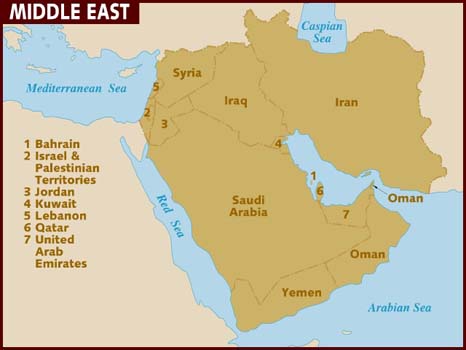
Iran’s dictator Ahmadinejad: Israel’s existence is an “insult to all humanity”

Map of the Middle East

From the UK Telegraph.

Excerpt:

Mahmoud Ahmadinejad said confronting Israel is an effort to “protect the dignity of all human beings”.

“The existence of the Zionist regime is an insult to all humanity,” Ahmadinejad said. He was addressing worshippers at Tehran University after nationwide pro-Palestinian rallies, an annual event marking Quds (Jerusalem) Day on the last Friday of the holy month of Ramadan.

Israel considers Iran an existential threat because of its nuclear and missile programs, support for radical anti-Israel groups on its borders and repeated references by Iranian leaders to Israel’s destruction. Ahmadinejad himself has repeatedly made such calls, as has Iran’s Supreme Leader Ayatollah Ali Khamenei.

[…]Ahmadinejad called Israel “a corrupt, anti-human organized minority group standing up to all divine values”.

“Today, confronting the existence of the fabricated Zionist regime is in fact protecting the rights and dignity of all human beings,” said Ahmadinejad, with a black and white scarf many Palestinians wear around his neck.

Demonstrators in Tehran set U.S. and Israeli flags on fire and chanted “Death to the US” and “Death to Israel” during their pro-Palestinian rally.

Iran and Israel have been bitter enemies for decades. Khamenei has called Israel a “cancerous tumor” that must be wiped out.

Tensions between Iran and Israel have intensified since 2005, when Ahmadinejad said in a speech that Israel will one day be “wiped off the map.” The Iranian president has also described the Holocaust, when 6 million Jews were killed by German Nazis and their collaborators during World War II, as a “myth”.

Do you think that Barack Obama is going to do anything about this? He has done nothing whatsoever to protect Israel in four years. And more, he’s actually acted to embolden Iran. When he had the chance to speak out in favor of pro-democracy movements in Iran, he chose the Iranian theocrats instead. Defense analysts have speculated that the Obama administration leaked Israel’s plan to strike the Iranian nuclear facilities.

Mark Levin interviewed a former Marine strike planner who had this to say about the leak:

I just want to comment on this revelation by the State Department regarding this Israel-Azerbaijan connection. A few years ago, I was writing an article and studying how Israel might go about attacking Iran with the assets we knew they had…

I’ve got experience as a Marine F-4 Phantom Radar Interceptor Officer. I’ve planned strike missions. I’ve got a thousand hours in the Phantom. So I’m familiar with the problems strike planners have in attacking a target or multiple targets like Iran. And as I looked at the map, I thought: ‘Boy, oh, boy, if the Israelis had an alliance with Azerbaijan, that would be the perfect place to launch a strike.

They’ve got this beautiful, 10,000-foot concrete runway in Baku. You take off, you come right out over the Caspian Sea. The pilots flip on their radar altimeters, drop down 25-feet off the deck, and they just race in a straight line.

They pop up over some hills, and they’re in Tehran before the Iranians even know what hit them. They could then go hit the other targets. It reduces the distance for this strike by, oh, six, seven hundred miles. It might alleviate the need for tankers. Or, if they do need tanker support, you could put them over the Caspian Sea…

…The beauty of Baku is that the Caspian Sea is right at the end of the runway. It’s a straight shot, maybe 300 miles, from that base to Tehran. A good radar altimeter will get an F-4, F-16, F-15 strike fighter maybe 25 feet off the water. Going in at that altitude, you’re not going to be picked up by radar.

But there’s something even more important here. The Iranians are not expecting an attack from the north. Now, with the revelation of this relationship, they are. And that has a lot of implications beyond the tactical.

Think of it this way. Prior to this revelation, the Iranians — although they noticed some connections between Israel and Azerbaijan — didn’t know how deep that connection was.

Now the Iranians can start bullying the Azerbaijanis. They can send a diplomat up to Baku and say, basically, ‘if any Israeli plane hits us from the north, when we get our nuke, we are going to test it on Baku. Of course that will all happen behind the scenes, but the threat will be made.

Now, I want you to consider this: there are many ways to attack Iran. You can go for the nuke sites. Or you can go for a decapitation strike. A decapitation strike is a much easier operation if you’re coming from Azerbaijan.

Think of it this way: every once in a while, the Iranians have a little get-together. They bring all of the Mullahs together in one place… Why not? They’d be doing us and the world a tremendous favor if they did that.

And it’s not going to happen now.

I can guarantee that all of those new Soviet anti-aircraft missiles that the Iranians bought are all going up north now, pointed and waiting for something there. In fact, they’ll probably put radars on the Caspian from the mountaintops there, just to see if there’s anything come up off the water.

Strategic, tactical surprise: gone.

You have to ask for the motivation behind the leak. I mean, if the Israelis can do this operation, it’s to our benefit! From a diplomatic standpoint, if you wanted to tell the Iranians that the Israelis did this, it’s without our permission. And then try to butter up the Iranians after the strike, so they don’t close the Strait of Hormuz, that’s one thing.

But giving away all of the secrets of an ally? When you’re doing that, you have to ask whether we still have Israel as an ally. We are not acting like an ally. In fact, if you ask me, based on the amount of time I expect the Israelis put in this relationship with Azerbaijan, I would start viewing this administration as an existential threat to Israel.

Recall that there have been accusations that the Obama administration has been infiltrated by the Muslim Brotherhood – the same Muslim Brotherhood that is reported to be crucifying their political opponents following the Egyptian elections. The Muslim Brotherhood that took power after Obama helped them to overthrow the Egyptian government. The Muslim Brotherhood that got $1.5 billion dollars from Obama, who bypassed Congress in order to do it. The Muslim Brotherhood whose leader was invited to the White House by Obama. Not only that, but the Obama administration has done nothing about the sale of weapons to Iran from China – weapons that are then transferred to Hezbollah to be used to sink Israeli ships.

On the other hand, Mitt Romney has come out in favor of defending Israel.

Defense cuts to an already weakened military exposes us to aggression

Mackenzie Eaglen is a defense policy analyst for the American Enterprise Institute.

Here’s a recent article that she wrote from the Wall Street Journal. (Full text also here on the AEI web site)

Excerpt:

Washington is battling these days over “sequestration,” the $500 billion additional cut to the defense budget looming in January.

[…]In April 2011—long before the near shutdown of the government and the last-minute debt-ceiling deal, which paved the way for sequestration—the president outlined $400 billion in defense cuts he had already approved. He also said that he wanted to “do that again” and find another $400 billion in military spending reductions. All this without any talk of threats, strategy or requirements—just arbitrary budget targets imposed on the military.

Even before sequestration and the possible loss of a half-trillion dollars, the U.S. military has seen three years of budget cuts. The consequences are already here. We have to look all the way back to 1916 to find a year when the Air Force purchased fewer aircraft than are included in Mr. Obama’s 2013 budget request.

Many of the Air Force’s aerial refueling tankers predate human space flight. Training aircraft are twice as old as the students flying them. The F-15 fighter first flew 40 years ago. A-10 ground-attack planes were developed in the Carter years. And all of our B-52 bombers predate the Cuban missile crisis.

Then there’s the Navy, which is the smallest it has been since 1916. At 286 combat and combat-support ships, the Navy today is less than half the size it reached during the Reagan administration. And what about those men and women who have been fighting America’s wars in Afghanistan and Iraq since 2001? They’re losing 100,000 in active duty personnel. Surely some will go from the front lines to unemployment lines as a result.

[…]Military leaders have suggested that taking on Syrian President Bashar al-Assad and his Third World army would be an operation of “many, many months.” The so-called “pivot” to Asia is being mimed with fewer ships on longer deployments and a shrinking, aging air force. We’re ignoring a wholesale Chinese power grab in the South China Sea and watching the nuclearization of Iran.

In another article on AOL Defense, she focuses in on the cuts to the U.S. Air Force. (Full text also here on the AEI web site)

Excerpt:

Between the existing reduction of $487 billion and sequestration’s additional half-trillion dollar cut, the Pentagon faces a very profound strategic turning point — one entirely different than that articulated by Secretary Panetta. Instead of prudently posturing for future successes, America’s armed forces are headed for a crash.

These pressures are perhaps best illustrated within the Air Force. The service absorbed 90 percent of the cuts levied on the Department of Defense in the 2013 budget — $4.8 billion of $5.2 billion. The effects have been immediate and pronounced: nearly 10,000 airmen are being cut; 227 aircraft are being prematurely retired; and critical capability shortfalls are on the rise.

[…]These budget cuts would not present such dire effects if the Air Force had been able to use the past decade to recapitalize its fleet and overarching infrastructure. At the end of World War Two, the Korean War, Vietnam, and the Cold War, the service was able to weather post-war budget downturns precisely because it had reset the majority of its capabilities during wartime.

Circumstances were different this past decade. The Air Force, already stretched thin by the 1990s procurement holiday, actually saw its percentage of the defense budget decline by one-third during the wars in Iraq and Afghanistan. The service canceled or delayed the vast majority of its modernization portfolio to sustain wartime operational demands.

So 20 years of underfunding has given us an Air Force on the brink. Its aircraft average a quarter of a century in age-with many dating back to the Eisenhower Administration. The wings of Carter-era A-10 ground attack airplanes are riddled with structural cracks. Airmen learning to fly are strapping into T-38s over twice their age. B-52s, all of which pre-date the Cuban missile crisis, are spending up to a year in depot-level maintenance. In light of the F-22 shortage, the Air Force is now extending the lifespan of its 28 year-old F-15s to 18,000 hours — more than three times their original design life.

The Air Force also spent the last decade retiring nearly a quarter of its bombers, fighters, and cargo aircraft in an attempt to free up money for immediate priorities. While helpful on a budget spreadsheet in the near-term, this has stretched the remaining tails even thinner. Shrinking the fleet makes little sense when the mission demand is constant. Aircraft availability rates and maintenance statistics clearly illustrate the rising costs associated with this decision.

Obama is also in favor of the complete disarmament of the United States with respect to nuclear weapons.

The Wall Street Journal explains:

The White House and Pentagon are considering several proposals that would deeply cut the nation’s stockpile of nuclear weapons, potentially to as low as 300 warheads under one such plan, according to a U.S. official.

The proposals haven’t been presented to President Barack Obama but are being debated by lower-level officials on the national-security staff and in the Pentagon.

The U.S. official said the government isn’t considering a unilateral cut to the nation’s nuclear arsenal. Instead, the different proposals represent arsenal levels that could be negotiated with Russia in a future round of arms-control talks.

Nonetheless, the prospect of nuclear-arsenal cuts during a hard-fought presidential campaign is certain to stoke political controversy.

Under current treaty obligations, the U.S. must reduce its nuclear arsenal to 1,550 warheads by 2018 from just below 1,800 now. One of the new proposals would cut the arsenal to between 1,000 and 1,100; another proposes an arsenal of between 700 to 800; and the most drastic proposal would cut the arsenal to between 300 and 400, according to the official.

The fact of the matter is that there are hot spots and threats all over the world. If we want to work towards peace and protect the weak, then we need a large, capable military force. This is the doctrine of peace through strength. Talk is cheap, and disarmament only emboldens evildoers to be aggressive. If we want to stop war, we have to make it costly for aggressors and tyrants. They have to know that there is a cost.