Tag Archives: Hosni Mubarak

Obama foreign policy: Muslim Brotherhood imposing anti-US dictatorship in Egypt

North Africa and Middle East Political Map

The Heritage Foundation explains what Obama enabled by using American military force to remove Hosni Mubarak in Egypt.

Excerpt:

Egypt was wracked by protests today, the day after President Mohamed Morsi purged key judicial officials and issued a decree that granted himself sweeping new powers. In Cairo, protesters gathered in Tahrir Square, the epicenter of Egypt’s stalled revolution, to denounce Morsi’s power grab and chant: “Morsi is Mubarak.” There were reports of heavy rioting in three Suez Canal cities, Suez, Port Said, and Ismaila, with angry crowds burning the offices of Morsi’s political party, the Freedom and Justice Party.

Opposition political leaders accused Morsi of “monopolizing all three branches of government.” Mohamed El Baradei tweeted that Morsi had “appointed himself Egypt’s new pharaoh.”

And more from a different Heritage Foundation article:

Egypt has been rocked once again by a political crisis triggered by President Mohamed Morsi’s relentless efforts to secure dictatorial power. Hundreds of protesters from liberal and secular opposition groups demonstrated in Cairo’s Tahrir Square, the birthplace of Egypt’s stunted “Arab Spring” revolt. One barometer of the coming test of strength between Morsi and the weak and splintered opposition will be whether the disappointed democrats can retain control over Tahrir Square in the face of police and Muslim Brotherhood countermoves.

Egypt’s judiciary also has pushed back against Morsi’s power grab. The Supreme Council of the Judiciary denounced Morsi’s unilateral assertion of power over the judiciary as “an unprecedented attack on judicial independence.” The Judges Club, an association of judges made up of many appointees by the Mubarak regime, called for a strike by courts across Egypt.

But the judges alone will not be enough to reverse Morsi’s power grab. The key vote will be wielded by the armed forces. Morsi appears confident that he can count on support from key military leaders, whom he hand-picked after purging the top ranks of Mubarak loyalists in August.

While the army’s ultimate verdict on Morsi’s power grab is not yet apparent, Egypt’s investors voted with their wallets and withdrew their money from Egypt’s stock market, which plunged almost 10 percent on Sunday. Even if Morsi does secure the backing of the army, his assertion of dictatorial powers will further undermine what little confidence remains in Egypt’s deteriorating economy.

Guess what? It’s not always a good idea to use American power abroad. We have to ask what is in it for us. And in Egypt and Libya, there was nothing in it for us. We should have intervened appropriately in Syria and Iran, which are much more threatening to us.
Islamic extremists dominate Egypt’s parliamentary elections

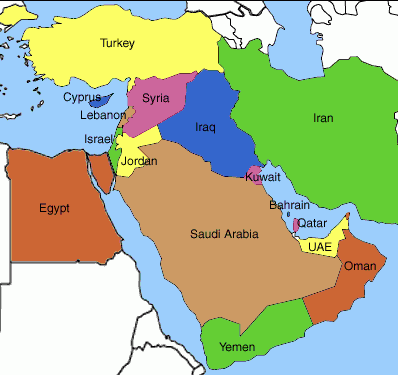
Map of the Middle East

From the Wall Street Journal.

Excerpt:

Unofficial initial results from the first two days of Egypt’s parliamentary elections pointed to a dominant showing for Islamist candidates, fulfilling most analysts’ expectations that conservative religious politicians could have the upper hand in next year’s drafting of a new Egyptian constitution.

Initial tallies put the powerful Muslim Brotherhood’s political arm, the Freedom and Justice Party, or FJP, in a leading position, followed by the Nour Party, which represents the ultraconservative Salafi school of Islam, FJP said.

An FJP official said the party’s vote-counting observers expect the group to win as much as 50% of the vote. A Nour Party spokesman said the early returns point to a Salafi capture of about 10% to 15% of seats in the incoming Parliament.

The Egyptian Bloc, a list of liberal parties dominated by the left-leaning Social Democrat Party and the pro-market Free Egyptians Party, appeared to be in third place. Official early results are expected to be announced on Thursday, the High Elections Commission said.

The results are far from final—a second and third round of elections covering two-thirds of Egypt’s 27 governorates are scheduled to take place in December and January. Individual candidate races that didn’t secure at least 51% will face runoffs beginning next week.

But the early results indicate that Egypt—the largest Arab country and under former President Hosni Mubarak one of the region’s staunchest defenders of secular governance—is set to pivot toward political Islam. The next voting rounds include mostly smaller Egyptian cities and villages, where Islamist rule is popular.

Such an outcome would surprise few Egyptians or political observers. Egypt’s deeply religious population grated under the ousted regime’s secular policies, and Tunisia and Morocco have recently awarded pluralities to moderate Islamist parties.

[…]Both Salafi and Brotherhood representatives said it was too early to say whether the two groups would form a coalition in Parliament—an alliance that would give Islamists a powerful majority.

This is what Obama bought us by taking his eye off the ball in Iraq, Afghanistan, Syria, Pakistan and Iran. We had no business firing a shot in Libya and Egypt. There was no strategic reason for us to be there.

What do Egyptians really want?

Map of Africa
Map of Africa

This IBD editorial discusses the latest Pew Research poll.

Excerpt:

According to a major survey conducted last year by the Pew Research Center, adults in Egypt don’t crave Western-style democracy, as pundits have blithely trumpeted throughout coverage of the unrest.

Far from it, the vast majority of them want a larger role for Islam in government. This includes making barbaric punishments, such as stoning adulterers and executing apostates, the law of their country. With the ouster of their secular, pro-American leader, they may get their wish.

Among highlights from the Pew poll:

• 49% of Egyptians say Islam plays only a “small role” in public affairs under President Hosni Mubarak, while 95% prefer the religion play a “large role in politics.”

• 84% favor the death penalty for people who leave the Muslim faith.

• 82% support stoning adulterers.

• 77% think thieves should have their hands cut off.

• 54% support a law segregating women from men in the workplace.

• 54% believe suicide bombings that kill civilians can be justified.

• Nearly half support the terrorist group Hamas.

• 30% have a favorable opinion of Hezbollah.

• 20% maintain positive views of al-Qaida and Osama bin Laden.

• 82% of Egyptians dislike the U.S. — the highest unfavorable rating among the 18 Muslim nations Pew surveyed.

This empirical evidence refutes the sympathetic narrative broadcast as a continuous loop in the media over the past fortnight.

Another case of media spinning for Obama, trying to make this not look like a foreign policy disaster in order to protect a weak President.