Tag Archives: Hindu

Was Mahatma Gandhi really a good person?

From the Wall Street Journal. (H/T Thinking Matters New Zealand)

Excerpt:

  • Although credited with leading India to independence from Britain, Gandhi actually undermined this effort. Between 1900 and 1922, he ­suspended his civil disobedience at least three times, even though more than 15,000 supporters were in jail for the cause. (When Britain finally did withdraw from India, it was largely motivated by their anti-imperialist Prime Minister, Clement Attlee, and the fact that Britain was nearly bankrupt from the war.)
  • Gandhi was dangerously politically incompetent. He ­advised the Jews to adopt nonviolence toward the Nazis, and wrote a letter to ­Hitler starting with the words “My friend”. He also advised the Jews of Palestine to “rely on the goodwill of the Arabs”. Fortunately for their existence, the Jews ignored him.
  • As well as calling Hitler his friend, Gandhi and Mussolini got on well when they met in December 1931. Gandhi praised Mussolini’s “service to the poor, his opposition to super-urbanization, his efforts to bring about a coordination between Capital and ­Labour, his passionate love for his people.”
  • Gandhi was outstandingly racist, describing “the raw Kaffir” as someone “whose occupation is hunting and whose sole ambition is to collect a number of cattle to buy a wife, and then pass his life in indolence and ­nakedness,” and saying of white Afrikaaners, “We believe as much in the purity of races as we think they do.”
  • He was also a hypocrite on many levels. He prevented his son marrying a Muslim despite publicly promoting Muslim-Hindu unity. He denounced lawyers, railways and parliamentary politics, yet he was a professional lawyer who constantly used railways to get to meetings to argue that India ­deserved its own parliament. And although he is known for his hunger strikes, his official position was that these were “the worst form of coercion, which militates against the fundamental principles of non-violence” (in which he believed).
  • His views on nakedness and sexual chastity were also belied by his depraved behavior: when he was in his 70s he encouraged his ­17-year-old great-niece, Manu, to be naked during her “nightly cuddles” with him. After sacking several long-standing and loyal members of his 100-strong ­personal entourage who might disapprove of this part of his ‘spiritual quest’, he began sleeping naked with Manu and other young women also.
  • Despite being thought of as a peaceful man, he was vicious and callous. “There will be no tears but only joy if tomorrow I get the news that all three of you were killed,” he once told some of his workers. To a Hindu he once said, “I do not mind if each and every one of the 500 families in your area is done to death.” And he forced Manu, his niece (remember the “nightly cuddles”), to walk through a jungle known for harboring rapists—just so she could retrieve a pumice stone he liked to use on his feet. When she returned in tears, he “cackled” with laughter and said: “If some ruffian had carried you off and you had met your death courageously, my heart would have danced with joy.”
  • In 1908 he left his wife for a German man named Hermann Kallenbach. “Your portrait (the only one) stands on my mantelpiece in my bedroom,” he wrote to Kallenbach. “The mantelpiece is opposite to the bed.” Gandhi nicknamed himself “Upper House” and Kallenbach “Lower House.” The two pledged “more love, and yet more love—such love as they hope the world has not yet seen.”

People ask about what will happen to the good people who never hear of Jesus, but who among us is really good? We all need a Savior to be reconciled with God. None of us is morally perfect.

More about Gandhi from ABC News. Don’t believe everything you see in the movies.
India Supreme Court exonerates eleven Hindus who murdered three Christians

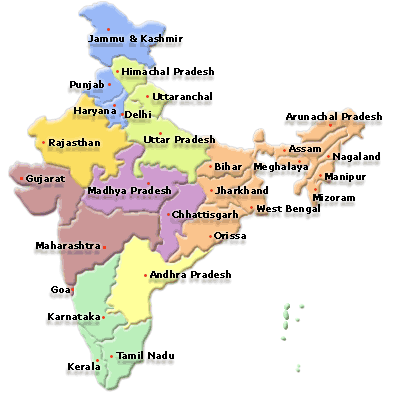
Map of India
Map of India

First, let’s hear about an anti-Christian crime that occurred in Orissa, the most anti-Christian area in India.

Excerpt:

The Central Bureau of investigation (CBI) wanted the death penalty for Singh, who was linked to extreme right-wing Hindu group Bajrang Dal. The GCIC has opposed the request for a death sentence. The wife of the slain pastor, Gladys Staines, had already forgiven Dara and his accomplices involved in the brutal murder of her husband and children. (20/01/2009 Widow of Graham Staines: “Do not give up hope, pray for India”).

Twelve years ago, Graham Staines was burnt alive with his children aged eight and ten years in the small village of Manoharpur, in the tribal area of Orissa. Graham Staines had worked for thirty years with leprosy patients in Orissa, and was sleeping with his children in a car, on his journey home on a cold December night. A group of attackers poured petrol on the car, and burned them alive.

The Staines tried to escape, but the assailants, fifty in all, prevented them. A witness said the attackers shouted slogans in praise of Dara Singh, the Hindu movement and the god Hanuman.

In 2003 a court in Khurda judged all 13 accused guilty. Life in prison for everyone else, a death sentence for Dara Singh. In 2005, the Orissa High Court commuted the death penalty to life imprisonment, judged Hembran guilty and exonerated the others.

Shalini sent me this story about how the Supreme Court upheld the High Court’s decision.

Excerpt:

Dara Singh killed Australian missionary Graham Staines and his two minor sons by setting fire to the vehicle in which they were sleeping, but the Supreme Court on Friday ruled that it was not a “rarest of rare” category crime to warrant death penalty for him.

In a judgment drawing curtains on court proceedings in the sensational incident of January 1999, a bench of Justices P Sathasivam and B S Chauhan upheld the Orissa High Court judgment imposing life sentence on Singh alias Rabindra Kumar Pal and Mahendra Hembram. The trial court had awarded death penalty to Singh.

The bench said the Orissa HC was justified in awarding life term to Singh and Hembran as the crime was committed in the passion to teach Staines a lesson for his alleged attempts to convert tribals.

“Though Graham Staines and his two minor sons were burnt to death while they were sleeping inside a station wagon at Manoharpur, the intention was to teach a lesson to Staines about his religious activities, namely, converting poor tribals to Christianity,” it said.

“All these aspects have been correctly appreciated by the high court and modified the sentence of death into life imprisonment with which we concur,” the bench said.

Justice Sathasivam, writing the judgment for the bench, also dismissed the CBI`s appeal challenging the HC`s decision to acquit 11 other accused. “We have highlighted the weakness and infirmities of the prosecution case insofar as acquitted accused, who are poor tribals,” he said. The CBI had taken over the probe from Orissa Police on May 3, 1999.

“In the absence of definite assertion from the prosecution side about their specific role and involvement, it is not safe to convict them. We entirely agree with the reasoning and conclusion of the high court,” it said.

While condemning killings in the name of religion, the bench also expressed its disapproval of conversion. “It is undisputed that there is no justification for interfering in someone`s belief by way of `use of force`, provocation, conversion, incitement or upon a flawed premise that one religion is better than the other,” said the bench.

This story is interesting because it shows how the pluralist view that “all religions are valid” can actually lead to violence. The pluralist view is itself a point of view that takes itself to be true. Pluralists think that religions like Christianity, which claim to be true, are actually FALSE. In short, pluralism DOES disagree with Christianity. If disagreement with other religions is bad, then pluralists are just as guilty of being bad as Christians.

Is what they say about Christians being “exclusive” true? Does being “exclusive” make Christians dangerous? Well, the reason why the practice of Christianity DOES NOT result in violence is because part of the “truth” that Christians believe is that they should love their enemies and pray for the people who persecute them. That’s why the victim’s wife forgave the murderers for their crimes.

I actually have Hindus and Muslims in my family. They treat religion as a cultural or national identity – not really something to investigate to see if it is true or false. Hindus are not usually Hindus because they did some big investigation and found Hinduism to be true. (Hinduism requires an eternally oscillating cosmology, which contradicts physics and the Big Bang theory). It’s more like that they do it for personal reasons or community reasons – it’s like part of their national/cultural identity.

Why do some Hindus oppose evangelism?

A while back I posted this debate featuring a Hindu who disagreed with Christian evangelism and wanted to make it illegal. He complained about Christians using “force” (being kind and giving gifts) to convince people to become Christians. In the next breath he was pushing the government to use force his anti-Christian views onto Christians. He did not want them to evangelize, so he wanted to pass that view into law and force his neighbors to accept HIS views by force. He thought his view of Christianity and evangelism was TRUE, and he thought the traditional, Biblical Christian view was false. He actually insisted that his interpretation of the Bible was correct and all the Christian theologians were misinterpreting the Bible. He expected Christians to act like Hindus! And he thought that Christianity WAS Hinduism – or that it should be redefined to be understood to be Hinduism. Then he complained about Christians who thought that their views were TRUE and that his were FALSE.

The difference between Christians and Hindus is that committed Christians think they are right and use ideas and words to persuade, while militant Hindus think they are right and are willing to use force to make people agree with them. I think the difference is that a Christian can appeal to facts like the Big Bang theory, and the Hindu cannot really do that, as this Hindu commenter to another post showed.

I really recommend that you listen to that debate, and there is a play-by-play summary that I wrote in case the bandwidth is too high. And read my exchange with the Hindu commenter, too.

Here is the major persecution story in Orissa that I blogged about before. And here’s another small story from Orissa that I found.

Tea party candidate Nikki Haley is the new governor of South Carolina

Nikki Haley and her husband Michael Haley

The Hindustan Times is awfully proud of our two Indian-American governors – Bobby Jindal and now Nikki Haley. (Both Republicans!)

Excerpt:

Parents of both Nikki Randhawa Haley, who on Tuesday won the governor’s election in South Carolina, and Bobby Jindal, the other Indian American governor of Lousiana, were born to immigrants from Punjab. Nikki Haley is the first woman and the second person of Indian origin after Bobby Jindal to become governor in the US. Jindal won the top job in Louisiana state in 2007.

[…]”I don’t do anything halfway – I’m in this race to win,” Nikki had told IANS in July taking time off her busy campaign for raising money.

“I am confident that come November, the people of South Carolina will send me to the Governor’s Mansion.

“When they (voters) do, I will immediately get to work to give them progress that makes them proud.”

Asked whether her Sikh background will matter in the race, she had said,”What matters most in South Carolina – and I imagine elsewhere in the country – is not the personalities of the candidates but the message they carry.

“Our message of bringing good government back to the people of this state, creating jobs by reforming our tax code so it’s flatter and fairer, and reminding government of the value of a dollar resonates with all the people of this state.

“I am very proud of my background and how I was raised. Just as in 2004 (when her opponents had raised the issue of background) I will hold my head up high and focus on what I can do for the people of this state.”

It seems to me that the Indian culture of hard work and family is a natural fit with conservative ideals.