
Tag Archives: Health Insurance

Is it time to start thinking of an exit strategy for the quagmire of Obamacare?

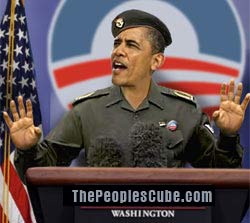
Baghdad Obama says: "No one will lose their health care plan!"
Baghdad Obama says: “No one will lose their health care plan!”

Letitia posted this article from the pro-Obama NBC News.

Excerpt:

Health plans are sending hundreds of thousands of cancellation letters to people who buy their own coverage, frustrating some consumers who want to keep what they have and forcing others to buy more costly policies.

The main reason insurers offer is that the policies fall short of what the Affordable Care Act requires starting Jan. 1. Most are ending policies sold after the law passed in March 2010. At least a few are canceling plans sold to people with pre-existing medical conditions.

[…][T]he cancellation notices, which began arriving in August, have shocked many consumers in light of President Barack Obama’s promise that people could keep their plans if they liked them.

“I don’t feel like I need to change, but I have to,” said Jeff Learned, a television editor in Los Angeles, who must find a new plan for his teenage daughter, who has a health condition that has required multiple surgeries.

An estimated 14 million people purchase their own coverage because they don’t get it through their jobs. Calls to insurers in several states showed that many have sent notices.

Florida Blue, for example, is terminating about 300,000 policies, about 80 percent of its individual policies in the state. Kaiser Permanente in California has sent notices to 160,000 people – about half of its individual business in the state. Insurer Highmark in Pittsburgh is dropping about 20 percent of its individual market customers, while Independence Blue Cross, the major insurer in Philadelphia, is dropping about 45 percent.

[…]Some receiving cancellations say it looks like their costs will go up, despite studies projecting that about half of all enrollees will get income-based subsidies.

Kris Malean, 56, lives outside Seattle, and has a health policy that costs $390 a month with a $2,500 deductible and a $10,000 in potential out-of-pocket costs for such things as doctor visits, drug costs or hospital care.

As a replacement, Regence BlueShield is offering her a plan for $79 more a month with a deductible twice as large as what she pays now, but which limits her potential out-of-pocket costs to $6,250 a year, including the deductible.

“My impression was …there would be a lot more choice, driving some of the rates down,” said Malean, who does not believe she is eligible for a subsidy.

Regence spokeswoman Rachelle Cunningham said the new plans offer consumers broader benefits, which “in many cases translate into higher costs.”

“The arithmetic is inescapable,” said Patrick Johnston, chief executive officer of the California Association of Health Plans. Costs must be spread, so while some consumers will see their premiums drop, others will pay more — “no matter what people in Washington say.”

Health insurance experts say new prices will vary and much depends on where a person lives, their age and the type of policy they decide to buy. Some, including young people and those with skimpy or high-deductible plans, may see an increase. Others, including those with health problems or who buy coverage with higher deductibles than they have now, may see lower premiums.

Blue Shield of California sent roughly 119,000 cancellation notices out in mid-September, about 60 percent of its individual business. About two-thirds of those policyholders will see rate increases in their new policies, said spokesman Steve Shivinsky.

But the media told me that Obamacare was affordable! It’s even called the Affordable Care Act. Would a bunch of doped-up leftists  who dropped math in junior high school mislead me about how health insurance works? Inconceivable!

How much more are people paying for health insurance under Obamacare?

Here’s a story from the Charlotte Observer that explains how expensive Obamacare really is.

Excerpt:

Across North Carolina, thousands of people have been shocked in recent weeks to find out their health insurance plans will be canceled at the end of the year – and premiums for comparable coverage could increase sharply.

One of them is George Schwab of Charlotte, who pays $228 a month for his family’s $10,000 deductible plan from Blue Cross and Blue Shield of North Carolina.

In a Sept. 23 letter, Blue Cross notified him that his current plan doesn’t meet benefit requirements outlined in the Affordable Care Act and suggested a comparable plan for $1,208 a month – $980 more than he now pays.

“I’m 62 and retired,” Schwab said. “This creates a tremendous financial burden for our family.

“The President told the American people numerous times that… ‘If you like your coverage, you can keep it,’” Schwab said. “How can we keep it if it has been eliminated? How can we keep it if the premium has been increased 430 percent in one year?”

And another:

Michael Hood, 46, who lives near Winston-Salem, is another of the Blue Cross customers who is suffering sticker shock after receiving a recent renewal letter.

He and his wife, who is expecting their third child, now pay $324 per month for a plan with a $10,000 family deductible. The comparable plan suggested by Blue Cross for next year would cost $895.27 per month with an $11,000 family deductible. Their annual payment would rise from $14,000 to $24,000.

Self-employed as part owner of a medical device distributorship, Hood said he and his wife “try to live a healthy lifestyle and keep our medical costs down.” They chose the high-deductible plan to keep their premium low.

Hood said his income is about $85,000 a year, which would mean he might be able to qualify for a subsidy. He said he checked the online marketplace, which has been operating only sporadically this week, and didn’t think it looked like his family would be eligible.

One of the pluses of any new plan is that it will cover maternity care, which his current plan doesn’t. But “is that really worth paying $1,000 a month more for?”

“I’m angry that legislation has been passed that is forcing me to purchase something that otherwise I would not have to purchase,” Hood said.

“The President told us Obamacare would make health insurance affordable and reduce costs. It is now impossible for our family to afford private health insurance.”

I keep hearing from my friends in other countries how their media is reporting that Obamacare is enormously popular, and that Republicans are trying to hold up this great policy that Americans all want out of meanness and spite. I doubt that these foreign journalists are actually reporting the facts about this health care policy. The facts show a completely different picture.

Why do so many people oppose Obamacare and why isn’t Obama willing to fix it?

This article from National Review provides a simple overview of a few of the main problems with Obamacare.

I’ll just highlight a few of the points in the article.

Higher health care costs, higher health insurance costs, higher taxes:

Under ACA, health-care spending is expected to rise significantly, even beyond the usual inflation in medical prices. President Obama’s economic advisers originally had calculated that the bill would reduce health-care spending by $200 billion a year, from whence the president derived his intellectually indefensible conclusion that the bill would save the average family of four some $2,500 a year. Recently, the Centers for Medicare and Medicaid Services calculated that ACA will not reduce health-care spending at all and will instead add about $70 billion per year in the immediate future. Estimates of the program’s expense keep growing. It will spend more than originally estimated, it will tax more than originally estimated, and its vaunted deficit-reduction benefits have been evaporating at a pace suggesting that, as many predicted, they will never come to pass. In 2010, CBO projected that ACA would reduce the deficit by $140 billion through 2019; today that projection is a mere $4 billion. The estimated tax increases in the bill have doubled.

It discriminates against men by forcing them to subsidize women’s health care:

The difference between the increase in men’s rates and those in women’s rates is one of the more naked bits of ideology apparent in the bill. Women spend considerably more on health care than men do, and hence have paid higher health-insurance premiums. The architects of the ACA decided that this was not permissible, and so by fiat eliminated the difference, meaning a disproportionate increase in men’s rates. Likewise, because there can be only so much difference permitted in prices paid by the young and the old, the young will pay much higher rates.

Employers are forced to make full-time employees work part-time:

[The employer mandate creates a] powerful economic preferences for part-time workers. By mandating coverage for those working 30 hours or more, the employer mandate makes part-time workers that much more attractive to businesses, a fact not lost on President Obama’s erstwhile supporters in organized  labor. “The ACA will shatter not only our hard-earned health benefits, but destroy the foundation of the 40-hour work week that is the backbone of the American middle class,” reads a joint letter from the major labor unions.

It creates incentives to not marry and to not work:

And in an especially clumsy move, the program’s architects have designed the income limits on its subsidies as hard cutoffs rather than gradual phaseouts. For example, as Ed Driscoll points out, a married couple earning $62,040 would face a $10,000 penalty for earning $1 extra — unless they get divorced. That’s a very high effective marginal tax rate. Likewise, a married couple with two children with $93,000 in joint income would pay far more for insurance than they would if they divorced and custody were granted to the lower-earning spouse. So while the employer mandate creates a disincentive to hire, the high penalties for extra income create a disincentive to work — hardly the thing that’s called for in a period of high joblessness and record welfare dependency.

That’s enough – read the article for many, many more. And the article doesn’t even cover all the problems, although some of my previous posts (like this one) have talked about these other problems that weren’t mentioned in the National Review article. And there are even ethical problems, like the abortion drugs coverage mandate and the fact that pro-life taxpayers will be subsidizing abortions from day one. I could go on, but I’ll try to keep this post short.

So what is Obama doing about the problems in his policy? The Republicans have asked him to delay the individual mandate for a year, and to make Congress give up their exemption from Obamacare – a law they passed themselves!

The Wall Street Journal explains Obama’s response to the problems in his health care policy.

Excerpt:

President Obama is sitting out one of the most important policy struggles since he entered the White House. With the government shutdown, it has reached the crisis stage. His statement about the shutdown on Tuesday from the White House Rose Garden was more a case of kibitzing than leading. He still refuses to take charge. He won’t negotiate with Republicans, though the fate of ObamaCare, funding of the government and the future of the economic recovery are at stake. He insists on staying on the sidelines—well, almost.

Mr. Obama has rejected conciliation and compromise with Republicans. Instead, he attacks them in sharp, partisan language in speech after speech. His approach—dealing with a deadlock by not dealing with it—is unprecedented. He has gone where no president has gone before.

[…][A]s he was predicting widespread suffering, Mr. Obama steadfastly refused to negotiate with Republicans. He told House Speaker John Boehner in a phone call that he wouldn’t be talking to him anymore. With the shutdown hours away, he called Mr. Boehner again. He still didn’t negotiate and said he wouldn’t on the debt limit either.

Mr. Obama has made Senate Majority Leader Harry Reid his surrogate in the conflict with Republicans. Mr. Reid has also declined to negotiate. In fact, Politico reported that when the president considered meeting with Mr. Boehner and Mr. McConnell, along with the two Democratic congressional leaders, Mr. Reid said he wouldn’t attend and urged Mr. Obama to abandon the idea. The president did just that.

[…]The president’s tactic of attacking Republicans during a crisis while spurning negotiations bodes for a season of discord and animosity in the final three-and-one-quarter years of the Obama presidency. That he has alienated Republicans doesn’t seem to trouble Mr. Obama.

The important lesson we must all learn from this is that Barack Obama had no experience in health care policy. He didn’t surround himself with people who understood health care policy, either. The next time that we have the opportunity to elect a President, we need to realize that we are not picking a favorite celebrity or an American Idol. The President’s job is not to dance and sing and act to amuse us. The President’s job is to solve problems. Part of being a problem solver is also being a good negotiator. We need to pick someone who has experience successfully solving the problems that are facing us as a nation. Speeches are no substitute for past performance.

Related posts