Tag Archives: Health-care

Trump signs executive order giving Americans relief from Obamacare fees and taxes

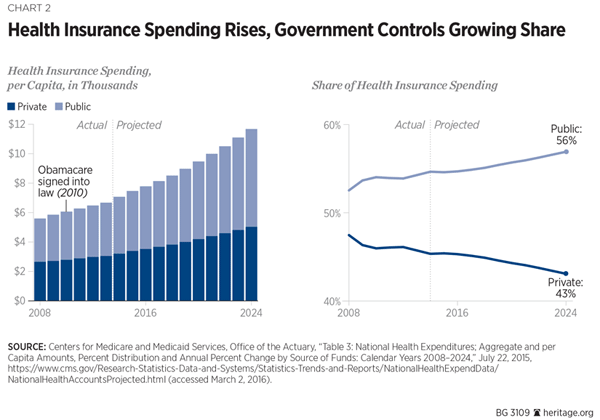
Health insurance costs rose dramatically under Obama
Health insurance costs rose dramatically under Obama (click for larger image)

The Washington Free Beacon reports.

Excerpt:

On his first day in office, President Trump signed an executive order that would relieve the economic burden that Obamacare has caused, fulfilling a promise he made on the campaign trail.

[…]Trump promised Americans that on day one of taking office, he would ask Congress to immediately deliver a full repeal of the Affordable Care Act.

“Since March of 2010, the American people have had to suffer under the incredible economic burden of the Affordable Care Act—Obamacare,” Trump said. “As it appears Obamacare is certain to collapse of its own weight, the damage done by the Democrats and President Obama, and abetted by the Supreme Court, will be difficult to repair unless the next president and a Republican congress lead the effort to bring much-needed free market reforms to the healthcare industry.”

“It is not enough to simply repeal this terrible legislation,” Trump said. “We will work with Congress to make sure we have a series of reforms ready for implementation that follow free market principles and that will restore economic freedom and certainty to everyone in this country.”

Since Trump’s economic policy draws on the experts at the conservative Heritage Foundation, we can expect that the alternative to Obamacare will be one based on a system that is proven to be successful. Switzerland has a health care system that has universal coverage, yet is fully privatized. It costs little, and delivers a lot of health care. Their system works, unlike socialist health care systems in the UK and Canada – which Obama was trying to emulate.

House Republicans say:

“Our goal is a truly patient-centered system, which means more options to choose from, lower costs, and greater control over your coverage,” said Speaker of the House Paul Ryan (R., Wis.). “And as we work to get there, we will make sure there is a stable transition period so that people don’t have the rug pulled out from under them.”

The nominee to lead the Department of Health and Human Services Rep. Tom Price (R., Ga.) echoed that sentiment, saying at his confirmation hearing that it is imperative that individuals have health coverage and have greater choices and opportunities to get the coverage they need.

“I think there’s been a lot of talk about individuals losing health care coverage—that is not our goal, nor is it our desire, nor is it our plan,” Price said.

The Daily Signal has more details on the relief provided to poor Americans in his executive order. It directs Trump’s subordinates to:

[…]exercise all authority and discretion available to them to waive, defer, grant exemptions from, or delay the implementation of any provision or requirement of the Act that would impose a fiscal burden on any State or a cost, fee, tax, penalty, or regulatory burden on individuals, families, healthcare providers, health insurers, patients, recipients of healthcare services, purchasers of health insurance, or makers of medical devices, products, or medications.

The Daily Signal also comments:

As to the substance, the new president’s clear directive is for his appointees to focus on minimizing the damaging effects of the law. That constitutes a sharp change in direction from the one taken by the Obama administration.

The implementation approach taken by the Obama administration was essentially to try to increase subsidized enrollment heedless of any resulting costs or disruptions to either the public or private sectors. This executive order signals that the Trump administration’s first order of business for Obamacare will instead be to minimize those costs and disruptions.

Some numbers from CNBC:

For many Obamacare customers this year, they’ll be paying more for less.

A new report on Obamacare plans details how plan premiums, deductibles and other out-of-pocket insurance costs have grown sharply even as the size of networks of health providers covered by those plans are shrinking in 2017.

The report from the Avalere consultancy also details how the number of insurers selling Obamacare plans have also shrunk, decreasing competition in the individual health plan market.

Last year, just 4 percent of all regions of the United States had only one participating insurer on Obamacare exchange, according to Avalere’s analysis. This year, 36 percent of all regions in the U.S. will have only one participating health insurer on an Obamacare exchanges.

Avalere’s report also found that in 2017, just 31 percent of all exchange-sold plans are “preferred provider organizations” or “point of service” plans, down from 52 percent of all plans in 2014, the first year of Obamacare coverage

PPOs generally have a wider networks of doctors and hospitals covered by the plan, and cover more out-of-network services than do other types of plans, including health maintenance organizations.

I have a friend who is a Democrat. For every month of the last 6 years, I have been presenting him with the numbers on Obamacare showing the negative impact on small businesses and poor Americans. He makes 6 figures as a software engineer, and knows literally nothing about economics. I have even told him stories about some of my friends who are poorer who struggled with the financial burdens caused by the law. His response was stunning: “what does this matter to you, you have health care through your employer”. That’s how Democrats think. As long as they are OK, who cares about the poor. The important thing for them is that government run everything and make all the decisions, because ordinary people cannot be trusted with freedom.

You can read more about the disaster of Obamacare here in a report by the Heritage Foundation.

Is health care a right or a commodity?

I have a key that will unlock a puzzling mystery

Here is a splendid post about the economics of health care from Ben Shapiro, writing for National Review.

He responds to a view held by those on the radical left: people need health care, therefore health care is a right.

Excerpt:

The idea here seems to be that unless you declare medical care a right rather than a commodity, you are soulless — that as Marx might put it, necessity, rather than autonomy, creates rights.

This is foolhardy, both morally and practically.

Morally, you have no right to demand medical care of me. I may recognize your necessity and offer charity; my friends and I may choose to band together and fund your medical care. But your necessity does not change the basic math: Medical care is a service and a good provided by a third party. No matter how much I need bread, I do not have a right to steal your wallet or hold up the local bakery to obtain it. Theft may end up being my least immoral choice under the circumstances, but that does not make it a moral choice, or suggest that I have not violated your rights in pursuing my own needs.

But the left believes that declaring necessities rights somehow overcomes the individual rights of others. If you are sick, you now have the right to demand that my wife, who is a doctor, care for you. Is there any limit to this right? Do you have the right to demand that the medical system provide life-saving care forever, to the tune of millions of dollars of other people’s taxpayer dollars or services? How, exactly, can there be such a right without the government’s rationing care, using compulsion to force individuals to provide it, and confiscating mass sums of wealth to pay for it?

The answer: There can’t be. Rights that derive from individual need inevitably violate individual autonomy.

But there are ways to make a commodity less expensive, and of higher quality. It happens all the times in free markets, where innovators are rewarded with profits – just think of the people who sell smartphones.

More:

To make a commodity cheaper and better, two elements are necessary: profit incentive and freedom of labor. The government destroys both of these elements in the health-care industry. It decides medical reimbursement rates for millions of Americans, particularly poor Americans; this, in turn, creates an incentive for doctors not to take government-sponsored health insurance. It regulates how doctors deal with patients, the sorts of training doctors must undergo, and the sorts of insurance they must maintain; all of this convinces fewer Americans to become doctors. Undersupply of doctors generally and of doctors who will accept insurance specifically, along with overdemand stimulated by government-driven health-insurance coverage, leads to mass shortages. The result is an overreliance on emergency care, costs for which are distributed among government, hospitals, and insurance payers.

So, what’s the solution for poor people? Not to declare medical care a “right,” and certainly not to dismiss reliance on the market as perverse cruelty. Markets are the solution in medical care, just as they are in virtually every other area.

Treating medical care as a commodity means temporary shortages, and it means that some people will not get everything we would wish them to have. But that’s also true of government-sponsored medical care, as the most honest advocates will admit. And whereas government-sponsored medical care requires a top-down approach that violates individual liberties, generates overdemand, and quashes supply, markets prize individual liberties, reduce demand (you generally demand less of what you must pay for), and heighten supply through profit incentive.

It’s always a good idea to look at how health care is working in countries that do have single payer health care systems. Canada has a single-payer system. How is that working out?

The Fraser Institute issued a recent report on health care in Canada:

Waiting for treatment has become a defining characteristic of Canadian health care. In order to document the lengthy queues for visits to specialists and for diagnostic and surgical procedures in the country, the Fraser Institute has—for over two decades—surveyed specialist physicians across 12 specialties and 10 provinces.

This edition of Waiting Your Turn indicates that, overall, waiting times for medically necessary treatment have in-creased since last year. Specialist physicians surveyed report a median waiting time of 20.0 weeks between referral from a general practitioner and receipt of treatment—longer than the wait of 18.3 weeks reported in 2015. This year’s wait time—the longest ever recorded in this survey’s history—is 115% longer than in 1993, when it was just 9.3 weeks.

[…]It is estimated that, across the 10 provinces, the total number of procedures for which people are waiting in 2016 is 973,505. This means that, assuming that each person waits for only one procedure, 2.7% of Canadians are waiting for treatment in 2016.

[…]Patients also experience significant waiting times for various diagnostic technologies across the provinces. This year, Canadians could expect to wait 3.7 weeks for a computed tomography (CT) scan, 11.1 weeks for a magnetic resonance imaging (MRI) scan, and 4.0 weeks for an ultrasound.

Research has repeatedly indicated that wait times for medically necessary treatment are not benign inconveniences. Wait times can, and do, have serious consequences such as increased pain, suffering, and mental anguish. In certain instances, they can also result in poorer medical outcomes—transforming potentially reversible illnesses or injuries into chronic, irreversible conditions, or even permanent disabilities. In many instances, patients may also have to forgo their wages while they wait for treatment, resulting in an economic cost to the individuals themselves and the economy in general.

The typical cost of the single-payer health care system to a Canadian family is nearly $12,000.

Socialist Canada has been doing a lot of taxing and spending to try to fix this problem, but the problem is getting worse. And no wonder: when the government controls health care, it becomes a tool for buying votes. Abortions and sex changes are “health care” in Canada. Breast enlargements and IVF are “health care” in the UK. Of course, good luck getting treatment when you are in your old age and will not be voting much in the future : both Canada and the UK have euthanasia programs to get rid of elderly people who are no longer as useful to politicians as young people who still have lots of voting ahead of them.

Obama’s Affordable Care Act: health care costs rise by the most in 32 years

Trust Obama with your health care plan

Should you entrust a “community organizer” to reform health care? What if he had no record of having successfully reformed health care in his resume – at any level of government? What if he refused to show you his academic transcripts? What if he had not a single private sector job related to health care in his resume? What if he had written an autobiography where he confessed to drug use that has very possibly damaged his brain so that all he can do is play golf and read a teleprompter?

Should you hire someone like that to reform health care? What if he only gives you one reason to hire him: his skin color? Should you hire someone to reform health care based solely on his skin color?

CNN Money explains what Obamacare has done to health care costs:

Health care costs rose sharply in August.
Prices for medicine, doctor appointments and health insurance rose the most last month since 1984. The price increases come amid a broader debate about climbing health care costs and high premiums for Obamacare coverage.

A recent report by Kaiser/HRET Employer Health Benefits forecasts that the average family health care plan will cost $18,142, up 3.4% from 2015. That’s faster than wage growth in America.

Medical care costs altogether rose 1% just in August from July, according to the Consumer Price Index, a report on price inflation from the U.S. Labor Department.

Premiums on the Obamacare exchanges are expected to rise by double-digits this year.

Some health insurers, such as Aetna, have recently announced they would pull out of the Obamacare exchanges, saying Obamacare patients have turned out to be sicker and costlier than expected.

Overall, workers are paying up more for deductibles. Over half of U.S. workers with single coverage health insurance plans pay a deductible of $1,000 or more, up from 31% of workers in 2011.

And the health care price increases come as inflation overall continues to be low. Consumer prices altogether rose 1.1% in August compared to a year ago.

Consider this article from Investors Business Daily to illustrate the importance of not picking a President based on confident words and personal charisma.

It says:

Employer-based health insurance premiums climbed 4.2% this year for family plans, according to an annual Kaiser Family Foundation report. That’s up from 3% the year before.

Since 2008, average family premiums have climbed a total of $4,865.

The White House cheered the news, saying it was a sign of continued slow growth in premium costs.

[…]”We will start,” Obama said back in 2008, “by reducing premiums by as much as $2,500 per family.”

That $2,500 figure was Obama’s mantra on health care. You can watch the video if you don’t believe it.

And Obama wasn’t talking about government subsidized insurance or expanding Medicaid or anything like that. He specifically focused on employer provided health care.

For “people who already have insurance, and the employers who are providing it,” he said at one campaign event, “we will work to lower your premiums by up to $2,500 per family.”

Let’s watch the video. I want everyone to see how confident a clown can sound when he lies about being able to solve problems that he knows nothing about.

He had no record of achievement in this area. None, Zero, Zip. And the same goes for his claims about keeping your doctor, keeping your health care plan, and so on. It was all lies – just things that people wanted to believe, that Obama did not have the ability to make happen. He had never, ever done anything with health care ever before. You would literally have had a better result if you had handed the job of health care reform to a turnip.

Honestly, someone’s skin color, sex, national origin or sexual orientation is not a reason to hire them to do an important job. Obama isn’t qualified to flip burgers in a McDonald’s. Why would anyone entrust someone with no transcripts and no resume to undertake such a momentous task? This is hurting real people – real people are having to pay the costs of electing an affirmative action President. We really need to not do things like that.

Next time, if we are going to hire someone to reform health care, let’s hire someone like black economist Thomas Sowell. At least he has experience in economics enough to know what happens next to all parties involved in a policy implementation. Obama, on the other hand, has doubled the national debt from $10 trillion to $20 trillion – an enormous burden on the next generation of American workers. What did we get for all this spending? Absolute and complete failure across the board.