

Tag Archives: Happiness

J. Warner Wallace: I am not a Christian because it works for me

12231469_1518516371799768_1908477683_n

Here’s a must-read post from Cold-Case Christianity author J. Warner Wallace.

Excerpt:

Life on this side of my decision hasn’t always been easy. It’s been nearly seventeen years since I first trusted Jesus as Lord and Savior. I still struggle to submit my prideful will to what God would call me to do. Christianity is not easy. It doesn’t always “work” for me. There are times when I think it would be easier to do it the old way; easier to cut a corner or take a short cut. There are many times when doing the right thing means doing the most difficult thing possible. There are also times when it seems like non-Christians have it easier, or seem to be “winning”. It’s in times like these that I have to remind myself that I’m not a Christian because it serves my own selfish purposes. I’m not a Christian because it “works” for me. I had a life prior to Christianity that seemed to be working just fine, and my life as a Christian hasn’t always been easy.

I’m a Christian because it is true. I’m a Christian because I want to live in a way that reflects the truth. I’m a Christian because my high regard for the truth leaves me no alternative.

I think this is important. There are people who I know who claim to be Christian, but they are clearly believing that God is a mystical force who arranges everything in their lives in order to make them happy. They are not Christians because it’s true, but because of things like comfort and community. But people ought to become Christians because they think it’s true. Truth doesn’t necessarily make you happy, though. Truth can impose intellectual obligations and moral obligations on you. Seeing God as he really is doesn’t help us to “win” at life, as the culture defines winning.

Winning in Christianity doesn’t mean making lots of money, or being famous, or winning human competitions, or being approved of by lots of people. Winning for a Christian might involve things like building relationships with people and leading them to know that God exists and who Jesus is. That has no cash value, and it’s not going to make you famous. Actually, it will probably cost you money and time, and make you unpopular with a lot of people.

The Bible doesn’t promise that people who become Christians will be happier. Actually, it promises that Christians will suffer for doing the right things. Their autonomy will suffer, as they sacrifice their own interests and happiness in order to make God happy, by serving his interests. Christianity isn’t something you add on to your before-God life in order to achieve your before-God goals. When you become a Christian, you get a new set of goals, based on God’s character and his design for you. And although you might be very successful in the world as part of serving God, there is no guarantee of that. Christianity is not life enhancement.

New study: parents of four or more kids are happiest

Marriage and family
Marriage and family

When I was planning out my life, I did some research on how many kids I wanted to have. I love to plan and budget things out way in advance, because even if things don’t go as planned, the planning phase helps you to improvise. According to my research, four was the right number. Of course, you can never be sure how many you’ll get, but it doesn’t hurt to make a budget for the number of kids you want and a plan to make them.

Anyway, here’s a new study that says that four or more makes parents the most happy. Now, happiness may not be the goal of a relationship, but it definitely helps the spouses to apply themselves to the real goal of serving God. You can’t get miserable people to achieve anything for God, and you have to be serious about what people need to engage.

Anyway, The Daily Signal reports:

The happiest parents are—drumroll, please—parents with four or more kids.

Parents of large families were found to have the most life satisfaction, according to a study by Australia’s Edith Cowan University. Dr. Bronwyn Harman, of the psychology and social science school at the university, spent five years studying what types of families are most content.

“[The parents] usually say they always wanted a large family, it was planned that way, and it was a lifestyle they’d chosen,” Harman told The Sydney Morning Herald.

During her five-year study, Harman interviewed hundreds of parents from different family makeups. Her findings are based on resilience, social support, self-esteem, and life satisfaction.

Her research points out that parental happiness relates to how much effort has been put into growing the family.

“What is important for kids are things like consistency, boundaries and [to] know that they are loved, no matter what,” Harman tells ABC Australia.

Prior to the study, Harman thought parents with more children would be less happy.

Though larger families may have more chaos and expenses than a smaller family, Harman’s research shows that these issues are balanced by the amount of joy received from having more children.

Her findings show that children who grow up in large families learn independence at a young age and always have someone to play with.

I often get a lot of flak from single women who want to delay marriage, and/or not have so many children. Although many of the “rules” I have about where relationships should be headed seem arbitrary, there is actually data to back it up. I’m not trying to rush into marriage and four children for no reason, but because this is what makes people happiest in the long run. It makes for a better environment for achieving other things for God. I never do anything or ask others for anything without some evidence to back it up.

I think people tend to worry a lot about having kids, and that’s because having kids is expensive. But that can easily be planned out if you earn and save to prepare. My plan was to raise the kids in the country and have a capable homeschooling mom teach them and build their resumes up. Having lots of kids is not a problem if you take care of the money requirement, and don’t let them be spoiled all the time. Sometimes, they will just have to be patient and do things on their own and not be the center of attention. That’s probably good for them in any case.

New study: conservatives are more likely to be happily married than progressives

If you want a very happy marriage, don't be a progressive
If you want a very happy marriage, don’t be a progressive

New study from social science researchers W. Bradford Wilcox and Nicholas Wolfinger.

It’s written up in The Federalist.

Excerpt:

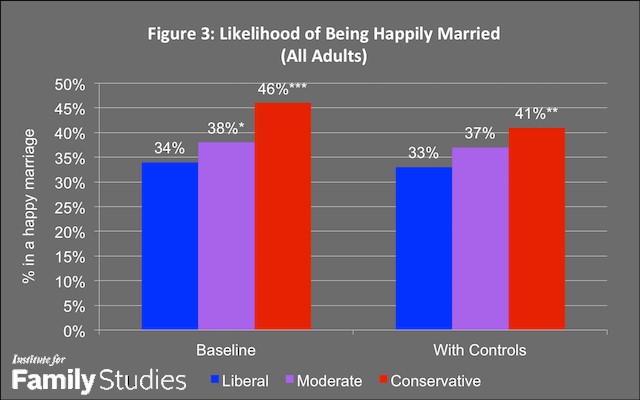
In the General Social Survey (GSS), one of the best barometers of American society, ideology is measured by asking respondents to rate their political attitudes on a liberal-conservative continuum (1 = extremely liberal, 7 = extremely conservative). We coded those men and women answering 1 to 3 as “liberal,” those answering with a 4 as “moderate,” and those answering 5 to 7 as “conservative.”

Figure 1 indicates that conservatives are significantly more likely to be married than are moderates and liberals. In fact, they are about 15 percentage points more likely to be married than their liberal fellow citizens. Moreover, this relationship remains strong after controlling for race or ethnicity, age, sex, and… income and education.

[…]Figure 3 examines the effects of political ideology on the chances of being in a very happy marriage among all Americans, not just those who are currently married, as Figure 2 depicted. Figure 3 shows that in the baseline model, conservatives are 12 percentage points more likely to be in happy marriages than are liberals. This gap persists, albeit to a diminished extent, after controlling for race or ethnicity, age, sex, income, and education. After adjusting for these differences between General Social Survey respondents, conservatives are about eight percentage points more likely than liberals to be in a happy marriage.

So basically, if you are a leftist, then you are much less likely to be happily married. And if you are a conservative, then you are much more likely to be happily married.

Why?

The answer lies in the design of marriage. Marriage is not about two people moving in together so that they can feel good about doing whatever they want to do. Marriage is a design that works best with a man and a women who are equipped at the worldview level with the capacity for resilient, self-sacrifice love.

Progressives are not equipped for the kind of self-denial, self-control, and self-sacrifice that marriage requires. They don’t believe in God, generally, so they don’t believe in objective morality. And if you don’t believe in objective morality, then there is no foundation there for self-sacrificial love, and honoring moral obligations when it goes against your self-interest. Atheism as a worldview doesn’t have the foundation for the kinds of behaviors that marriage entails. And that’s why you see Peter Atkins, Richard Dawkins, Richard Carrier, Michael Shermer, etc. divorcing their wives. The atheist worldview and the atheist community do not enable the sort of character that is suited for the design of marriage.

In contrast, conservatives typically do have a rationally-grounded morality. They tend to believe in God, and so the rightness of following the moral law when it goes against their self-interest makes sense to them. They think that there is a design to marriage, and design for the flourishing of children. They are more likely to be able to compromise and solve problems in order to keep a commitment going. There is an “ought to do” there in the conservative worldview that is objective – it exists independent of their feelings. The obligations to override selfishness is there regardless of how unfair life seems – it is resilient to challenges.

One of the ways you can tell how serious someone is about their religion, and therefore their morality, is by looking at the person’s church attendance. Church attendance is typically not as fun as other things you can do in life. So people who go are indicating that they put their relationship with God and their dedication to following the moral law above their own self-interest. So does that tendency help religious people to stay married?

Yes it does:

Brad Wilcox, director of the National Marriage Project at the University of Virginia, agrees there’s been some confusion.

“You do hear, both in Christian and non-Christian circles, that Christians are no different from anyone else when it comes to divorce and that is not true if you are focusing on Christians who are regular church attendees,” he said.

Wilcox’s analysis of the National Survey of Families and Households has found that Americans who attend religious services several times a month were about 35% less likely to divorce than those with no religious affiliation.

Nominal conservative Protestants, on the other hand, were 20% more likely to divorce than the religiously unaffiliated.

“There’s something about being a nominal ‘Christian’ that is linked to a lot of negative outcomes when it comes to family life,” Wilcox said.

So the bottom line is that marriage is a moral enterprise. It works better when each spouse has a worldview and a community that recognizes objective, prescriptive morality. And objective, prescriptive morality has no rational foundation in a non-theistic worldview. Progressives tend to be non-theists, so of course they are going to struggle with any enterprise that requires them to set aside their natural self-centeredness in order to honor moral obligations to another person.