Tag Archives: Gratitude

Study finds that attitude of gratitude has many health benefits

From the Harvard Mental Health Newsletter.

Excerpt:

Two psychologists, Dr. Robert A. Emmons of the University of California, Davis, and Dr. Michael E. McCullough of the University of Miami, have done much of the research on gratitude. In one study, they asked all participants to write a few sentences each week, focusing on particular topics.

One group wrote about things they were grateful for that had occurred during the week. A second group wrote about daily irritations or things that had displeased them, and the third wrote about events that had affected them (with no emphasis on them being positive or negative). After 10 weeks, those who wrote about gratitude were more optimistic and felt better about their lives. Surprisingly, they also exercised more and had fewer visits to physicians than those who focused on sources of aggravation.

Another leading researcher in this field, Dr. Martin E. P. Seligman, a psychologist at the University of Pennsylvania, tested the impact of various positive psychology interventions on 411 people, each compared with a control assignment of writing about early memories. When their week’s assignment was to write and personally deliver a letter of gratitude to someone who had never been properly thanked for his or her kindness, participants immediately exhibited a huge increase in happiness scores. This impact was greater than that from any other intervention, with benefits lasting for a month.

Of course, studies such as this one cannot prove cause and effect. But most of the studies published on this topic support an association between gratitude and an individual’s well-being.

Other studies have looked at how gratitude can improve relationships. For example, a study of couples found that individuals who took time to express gratitude for their partner not only felt more positive toward the other person but also felt more comfortable expressing concerns about their relationship.

Managers who remember to say “thank you” to people who work for them may find that those employees feel motivated to work harder. Researchers at the Wharton School at the University of Pennsylvania randomly divided university fund-raisers into two groups. One group made phone calls to solicit alumni donations in the same way they always had. The second group — assigned to work on a different day — received a pep talk from the director of annual giving, who told the fund-raisers she was grateful for their efforts. During the following week, the university employees who heard her message of gratitude made 50% more fund-raising calls than those who did not.

My editor Mary writes: There is a health bonus to thankfulness but health isn’t why we should be thankful. We should be thankful because we are the recipients of many good things and it is appropriate under such circumstances to express gratitude. It is also the overflow of a heart made happy by the generosity of another.

To help us be thankful, here is a famous Thanksgiving day proclamation.

Here it is:

PRESIDENTIAL THANKSGIVING PROCLAMATIONS

1789-1815 : George Washington, John Adams, James Madison

THANKSGIVING DAY 1789

BY THE PRESIDENT OF THE UNITED STATES OF AMERICA – A PROCLAMATION

Whereas it is the duty of all Nations to acknowledge the providence of almighty God, to obey his will, to be grateful for his benefits, and humbly to implore his protection and favor – and Whereas both Houses of Congress have by their joint Committee requested me “to recommend to the People of the United States a day of public thanksgiving and prayer to be observed by acknowledging with grateful hearts the many signal favors of Almighty God, especially by affording them an opportunity peaceably to establish a form of government for their safety and happiness.”

Now therefore I do recommend and assign Thursday the 26th day of November next to be devoted by the People of these States to the service of that great and glorious Being, who is the beneficent Author of all the good that was, that is, or that will be – That we may then all unite in rendering unto him our sincere and humble thanks – for his kind care and protection of the People of this country previous to their becoming a Nation – for the signal and manifold mercies, and the favorable interpositions of his providence, which we experienced in the course and conclusion of the late war –for the great degree of tranquillity, union, and plenty, which we have since enjoyed – for the peaceable and rational manner in which we have been enabled to establish constitutions of government for our safety and happiness, and particularly the national One now lately instituted, for the civil and religious liberty with which we are blessed, and the means we have of acquiring and diffusing useful knowledge; and in general for all the great and various favors which he hath been pleased to confer upon us.

And also that we may then unite in most humbly offering our prayers and supplications to the great Lord and Ruler of Nations and beseech him to pardon our national and other transgressions – to enable us all, whether in public or private stations, to perform our several and relative duties properly and punctually – to render our national government a blessing to all the People, by constantly being a government of wise, just, and constitutional laws, discreetly and faithfully executed and obeyed – to protect and guide all Sovereigns and Nations (especially such as have shewn kindness unto us) and to bless them with good government, peace, and concord – To promote the knowledge and practice of true religion and virtue, and the increase of science among them and Us – and generally to grant unto all mankind such a degree of temporal prosperity as he alone knows to be best.

Given under my hand at the City of New York the third day of October in the year of our Lord 1789.

(signed) G. Washington

That’s from George Washington.

Happy Thanksgiving Day!

What is the meaning of Memorial Day?

Arlington National Cemetary

What is Memorial Day? It’s the day that we remember all those brave men and women who have sacrificed to protect our liberties and our lives so that we could be safe from harm.

This video may help you to understand.

From Hot Air, a quote from Ronald Reagan.

Memorial Day is an occasion of special importance to all Americans, because it is a day sacred to the memory of all those Americans who made the supreme sacrifice for the liberties we enjoy. We will never forget or fail to honor these heroes to whom we owe so much. We honor them best when we resolve to cherish and defend the liberties for which they gave their lives. Let us resolve to do all in our power to assure the survival and the success of liberty so that our children and their children for generations to come can live in an America in which freedom’s light continues to shine.

The Congress, in establishing Memorial Day, called for it to be a day of tribute to America’s fallen, and also a day of national prayer for lasting peace. This Nation has always sought true peace. We seek it still. Our goal is peace in which the highest aspirations of our people, and people everywhere, are secure: peace with freedom, with justice, and with opportunity for human development. This is the permanent peace for which we pray, not only for ourselves but for all generations.

The defense of peace, like the defense of liberty, requires more than lip service. It requires vigilance, military strength, and the willingness to take risks and to make sacrifices. The surest guarantor of both peace and liberty is our unflinching resolve to defend that which has been purchased for us by our fallen heroes.

On Memorial Day, let us pray for peace — not only for ourselves, but for all those who seek freedom and justice.

And check some of my Medal of Honor posts:

If you want to help out our troops, you can send them things through Soldier’s Angels.

God Bless Our Troops!

UPDATE: I am listening to this podcast from the Heritage Foundation about the origin and meaning of Memorial Day.

For more reading, why not check out some of the military bloggers?

If you want to help out our troops, you can send them things through Soldier’s Angels.

What can Christians learn from Rob Miller’s Medal of Honor story?

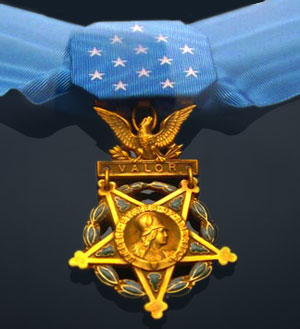
A Congressional Medal of Honor
A Congressional Medal of Honor (Air Force version)

Here’s a story from the Chicago Tribune to explain how a person can win the Congressional Medal of Honor. (H/T Blackfive)

Excerpt:

The damage assessment patrol walked north about 800 meters to a bridge impassable by vehicle. Led by Miller, the team turned east, crossed the estimated 100-foot bridge and turned south into a narrow, steep valley. They had trekked for about 45 minutes.

“That’s when we walked into the hornet’s nest,” McGarry said.

About 40 insurgents had dug under rock formations in the narrow pass east of the Kunar River. Nearly 200 more were higher on a ridge, Lodyga said.

Miller’s teammates recalled that an Afghan National Army soldier spotted an insurgent obstructed by a boulder and ordered him to surrender. The man refused.

“You heard somebody yell ‘Allah Akbar,'” the Muslim phrase loosely translated as “God is great,” Lodyga said, “and then an overwhelming amount of firepower came down on us.”

Miller’s first move was to shoot and kill the insurgent who had stepped from the boulder about 20 feet away, said McGarry. Other insurgents were nearly as close, Lodyga said. He, McGarry and Cusick said it was the worst firefight they’d experienced.

“It was almost like standing in the middle of all the fireworks on the Fourth of July,” Cusick recalled. “It was very loud.”

Added McGarry, “There were so many people shooting at us, the bullets were kicking up everything around us. I kept looking over and saw Rob shooting.”

Then McGarry and the others saw something else: Miller charged the enemy, firing his lightweight machine gun at several insurgent positions. At the same time, he was calling out the directions of and distances to enemy positions.

“Robbie was shouting at everybody to bound back, bound back,” McGarry recalled, “and he was taking on the entire south area of the kill zone by himself. I couldn’t look over for too long, but it took me a second or two to take it all in.”

Miller’s approach, while bold, was tactically astute. He was engaging at least four enemy positions and drawing their fire, allowing his teammates to get to safer ground. His aim was deadly accurate. Military records credit him with killing more than 16 insurgents and wounding 30.

In the first few moments, Cusick, the commander, was severely wounded when a bullet struck near his left collarbone and tore an exit hole in his left shoulder blade. His lung was punctured. One of the team members ran to his side and thrust a needle in his chest, allowing him to breathe.

While firing at the enemy, the rest of the team also was seeking cover, McGarry said.

Miller kept charging and firing, and when he had stopped firing, he threw at least two grenades “into enemy machine gun fire that basically had the patrol locked down,” Lodyga said. “He took them out.”

[…]So much chaos was roiling that patch of the narrow pass where the Special Forces were ambushed that it’s unclear how long Miller charged and engaged the insurgents. Those on the patrol said it could have been five to 15 minutes before he was shot inches below his right armpit, a spot unprotected by body armor.

“I don’t know if he stayed on his feet or not after he was shot,” Lodyga said, “but I do know he turned toward the enemy position and kept firing. He killed two or three right there.”

Two to five minutes later, Miller was struck again under his left armpit and died immediately. The entry points of the wounds indicate his arms were raised to fire his weapon, a young man facing death courageously.

“At the end of the day,” Lodyga said, “if Robbie hadn’t been courageous and did what came as second nature to him, you’d be looking at eight dead Special Forces. That’s what Robbie gave his life for.”

The military goes even further, contending that Miller’s actions also saved the lives of an estimated 12 Afghan National Army soldiers.

Although tens of millions of men and women have worn the uniform of the armed forces for the U.S., fewer than 3,500 have earned a Medal of Honor.

Actually, it’s much rarer than that – the military has really tightened up the requirements in the last 100 years or so. Basically, you have to give your life to save many others under heavy fire in order to win a medal of honor. They are extremely rare.

Here are the requirements for the Army version:

The Medal of Honor is awarded by the President in the name of Congress to a person who, while a member of the Army, distinguishes himself or herself conspicuously by gallantry and intrepidity at the risk of his or her life above and beyond the call of duty while engaged in an action against an enemy of the United States; while engaged in military operations involving conflict with an opposing foreign force; or while serving with friendly foreign forces engaged in an armed conflict against an opposing armed force in which the United States is not a belligerent party. The deed performed must have been one of personal bravery or self-sacrifice so conspicuous as to clearly distinguish the individual above his comrades and must have involved risk of life. Incontestable proof of the performance of the service will be exacted and each recommendation for the award of this decoration will be considered on the standard of extraordinary merit.

I once read an entire book on Medal of Honor award winners in World War II. It’s hard to read those stories, because these people who won the award did amazing acts of bravery, courage and self-sacrifice, but then most of them DIED. The stories almost always end in sadness and grief. Here’s the one that really stuck with me as an example. I read that book in 1999 as part of my effort to develop humility. I wanted to break down my own pride, and so I intentionally engaged in an activity to achieve that goal.

Today, many people think it is horrible to look up to anyone who is better than we are at anything. We don’t believe in heroes any more. We think that virtues are easy. That anyone can be virtuous. That virtue takes no preparation or discipline. That brave or cowardly acts are just things that people do because they like one or the other, and that’s all. That everyone, good or evil, is basically doing what they want to do. But I don’t think that’s true. I think bravery, courage and self-sacrifice are objectively good, and that we ought to recognize and honor those virtues.

I think we need to get into the habit of realizing that the character of a person as measured against an objective standard is more important than what they can do to make ME happy. Sometimes, we just need to hold up examples of goodness to ourselves and to others, even if it makes us feel inadequate. Acknowledging what is good is the first step to being good yourself. If you don’t acknowledge that anyone is better than you are, then how will you grow? You have to look at what the best people are doing and honor them and learn from them.

I think that as Christians, the more we reflect on the message of the gospel and the example of Jesus, the more sensitive and appreciative we become of things he exemplified, like self-sacrifice and humility. Jesus deserves something like a Medal of Honor, for sacrificing his life to save others in difficult circumstances. He showed courage in the face of danger in order to die in the place of every single person who has ever lived. When we stand before him to give our account, will we have love our neighbor the same way? Will he pin something like a Medal of Honor on our chest for uncommon valor under heavy fire? Stories like Rob Miller’s makes us think about that, don’t they? And that is a good thing. The story of a war hero points beyond the story to the moral truths that are built into the universe by God himself.

So that’s why I think it’s important for Christians to be grateful to those who give their lives fighting evil in foreign lands so that we can have liberty, prosperity and security here at home. I am grateful for the sacrifice of Rob Miller. Gratitude is another virtue that we often overlook.

You can read more about Rob Miller and see pictures of him here on Blackfive.