Tag Archives: Germany

Germany is further along the green energy road, how is it working for them?

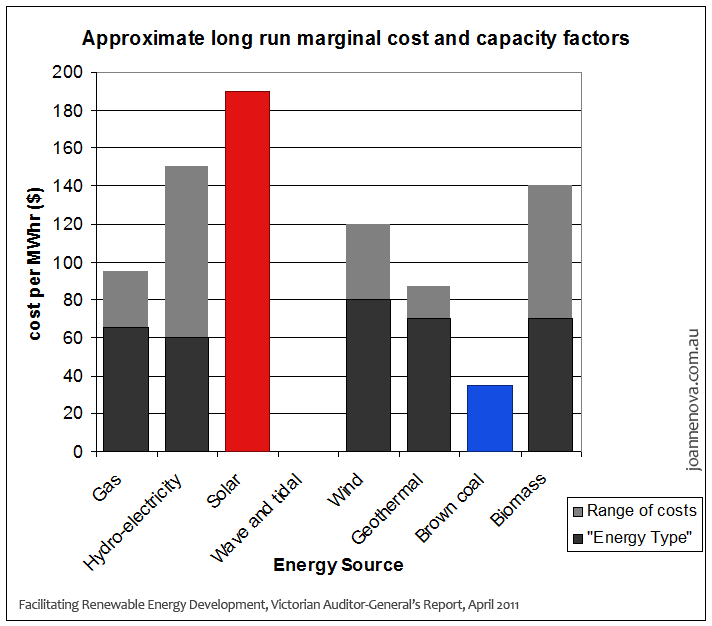
Cost of renewable wind and solar energy

This is from National Review, and I think it’s important for the young people to know, because they are the ones who think that green energy is a moral imperative that has no downside.

Look:

According to EU data, Germany’s average residential electricity rate is 29.8 cents per kilowatt hour. This is approximately double the 14.2 cents and 15.9 cents per kWh paid by residents of Germany’s neighbors Poland and France, respectively, and almost two and a half times the U.S. average of 12 cents per kWh. Germany’s industrial electricity rate of 16 cents per kWh is also much higher than France’s 9.6 cents or Poland’s 8.3 cents. The average German per capita electricity consumption is 0.8 kilowatts. At a composite rate of 24 cents per kWh, this works out to a yearly bill of $1,700 per person, experienced either directly in utility bills or indirectly through increased costs of goods and services. The median householdincome in Germany is $33,000, so if we assume an average of two people per household, the electricity cost would amount to more than 10 percent of available income. And that is for the median-income household. The amount of electricity that people need does not scale in proportion to their paychecks. For the rich, $1,700 per year in electric bills might be a pittance, or at most a nuisance. But for the poor who are just scraping by, such a burden is simply brutal.

The trouble with solar and wind power is that they are not consistent:

So, what has the German government accomplished for “the Earth” in exchange for the severe harm it has inflicted on the nation’s poorer citizens? It is claimed that Germany has replaced 30 percent of its electricity with renewable energy. If all you look at is capacity, that might appear to be true. Germany has a total installed capacity of 172 gigawatts (GW), and 65 GW of that is based on renewables. But neither wind nor solar power obtains an around-the-clock average of anything close to full capacity. Rather, these methods of electricity generation typically average at best about 20 percent of their full rated power. Thus Germany’s nominal 65 GW of solar and wind generation capacity is worth about as much as 13 GW capacity in conventional power plants. Of the 614,000 GW hours that Germany generated in 2014, 56,000 GWh came from wind and 35,000 GWh from solar, for an actual combined average power of 10.4 GW, or 14.8 percent of all electricity generated. About half of this, or 5.2 GW, has been developed since 2005.

Germany used to have safe, clean nuclear power with zero emissions, but they got rid of it:

However, in 2011 Germany had 20 GW of capacity in nuclear power plants, producing more than twice as much electricity as wind and solar do currently, at less than half the cost, with no carbon emissions whatsoever. But, using the rather improbable threat of a Fukushima-like tsunami as a pretext, the nation’s elites decided to shut them down; 8.3 GW have already been eliminated.

Thus, over the past decade, the total amount of carbon-free power that Germany has produced under its oppressive green-energy policy has actually decreased by 3 GW.

This makes me think of what happened to the wind farms in the UK during cold weather – they had to keep spinning using power from the main grid, to keep themselves from freezing! What a disaster. Green energy is just not ready for prime time. The more the government pushes it, the more the cost of electricity rises. Not good for the poor. Does anyone care how these “feel good” policies of the rich left affect the poorest people?

Friday night movie: One of Our Aircraft is Missing (1942)

Here’s tonight’s movie:

IMDB rating: [7.2/10]

Description:

During the Allied Bombing offensive of World War II the public was often informed that “A raid took place last night over …, One (or often more) of Our Aircraft Is Missing”. Behind these sombre words hid tales of death, destruction and derring-do. This is the story of one such bomber crew who were shot down and the brave Dutch patriots who helped them home.

The bomber in the movie that they start with is called a  Vickers Wellington. It’s not very good, but the four-engine Avro Lancaster they get at the end of the movie is as good or better than the B-17 bomber used by the Americans during the war. Most people think that the Avro Lancaster was the best bomber of World War 2 on either side. My Canadian readers will be thrilled to know that Avro Canada constructed many Avro Lancasters to help with the war effort. You can still see an intact Lancaster in Alberta,  Canada.

Happy Friday!

Friday night movie: Sink the Bismarck! (1960)

Here’s tonight’s movie:

IMDB mean rating: [7.2/10]

Description:

In 1939, the Nazi Germany’s largest and most powerful battleship, Bismarck, is launched in a ceremony at Hamburg with Adolf Hitler attending. The launching of the hull is seen as the beginning of an era of German sea power. Two years later, in 1941,British convoys are being ravaged by U-boats and surface raider attacks which cut off supplies which Britain needs to continue the war. In May, British intelligence discovers the Bismarck and the heavy cruiser Prinz Eugen are about to break into theNorth Atlantic to attack convoys.

The man assigned to coordinate the hunt is the Admiralty’s chief of operations, Captain Jonathan Shepard (Kenneth More), who has been distraught over the death of his wife in an air raid and the sinking of his ship by German ships commanded by Admiral Günther Lütjens (Karel Štěpánek). Upon receiving his new post, Shepard discovers Lütjens is the fleet commander on the Bismarck. Shepard’s experience of conflict with the German Navy and his understanding of Lütjens allow him to predict theBismarck‘s movements. Shepard is aggressive to his staff but comes increasingly to rely on the coolness and skill of his assistant, WREN Second Officer Anne Davis (Dana Wynter).

Below are the combatants.

The German battleship Bismarck:

The Bismarck (click for larger image)

The aircraft carrier HMS Ark Royal:

HMS Ark Royal (click for larger image)

I think this battle signaled the end of battleships as the best naval unit.

So why did battleships become extinct? Well, you can get a lot more range and striking power out of several squadrons of bombers and torpedo bombers than you can out of 16 or even 18 inch guns. In fact, you’ll see the torpedo bombers of the HMS Ark Royal face off against the Bismarck in the movie. Today, naval warfare is conducted with surface-to-surface missiles like the Tomahawk and the SS-N-27 Sizzler, etc. as well as air-to-surface missiles fired from land and carrier based strike aircraft. The range of these missiles is far greater than the range of the deck guns on any battleship. However, there is work being done on rail guns which may force a return to conventional deck guns, especially for operations like shore bombardments where you want to use cheaper munitions!

Happy Friday!