Tag Archives: George Bush

Did Obama’s foreign policy make America more respected abroad?

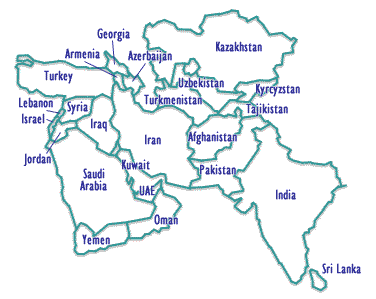
Map of the Middle East

From Investors Business Daily.

Excerpt:

In the Middle East, where U.S. military involvement and diplomacy are most closely watched, President Obama is held in lower regard in the Arab world than President Bush was in the last year of his presidency.

Obama is not only less liked than the supposedly hated Bush, he can’t even hold a candle to Iran’s grubby, menacing Mahmoud Ahmadinejad. Zogby reports that in Egypt, 31% of Egyptians agree with Iran’s policies compared with 3% for Obama’s, with similar figures in Jordan. Among Egyptians, just 5% hold a favorable attitude toward the U.S. compared with 9% in 2008.

[…]Clinton will do no better in bilateral talks with the Turks — a nation that has moved so far away from its long alliance with the U.S. it can only be called a former ally — on Syria, Iran and Israel/Palestine.

In these countries, Obama’s policy can be summed up in a litany of ineffectual maneuvers.

On Syria, the first move was to succor, then to scold as the dictatorship indifferently sheds streams of blood in the streets of Damascus — showing the fundamental disconnect between what the brutal Syrian regime is and what the Obama administration thinks it is.

After throwing Tunisia and Egypt, two pro-Western allies, overboard, the administration ineffectually grasps a problem in Syria as the bodies pile up.

On Iran, Obama policy shows even more weakness. The president wasted two years coddling the monster regime that threatens a region of more than a billion people. He missed a chance to support a student uprising in 2009 and now watches as Iran’s illegal nuclear program speeds ahead with little fear of consequences, more brazen and closer to realization.

Whatever this learning-curve policy amounts to, it garners no international respect.

Then there’s the stance the White House has taken on Israel, abusively telling its ally to retreat to 1967 borders. It emboldened provocations from Palestinian terrorist groups and showed the rest of the Arab world that it pays more to be America’s enemy than its friend. Now the Arab League is moving to recognize Palestine.

It turns out that what foreign powers respect is strength, not weakness.
How President George W. Bush helped to create South Sudan

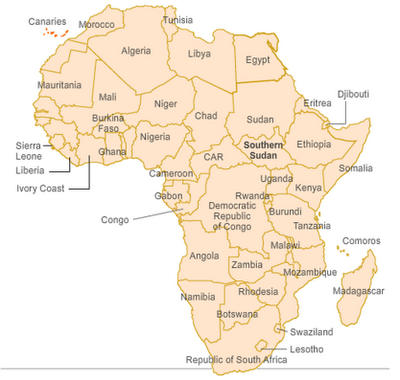
New Map of Africa including South Sudan

From Investors Business Daily. (H/T Muddling Towards Maturity)

Excerpt:

As South Sudan joyfully celebrated its independence from Sudan, President Obama hailed it as the fruit of partnership, togetherness, hope and unity. South Sudanese, however, hailed President Bush.

Proudly wearing the black cowboy hat given to him by President Bush, South Sudan’s new president, Salva Kiir Mayardit, couldn’t have made a stronger statement about who made his country’s independence possible after 50 years of warfare.

“It was George Bush and the Christian fundamentalists who heard the cry of South Sudan,” affirmed a South Sudanese man quoted by the Los Angeles Times.

[…]In 2005, President Bush put South Sudan at the top of the U.S. foreign policy agenda. Knocking heads, he forced the murderous Islamofascist government of Sudan to negotiate with the South Sudan rebels, including their right to secede. That hard work led to today’s result — and with it, the first chance South Sudan has ever had to break free of its oppression.

No President since Reagan cared more about the freedom of people in other countries than George W. Bush. And a lot of that is owing to his evangelical Christian convictions – he cared about the freedom of other people.

Are the Bush tax cuts to blame for Obama’s 1.6 trillion dollar deficits?

Obama Budget Deficit 2011

From the Wall Street Journal, the raw numbers on the Bush tax cuts and the deficit. (H/T Paul Ryan)

Excerpt:

But what about the liberal claim, repeated constantly, that the Bush tax cuts of 2001 and 2003 caused today’s deficits? CBO has shown this to be demonstrably false. On May 12, the budget arm of Congress examined the changes in its baseline projections from 2001 through 2011. In 2001, it had predicted a surplus in 2011 of $889 billion. Instead, it expects a deficit of $1.4 trillion.

What explains that $2.29 trillion budget reversal? Well, the direct revenue loss from the combination of the 2001 and 2003 Bush tax cuts contributed roughly $216 billion, or only about 9.5% of the $2.29 trillion. And keep in mind that even this low figure is based on a static revenue model that assumes almost no gains from faster economic growth.

After the Bush investment tax cuts of 2003, tax revenues were $786 billion higher in 2007 ($2.568 trillion) than they were in 2003 ($1.782 trillion), the biggest four-year increase in U.S. history. So as flawed as it is, the current tax code with a top personal income tax rate of 35% is clearly capable of generating big revenue gains.

CBO’s data show that by far the biggest change in its deficit forecast is the spending bonanza, with outlays in 2011 that are $1.135 trillion higher than the budget office estimated a decade ago. One-third of that is higher interest payments on the national debt, notwithstanding record low interest rates. But $523 billion is due to domestic spending increases, including defense, education, Medicaid and the Obama stimulus. Mr. Bush’s Medicare drug plan accounts for $53 billion of this unanticipated spending in 2011.

The last GOP budget was in 2007, and the deficit was $160 billion, ONE TENTH of Obama’s budget deficit. And that was WITH the tax cuts. The cause of the current trillion dollar deficits is Barack Obama’s spending.

Remember what the unemployment rate was under Bush:

Comparison of unemployment rates - Bush vs Obama

I think that looking at the budget deficit numbers and the unemployment numbers is a good way to judge how capable a President is. It gets away from the media spin, the gaffes, the jokes on those liberal Comedy Channel shows. Just look at the numbers, because we all have to care about jobs and spending. Politics is about our freedom, prosperity and security. Not about making us laugh or feel superior to others.