Tag Archives: Gay Marriage

Debunked: study claiming shorter lifespans for gays caused by discrimination

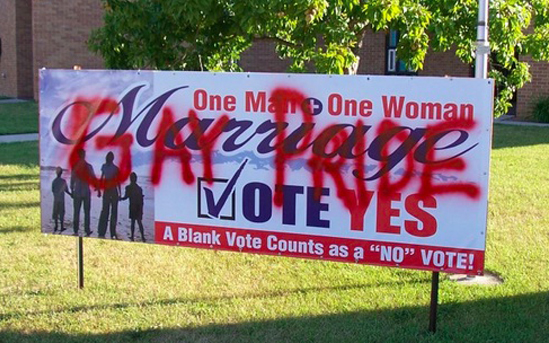
Gay activist vandalizes pro-marriage sign

In the New York Post, Naomi Schaefer Riley writes about a study used by gay activists to bully those who disagree with their agenda.

She writes:

The headlines were unsparing and unambiguous. “Anti-gay Stigma Shortens Lives,” wrote US News & World Report.

“Anti-Gay Communities Linked to Shorter Lives,” said Reuters. “LGB Individuals Living in Anti-Gay Communities Die Early,” according to Science Daily.

Two years ago, these stories were hard to ignore when Columbia professor Mark Hatzenbuehler found that gays and lesbians who faced prejudice in their communities had a life expectancy 12 years shorter than those who lived in more accepting areas. Just so we’re clear, that’s bigger than the lifespan gap between regular smokers and nonsmokers.

We always knew prejudice was bad, but an Ivy League researcher had found that there were significant effects on the physical health of those experiencing it.

But where, one might wonder, were the headlines when another researcher tried to replicate Hatzenbuehler’s effects and came up empty?

Last month, Mark Regnerus, a professor at UT Austin, published an article in the journal Social Science and Medicine that concluded that “ten different approaches to multiple imputation of missing data yielded none in which the effect of structural stigma on the mortality of sexual minorities was statistically significant.”

In other words, Regnerus tried seven — er, 10 — ways from Sunday to try to get the same results as Hatzenbuehler using the exact same data, but failed. Which means, he concluded, that “the original study’s . . . variable (and hence its key result) is so sensitive to subjective measurement decisions as to be rendered unreliable.”

This isn’t the first time that a study authored by a gay activist has run into evidential problems.

That story was reported in the far-left Politico.

They say:

One of the authors of a recent study that claimed that short conversations with gay people could change minds on same-sex marriage has retracted it.

Columbia University political science professor Donald Green’s retraction this week of a popular article published in the December issue of the academic journal Science follows revelations that his co-author allegedly faked data for the study, “When contact changes minds: An experiment on transmission of support of gay marriage.”

[…]The study received widespread coverage from The New York Times, Vox, The Huffington Post, The Washington Post, The Wall Street Journal and others when it was released in December.

The equally leftist Washington Post is even more forceful – calling the data a complete fake.

Excerpt:

[…]…[W]hat really happened was that the data were faked by first author LaCour. Co-author Green (my colleague at Columbia) had taken his collaborator’s data on faith; once he found out, he firmly retracted the article.

Ironically, LaCour benefited (in the short term) by his strategy of completely faking it. If he’d done the usual strategy of taking real data and stretching out the interpretation, I and others would’ve been all over him for overinterpreting his results, garden of forking paths, etc. But, by doing the Big Lie, he bypassed all those statistical concerns.

But the real issue is whether the negative health (and mental health) outcomes of homosexuality can be attributed to the lifestyle itself. The gay activists want you to believe that disagreement with their choices causes the negative effects. But the science shows the opposite: even in countries where there is no “stigma” against homosexuality, the unhealthy physical and mental outcomes persist.

Life Site News reports.

Excerpt: (links removed)

While many assume that family rejection is the leading cause of depression among LBGTI individuals, a new study has found that in fact the problem appears to stem predominantly from the higher incidence of relationship problems among homosexuals.

Dr. Delaney Skerrett led a team of researchers from the Australian Institute for Suicide Research and Prevention (AISRAP) in studying suicides in Queensland. He found that a leading cause of suicide among “lesbian, gay, bisexual, transgender, and intersex” (LGBTI) people is stress from their romantic partners.

“We tend to assume that the psychological distress LGBTI people are often going through is due to family rejection. But it seems that’s not so much the case. The conflict seems to be largely related to relationship problems, with partners,” Dr. Skerrett said.

[…][T]he study, which was published on April 2 in Asia Pacific Psychiatry, found that “LGBT individuals experienced relationship problems more often” than heterosexuals, “with relationship conflict also being more frequent than in non‐LGBT cases.”

That confirms previous studies finding that homosexuals also face higher rates of intimate partner violence than heterosexuals. A 2007 study in the Journal of Urban Health, which is published by the New York Academy of Medicine, found that 32 percent of homosexuals have been abused by at least one partner during their lifetime.

The researchers with AISRAP also found that a higher percentage of homosexuals took their lives [out] of despondency, rather than other psychological illnesses. While one-eighth of all Queensland suicide victims had been diagnosed with a psychosis that impaired their judgment, Skerrett reports “there were no such diagnoses among LGBT individuals.” The conclusion adds to the consensus that depression disproportionately besets active homosexuals.

Maybe the problem is with the person who is making the bad decisions, and not with the people who disagree with the bad decisions?

Before the rise of secularism, Americans believed in conscience

Dissent, disagreement, conscience and religious liberty
The importance of respecting the conscience of others

In the last 50 years, America exchanged religious liberty for hedonism. We used to believe that conscience was a good thing, and we respected individual differences rooted in religious convictions. But today, secular leftist politicians, lawyers and judges attack Christians using the courts. Pro-lifers, pro-marriage business owners, and people expressing Christian convictions in public have all felt what it is like to have conscience attacked by the secular leftist state.

Let’s take a look at what things were like in a different time when moral convictions had not been destroyed by secular leftism.

Consider this article in The Federalist about a new movie called “Hacksaw Ridge”.

Excerpt:

Over last weekend, I saw the new Mel Gibson flick “Hacksaw Ridge.” Gruesome and at times overshadowed by lead actor Andrew Garfield’s awkwardness, “Hacksaw Ridge” was an ode to the age-old American custom of protecting dissent by protecting the conscience.

In an age when attacks upon conscience and religious liberty grow more and more fiery, the true tale of World War II hero Desmond Doss’ conscientious objection to killing is a reminder of the difficult stakes involved in ensuring that individual liberty is the presumption that government takes toward individuals, even during war.

“Hacksaw Ridge” is the story of Doss, a Seventh Day Adventist whose religion prohibited taking the life of a fellow human being. Doss, obviously a patriot, felt obligated to serve in World War II as a medic. Where war is the business of taking life, Doss saw his role as helping save lives. That he does, as his heroism is on full display in his military record and receiving the Medal of Honor from President Truman.

The article has 6 sections.

The first one makes the point about how things have changed:

1. The Conscience Is Sacred

Doss arrived at his pacifism through religious conviction. It was an ethical precept he arrived at by religious devotion and piety, which means his pacifism was not something arbitrarily considered. Throughout the movie, the tattered Bible he carried with him everywhere he went symbolized the solemnity of his beliefs. Standing before a court martial, he was willing to go to jail for his convictions.

This is important today because so much hostility is based in rejecting religious motivation around contentious issues such as sexuality. Liberals are inclined to believe that any and all opposition to the ever-expanding lexicon of the sexual revolution is based in animus. That’s hogwash. Today’s dissenters from the sexual revolution have no use for animus. Rather, they believe the purposes of sexuality and human embodiment are different than what secular progressivism teaches.

Doss’ sincerity is a reminder that the convictions people arrive at by religious motivation are not designed to be capricious, but are ordered toward certain ends that people will naturally disagree about.

Part 3 was also good, because it explains efforts by Republicans to pass laws like the Religious Freedom Restoration Act – laws that are opposed by atheists in the Democrat party:

3. It’s Good to Accommodate People’s Consciences

When almost court-martialed for insubordination, Doss insists that his desire all along was to be a medic. This request was eventually approved. In the movie, we see the U.S. government preserve a man’s conscience by assigning him a duty that did not violate it. The U.S. government was right to accommodate Doss where accommodations can be made. In this move, it recommitted itself to an important principle at the heart of our constitutional system: The presumption of liberty.

This means it is government’s burden to prove infringing upon a person’s liberty is absolutely necessary. In Doss’ case, it was deemed unessential for him to carry a weapon, so he served in a different capacity. This is at the heart of legislation like the Religious Freedom Restoration Act, which puts the burden on the government to prove its case and make every last accommodation where possible.

The problem with people on the secular left today is that they have no empathy. For them, other people have no right to disagree because it makes them feel bad – but they don’t see how jail time and fines amounting to hundreds of thousands of dollars makes the victim of their legal attacks feel bad:

5. Protecting Conscience Means Developing Empathy for Others’ Convictions

As the movie’s plot develops, Doss’ fellow soldiers come to understand that his motives aren’t sinister. They realize that, when freed to live faithfully, Doss is there to help save their lives. Throughout this, and when they learn of his sincerity, his enemies-turned-friends gained a greater understanding of Doss’ convictions. They came to understand the force of his resolve, which dampens their mockery.

In one visceral scene in particular, Doss and the most intense warrior in his battalion are in a foxhole together. There, in seeing Doss’ devotion to sacrifice and conscience, his enemy-turned-friend makes lighthearted gestures recognizing that Doss’ motives are pure. In the crucible of conflict, progress occurs.

As in the case of Doss, protecting conscience doesn’t mean you will agree with the conscience you’re protecting. In fact, disagreement underscores the very need for protection. If conscience and religious liberty are simply ideas our society supports when popular, such protections are easily undone.

One of my favorite passages in the Bible talks about conscience.

1 Corinthians 4:2:

1 This is how one should regard us, as servants of Christ and stewards of the mysteries of God.

2 Moreover, it is required of stewards that they be found faithful.

3 But with me it is a very small thing that I should be judged by you or by any human court. In fact, I do not even judge myself.

4 For I am not aware of anything against myself, but I am not thereby acquitted. It is the Lord who judges me.

You can clearly see in today’s gay rights movement the problem with the government choosing to favor sinful behavior over religious liberty. People who are involved in sinful lifestyles don’t have the ability to do the right thing when it comes to respecting others. Engaging in a sinful lifestyle corrupts the ability to be respectful of the human rights of others. The desire to feel good and be approved of is seen as more important than respecting the right of others to disagree.

Who knows how far the secular left would go to punish dissenters from gay marriage? Although the media doesn’t cover it, there have been countless episodes of violence and vandalism, workplace persecution and job terminations, not to mention an armed attack by a domestic terrorist at the Family Research Council building. Because people in a sinful lifestyle don’t respect conscience rights of those who disagree. Conversely, when a person stands alone for a moral virtue (e.g. – chastity), there is no desire to compel others.

Robert Gagnon debates gay activist Jayne Ozanne on Bible vs homosexuality

Gay activist vandalizes pro-marriage sign

I am tempted to say that this is the best podcast I have ever heard on the Unbelievable show. Do anything you have to do in order to listen to this podcast.

Details:

Prof Robert Gagnon has become a well-known voice advocating the traditional biblical view on sexuality. In a highly charged show he debates the scriptural issues on sexuality with Jayne Ozanne, the director of Accepting Evangelicals who came out as gay earlier this year.

The MP3 file is here.

If you can only listen for 15 minutes, then start at 49 minutes in and listen from there.

The following summary is rated MUP for made-up paraphrase. Reader discretion is advised.

Summary:
Intro:

  • Speaker introductions
  • Gagnon: scholars who support gay marriage agree that the Bible doesn’t support it
  • Gagnon: scholars who support gay marriage agree Jesus taught male-female marriage
  • Ozanne: I went to the hospital because I was sick from trying to suppress my gay desires
  • Ozanne: Doctors told me that I would die if I didn’t act on my gay desires
  • Ozanne: I decided to reinterpret the Bible to fit with my gay desires
  • Ozanne: According to my new interpretation, Jesus actually supports my gay desires

Segment 1: Genesis

  • Ozanne: In Genesis the Bible says that Adam needs a woman to complete him
  • Ozanne: I reinterpret this to mean that Adam needed a “complementarian human being”
  • Ozanne: Genesis doesn’t say whether Eve was complemented by Adam in that chapter
  • Ozanne: It’s not critical that men are complemented by women, a man could complement a man
  • Ozanne: Genesis 2 doesn’t talk about children, it’s all about adult needs from a relationship
  • Gagnon: Genesis 2 has never been interpreted that way in all of history
  • Gagnon: Genesis 2 language specifically implies a human being who is opposite/different
  • Gagnon: Genesis 2 language translates to complement or counterpart
  • Gagnon: Genesis as a whole teaches that the sexuality is for male and female natures
  • Gagnon: The extraction of something from the man that is given to the woman is complementarian
  • Ozanne: I think that people can be complementary outside of male-female Genesis language
  • Ozanne: I don’t want to discuss specific words and texts and Greek meanings
  • Gagnon: the text has always been read and interpreted to support male/female complementarity
  • Gagnon: the male-female nature argument is made because the two natures are complementary
  • Ozanne: the text was interpreted by patriarchal males who treated women like property, it’s biased
  • Ozanne: what is important to me is how Christ interprets Genesis (?? how does she know that?)
  • Ozanne: I am passionate about my interpretation of Scripture which supports my gay desires
  • Gagnon: just because a person is passionate about their interpretation it doesn’t make it right
  • Gagnon: I am not arguing for the male-female view based on passion, but on scholarship, evidence and history
  • Ozanne: both sides are equally passionate about their interpretations (?? so both are equally warranted?)
  • Ozanne: the real question is why God “allowed” two different interpretations of Scripture

Segment 2: Is homosexuality a sin?

  • Gagnon: Jesus affirmed traditional sexual morality, which forbids homosexuality
  • Gagnon: Jesus teaches that marriage is male-female, and limited to two people
  • Gagnon: No one in history has interpreted the Bible to say that homosexuality was not immoral
  • Ozanne: Jesus came to bring life, and that means he supports homosexuality
  • Ozanne: I was dying, and embracing my gay desires allowed me to live, so Jesus approves of me
  • Ozanne: God says “I am who I am” and that means he approves of me doing whatever I want
  • Ozanne: There is an imperative to be who I am, and that means embracing my gay desires
  • Gagnon: Jesus argued that the twoness of the sexual bond is based on the twoness of the sexes
  • Gagnon: Jesus did not come to gratify people’s innate desires, he called people to repent of sin
  • Gagnon: Jesus did reach out to sinners but he never condoned the sins they committed
  • Gagnon: Jesus’ outreach to tax collectors collecting too much and sexual sinners is the same: STOP SINNING
  • Ozanne: I don’t think that Romans 1 is talking about homosexuality
  • Ozanne: I think it’s talking about sexual addiction, not loving, committed gay relationships
  • Ozanne: Paul was condemning pederasty in Romans 1, not loving, long-term, consensual sexual relationships between gay adults
  • Gagnon: nothing in the passage limits the condemnation to pederasty
  • Gagnon: the passage was never interpreted to be limited to pederasty in history
  • Gagnon: rabbis and church fathers knew about committed two-adult same-sex relationships, and said they were wrong
  • Gagnon: the argument for marriage is based on the broad two-nature argument, with no exceptions
  • Gagnon: the condemnation is not limited to exploitative / coercive / lustful / uncommitted relationships
  • Gagnon: even pro-gay scholars agree the passage cannot be interpreted Ozanne’s way (he names two)

Segment 3: The showdown (49:00)

  • Ozanne: I don’t care how many pages people have written on this
  • Ozanne: God says that “the wisdom of the wise I will frustrate” so you can’t use scholars, even pro-gay scholars, to argue against my passionate interpretation
  • Ozanne: I am not interested in the text or history or scholarship or even pro-gay scholars who agree with you
  • Ozanne: what decides the issue for me is my mystical feelings about God’s love which makes my sexual desires moral
  • Ozanne: you are certain that this is wrong, but your view does not “give life” to people
  • Ozanne: your scholarship and historical analysis is “a message of death” that causes teenagers to commit suicide (= you are evil and a meany, Robert)
  • Ozanne: “I pray for you and your soul” (= opposing me will land you in Hell) and “I hope that listeners will listen with their hearts” (?? instead of their minds?)
  • Ozanne: you can prove anything you want with research, even two mutually exclusive conclusions, so you shouldn’t rely on scholarship and research since it could be used to prove my view as well
  • Ozanne: instead of relying on research, you should rely on your heart and your feelings about God’s love to decide what the Bible teaches about sexual morality
  • Gagnon: you are distorting the gospel in order to make your case
  • Gagnon: attacking my “certainty” is an ad hominem attack to cover your dismissmal of the scholarship and history
  • Gagnon: you distort the gospel to make it seem like Christ just wants us to get what we want, when we want it, with who we want it with
  • Gagnon: Christ calls us to take up our cross, to lose our lives and to deny ourselves
  • Gagnon: you have a notion of what “fullness of life” is, but it’s not reflective of the gospel
  • Gagnon: Paul’s life was much more troubling than yours, mine or anyone else around here
  • Gagnon: Paul was beaten, whipped, stoned, poorly sheltered, poorly clothed, poorly fed, shipwrecked, and anxious for his churches
  • Gagnon: on your view, he should have been miserable and angry with God all the time
  • Gagnon: but instead Paul was constantly thankful and rejoicing to be able to suffer with Jesus and look forward to the resurrection
  • Gagnon: I have suffered too, but the suffering we go through never provides us with a license to violate the commandments of God
  • Ozanne: “the ultimate thing is what people feel God has called them to”
  • Ozanne: My goal right now is to tell young people that homosexuality is fine so they don’t commit suicide
  • Ozanne: the view that homosexuality is wrong is “evil and misguided”
  • Gagnon: the greater rates of harm in the gay community are intrinsic to homosexual unions, not caused by external disapproval of homosexuality

Segment 4: Concluding statements

  • Gagnon: gay male relationships on average have more sex partners and more STDs
  • Gagnon: female relationships on average have shorter-length relationships and more mental issues
  • Gagnon: the greater rates of harm are because there is no complementarity / balance in the relationships
  • Gagnon: everyone has some disappointment or suffering in their lives that hurts them, and that they are tempted to break the rules to fix, but we should not break the rules in order to be happy
  • Ozanne: both sides are passionate, so no one can be right, and evidence proves nothing
  • Ozanne: only feelings about “what God is doing” can allow us to decide what counts as sin or not
  • Ozanne: the main thing that is at stake here is to make people like us, not to decide what the Bible says about sin
  • Ozanne: my message to people is to do whatever you want, and ignore mean people who don’t affirm you
  • Ozanne: we should be more opposed to mean people who make non-Christians feel unloved than about doing what the Bible says