Tag Archives: Free Market

Conservative Party of Canada on track to deliver budget surplus in 2015

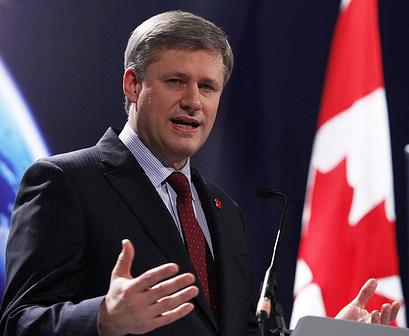
Prime Minister Stephen Harper
Prime Minister Stephen Harper (Conservative Party)

Story from Yahoo News about the results delivered by the Conservative Party of Canada.

Note: To understand the numbers in the article, simply multiple the numbers by 10 to compare with American numbers – Canada’s economy is about 1/10 the size of ours. For example, our GDP is $15.7 trillion and theirs is $1.8 trillion. Our national debt is $17 trillion, while their’s is $1.2 trillion.

Excerpt:

Canada’s Conservative government looks set to comfortably balance its books in 2015 or even sooner, its latest budget showed on Tuesday, with cuts in spending on the public service more than offsetting a series of modest new expenditures.

The low-key spending plan leaves Prime Minister Stephen Harper well-positioned to offer tax breaks and other initiatives in the runup to an election scheduled for October next year.

“Some people will say this budget is boring,” Finance Minister Jim Flaherty told reporters ahead of the budget speech. “Boring is good.”

The budget shows a deficit of C$2.9 billion ($2.63 billion)in the 2014-15 fiscal year, up from the previous estimate of C$5.5 billion. That balance includes a C$3 billion contingency fund, which in fact reveals an underlying surplus that year.

Flaherty acknowledged the budget would be narrowly balanced this coming year without the contingency fund, but said he preferred to have a “nice clean surplus next year”.

The government estimates a bigger-than-expected C$6.4 billion surplus in 2015-16. In the year ending March 31 of this year, the deficit is pegged at C$16.6 billion.

[…]Flaherty, who is 64 and battling a rare skin disease, has staked his reputation on eliminating Canada’ small deficit, equivalent to about 1 percent of gross domestic product (GDP), and restoring the reputation the country had before the global financial crisis as having the strongest fiscal record in the Group of Seven major economies.

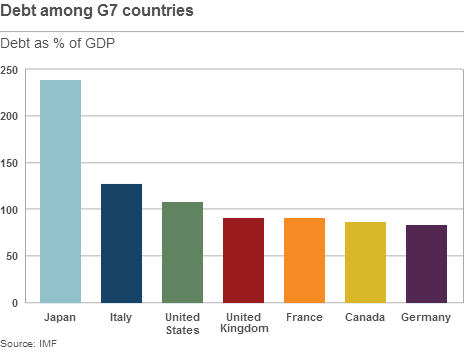
Germany is currently the only G7 country running a surplus, but Canada’s ratio of debt to GDP is substantially less and it is one of a handful of countries with a triple-A rating from rating agencies.

Canada is beating us in debt to GDP:

G7 Debt to GDP as of 2013
G7 % Debt to GDP as of 2012 (lower is better)

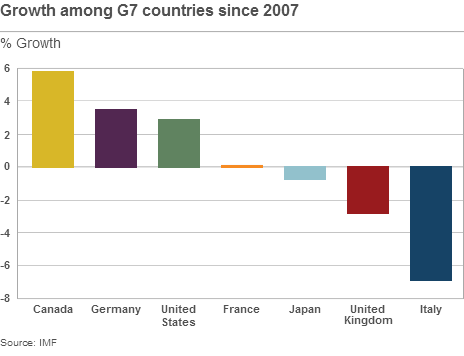
Canada is beating us in economic growth:

G7 GDP growth for 2013
G7 % GDP growth from 2007 to 2012 (higher is better)

Source: BBC Business

The next Canadian election is in 2015. I know that the Liberal Party is currently leading in the polls, but I found some good news. The Canadians just redistricted after their census, and there are 30 new electoral districts. If the same turnout occurs in 2015 which occurred in the 2011 election, then the Conservative Party of Canada would get 22 out of 30 of those new seats. However, I am concerned. I want Harper to keep his majority, as he and Tony Abbott (Australia) are two bright conservative stars who show people what conservatives can do. 

Sweden turning to capitalism as money for government spending runs out

I hear a lot of people in my office predicting doom and gloom for the United States. Rubbish. The worst that’s going to happen is that we have the kind of slow economy that France has, and that will only last until we run out of money to borrow.

Yahoo News explains what happens when socialists run out of money.

Excerpt:

The Nordic model, known for high taxes and its cradle-to-grave welfare system, is getting a radical makeover as nations find themselves cash-strapped.

[…]In the wake of a banking crisis in the early nineties, Stockholm scrapped housing subsidies, reformed the pension system and slashed the healthcare budget.

A voucher-based system that allows for-profit schools to compete with state schools was introduced, and has drawn attention from right-wing politicians elsewhere, including Britain’s Conservative Party.

In 2006, conservative Prime Minister Fredrik Reinfeldt’s government accelerated the pace of reform, tightening the criteria for unemployment benefits and sick pay while lowering taxes.

Income tax in Sweden is now lower than in France, Belgium and Denmark, and public spending as a share of GDP has declined from a record 71.0 percent in 1993 to 53.3 percent last year.

Just so you know, his numbers might be out of date.

The latest Heritage Foundation Index of Economic Freedom says this:

The top individual income tax rate is 57 percent, and the top corporate tax rate has been cut to 22 percent. Other taxes include a value-added tax (VAT) and a capital gains tax. The overall tax burden is 44.5 percent of GDP. Public expenditures make up about half of GDP, and public debt is below 40 percent of GDP. The government is attempting to expand investment in infrastructure and research while reining in welfare spending.

The United States had this:

The top individual income tax rate has risen to 39.6 percent, and the top corporate tax rate remains at 35 percent. Other taxes include a capital gains tax and excise taxes. The payroll tax holiday expired at the beginning of 2013. The overall tax burden amounts to 25.1 percent of gross domestic income. General government expenditures are slightly over 40 percent of GDP. Total public debt equals over 100 percent of the size of the economy.

So we are actually worse than Sweden now, in terms of government spending as a percent of GDP.

Denmark, too

More from the Yahoo News article:

If Sweden is the Nordic country to have gone the furthest in shrinking its welfare state, Denmark has moved the fastest.

When her Social Democratic government took power in 2011, there was little to suggest Prime Minister Helle Thorning-Schmidt would make any dramatic changes to the country’s cherished welfare state — funded by the world’s highest tax burden.

After a centre-right government had raised the retirement age and reduced the unemployment benefits period from four to two years, “Gucci Helle” — as she is known among her detractors — went on to cut corporate taxes to 22 percent from 25 percent.

Other reforms have included requiring young people on benefits to undertake training, and withdrawing student aid to those taking too long to finish their studies.

Denmark has been spurred into action by a persistently sluggish economy since a housing bubble imploded in 2007, leading to anaemic household spending.

But among Danes there is also a sense that the welfare state was ballooning out of control.

In 2011, a TV report aiming to show what life was like for the poor in Denmark visited the home of a single mother on benefits, whose disposable income turned out to be 15,728 kroner (2,107 euros, $2,860) per month.

“Poor Carina”, as she was later nicknamed, sparked a national debate on the level of unemployment benefits, with one pollster crediting her with fuelling a rise in the number of people who felt benefits were too high.

It would be nice if we had journalists who could do a story like that.

A different article from a Swedish newspaper called The Local has more on the new Sweden.

Excerpt:

One in ten Swedes now has private health insurance, often through their employers, with some recipients stating it makes business sense to be seen quickly rather than languish in national health care queues.

More than half a million Swedes now have private health insurance, showed a new review from industry organization Swedish Insurance (Svensk Försäkring). In eight out of ten cases, the person’s employer had offered them the private insurance deal.

“It’s quicker to get a colleague back to work if you have an operation in two weeks’ time rather than having to wait for a year,” privately insured Anna Norlander told Sveriges Radio on Friday. “It’s terrible that I, as a young person, don’t feel I can trust the health care system to take care of me.”

The insurance plan guarantees that she can see a specialist within four working days, and get a time for surgery, if needed, within 15.

I used to make fun of Sweden for being so socialist, but then I started to read more about them on Reason.com and from the Cato Institute (two libertarian sites) and my mind changed. These new articles confirm for me  that Sweden is improving their economy by embracing the free market system and rejecting socialism. Obviously, there is more to do, but the trend is good, and the results cannot be questioned. What could the United States do if we acted more like Sweden? It seems like just as they are moving away from government control of health care, we are moving towards it! We are embracing old ideas, and we need something new.

I am still worried about the European countries because of the breakdown of the family, the disrespect of marraige and the low fertility rates. But still, this is a good sign for those of us who are worrying that we need to cheer up. This is how socialism ends. We’ll get there.

Does the Bible teach government-controlled wealth redistribution to help the poor?

Eric from Ratio Christi posted an essay by famous Christian philosopher J.P. Moreland entitled “A Biblical Case for Limited Government”. 

About the author:

I am the Distinguished Professor of Philosophy at Talbot School of Theology, Biola University in La Mirada, California. I have four earned degrees: a B.S. in chemistry from the University of Missouri, a Th.M. in theology from Dallas Theological Seminary, an M. A. in philosophy from the University of California-Riverside, and a Ph.D. in philosophy from the University of Southern California.

Here’s the intro from the essay:

In what follows, I shall argue that, when properly interpreted, biblical teaching implies a minimal government with a specific function to be mentioned shortly. I will begin by describing the three-way worldview struggle in our country and explain why two of those worldviews have a vested interest in big government. I will then present a biblical methodology for getting at scriptural teaching about the state. I will apply that methodology to support the claim that Israel’s ethical policies in the Old Testament are better analogies for the church/covenant community than for the government, and in this context I will clarify the role that “defining terms of address” plays in my discussion. I will then distinguish negative and positive rights and argue that the best texts for unpacking biblical teaching about the state are two:  four key New Testament texts and the obligations placed on pagan nations by the Old Testament prophets. I will try to show that these key texts depict the state as a protector of negative rights and not a provider of positive rights. Thus the scriptures support a limited view of government and its function.

Next, I will turn to a description of the decisive feature of New Testament ethics in general, and Jesus’s ethics in particular, namely, virtue ethics with voluntary adherence to the love commands. I will show that, given this ethic, the state may be able to show mercy, but it cannot show compassion due to both the nature of the state and the nature of compassion. I will close with a brief treatment of the importance of Natural Moral Law in the state’s fulfilling of its God-given role so as to avoid a theocracy. And I will examine the charge that commitment to the Natural Moral Law makes one an intolerant bigot.

And here’s the best part:

[W]e need to make a distinction between positive and negative rights. A positive right is a right to have something given to the right-holder. If Smith has a positive right to X, say to health care, then the state has an obligation to give X to Smith. In general, positive rights and duties are correlative. That is, if someone has a positive right to something, then a duty is placed on others to provide that right to that person (or class of persons). Thus the state has the moral right to impose on citizens the duty to provide that right to the right-holder. A negative right to X is a right to be protected from harm while one seeks to get X on one’s own. If Smith has a negative right to X, say to health care, then the state has an obligation to protect Smith from discrimination and unfair treatment in his attempt to get X on his own. We learn much if we approach key biblical texts about the state armed with the distinction between positive and negative rights.

Then he brings up the Romans 13 passage that Wayne Grudem mentioned yesterday in the post on the Bible and capital punishment, which talks about how the state can punish evildoers.

More:

A second feature of the Romans 13 text is that it seems to depict the state as the protector of individuals from harm due to negative-rights violations (and as the praiser of those who do not engage in such law-breaking behavior) rather than as the provider of positive rights. In the preceding context (Romans 12:17-21), the issue in focus is someone who has had evil done against him, i.e., has had his negative rights violated. The passage makes clear that in such a case, the individual is not to take revenge and repay evil with evil. This would most naturally raise a question of criminal justice, viz., will the person have to pay for what he/she did to me in this age? Romans 13:1-7 answers that question in the affirmative by stating that such justice is precisely the purpose of the state. Moreover, in the verses that follow Romans 13:1-7 (verses 8-10) the focus is on showing compassion and love to one another, a topic mentioned in Romans 12:20 in the context of providing things (food and drink) for one who has harmed you. Now while compassion, love, and providing for others are mentioned just before and after Romans 13:1-7, it is significant that these topics fall from sight when the nature and function of the state is in view. A good explanation for this is that the state is not to be in the business of showing compassion (for more on this, see below) or providing positive rights for others. That is an  individual moral responsibility. No, the state is the protector of negative rights.

[…]By contrast with the voluntary nature of compassion and genuine ethical action, the state is coercive and forces conformity to its dictates. The coercive approach works well when the state is protecting negative rights, but it raises an ethical problem if the state tries to provide positive rights. While the state can show mercy—it bears the sword and can refrain from using it—the state cannot show compassion. As an individual, a representative of the state can have compassion in his heart as he gives to the poor; but this compassion is exhibited by him qua individual and not qua representative of the state. The state’s care for the poor is coercive since it redistributes wealth by force. It takes from some and gives to others, all by the force of law. Such actions count for very little in God’s eyes because they do not reflect the features of Jesus’s ethic identified above. And because Jesus was not a utilitarian, even if such actions accomplish good ends, the end does not justify the means. In a biblical ethic, helping the poor by the coercive power of the state is of little ethical value. If I am right about this, then it follows that when the state steps outside its role of protecting the violation of negative rights, the state will be incompetent and less effective than private or charitable alternatives.

And J.P. Moreland is right about it. This is a great essay and it helped me to understand how to talk about these issues. I think you should print this out and read it. Send it to everyone, especially young people who seem to be so confused about the free market system.

You can grab the PDF here from the Institute for Faith, Work and Economics (IFWE). It’s only 11 pages long, without footnotes. It took me only 15 minutes to read it.