
From Fox News.
Excerpt:
A federal stimulus grant of nearly $500,000 to grow trees and stimulate the economy in Nevada yielded a whopping 1.72 jobs, according to government statistics.
In 2009, the U.S. Forest Service awarded $490,000 of stimulus money to Nevada’s Clark County Urban Forestry Revitalization Project, aimed at revitalizing urban neighborhoods in the county with trees, plants, and green-industry training.
According to Recovery.gov, the U.S. government’s official website related to Recovery Act spending, the project created 1.72 permanent jobs. In addition, the Nevada state Division of Forestry reported the federal grant generated one full-time temporary job and 11 short-term project-oriented jobs.
[…]Repeated calls by FoxNews.com to the U.S. Forest Service were not returned.
[…]”Looking at the failure of the stimulus to live up to its promises, not just in Nevada, but throughout America, I think the question becomes ‘is there any good use of stimulus money?'” said Douglas Kellogg, communications manager for National Taxpayers Union, in an email to FoxNews.com.
[…]”The president may well propose new stimulus efforts when Congress returns from recess,” said Kellogg, “and those who learn from past stimulus debacles will not be fooled again.”
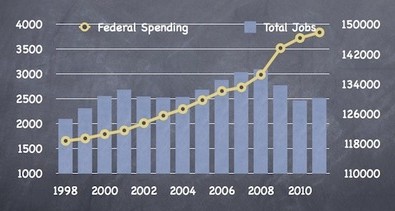
The Heritage Foundation explains how government spending has never worked to create jobs. Not even when Republicans do it.
Excerpt:
Indeed, President Obama’s stimulus bill failed by its own standards. In a January 2009 report, White House economists predicted that the stimulus bill would create (not merely save) 3.3 million net jobs by 2010. Since then, 3.5 million more net jobs have been lost, pushing the unemployment rate above 10 percent.[1] The fact that government failed to spend its way to prosperity is not an isolated incident:
- During the 1930s, New Deal lawmakers doubled federal spending–yet unemployment remained above 20 percent until World War II.
- Japan responded to a 1990 recession by passing 10 stimulus spending bills over 8 years (building the largest national debt in the industrialized world)–yet its economy remained stagnant.
- In 2001, President Bush responded to a recession by “injecting” tax rebates into the economy. The economy did not respond until two years later, when tax rate reductions were implemented.
- In 2008, President Bush tried to head off the current recession with another round of tax rebates. The recession continued to worsen.
- Now, the most recent $787 billion stimulus bill was intended to keep the unemployment rate from exceeding 8 percent. In November, it topped 10 percent.[2]
Why is this? It’s because the government never spends money as efficiently as the private sector. Private sector firms have to stay lean and mean in order to stay afloat – because they have competitors who are always trying to sell better goods and services for less money. In a capitalist economy, the consumer is king – all the businesses fight to earn the customers’ money. But the government has no competitors, and so they neither care about efficiency, nor pleasing their customers.
CBS News reports:
ABC News reports:
And this one features a real economist:
We shouldn’t let the government take money out of the private sector and let the public sector spend it on “stimulus”. Stimulus means taking money away from your boss, or your possible bosses, and spending it on trees. It’s how you lose jobs – and that’s what we have today.
Related posts
- Solar power firm goes bankrupt after receiving millions of taxpayer dollars
- Public schools spend $130,000 of stimulus money on diversity training books
- Democrat economists: “stimulus” cost $278,000 per job
- Obama blasts private jet tax breaks created by his own stimulus
- Green energy firm run by Obama fundraiser gets $535M loan guarantee
- Obama spent $80 billion dollars on green jobs so where are the jobs?

 WINTERY KNIGHT