Tag Archives: F. A. Hayek

What determines the prices of goods and services in a market economy?

Basic Economics: Prices are set by supply and demand
Basic Economics: In a free market, prices are set by supply and demand

A few days ago, I posted the meme above on the blog’s Facebook page. The meme makes fun of unionized public school teachers, who feel entitled to the same salary and benefits as doctors, software engineers, etc. in the private sector. I thought that all Americans were familiar with basic economics. But judging from some of the comments to the meme, that is not the case. This post will help.

So, the point of this meme is simple, it’s to point out that the teachers who belong to teacher unions are ignorant of basic economics, specifically, the law of supply and demand. As we’ll see in a minute, this is literally lesson 1 of Economics 101.

When there is more demand for a product or service than there is a supply for it, then prices go up. When there is more supply for a product or service than there is a demand for it, prices go down.

A good place to see this explained is in a book by famous black economist Thomas Sowell. Thomas Sowell has written many books, but he wrote one book in particular for people who have no knowledge of basic economics. It’s called “Basic Economics: A Citizen’s Guide to the Economy“. And the first few chapters explain how prices are set by supply and demand:

  1. What is Economics?
  2. The Role of Prices
  3. Price Controls
  4. An Overview of Prices

Most people who commented on the meme had some knowledge of basic economics, and how prices are determined.

Here’s Bruce:

Wages–the prices of labor–are set by free people bidding in an open market for the labor of people willing to work. They are not set by an emperor weighing abstractions. There are 3.7 million teachers working in the US, and only about 5000 professional athletes.

And Chris:

My coworkers and I (we are fintech people with highly specialized knowledge and computer skills) were talking about some computer-related consultants who are so specialized and so good that they command hundreds (if not thousands of dollars per hour). The top of the top cyber security guys, who do presentations at conferences on threats and vectors? Yeah, thousands if not tens of thousands of dollars per hour.

So far, so good. But others argued that the prices of goods and services are determined by a sinister cabal of politicians and other elites, who paid athletes lots of money in order to distract the masses with “bread and circuses”. Now, I know what you’re thinking. How does paying athletes MORE get people to care about sports? It doesn’t. Actually, it’s the (widespread) demand to see the performance of (scarce) elite athletes that causes the wages of those athletes to increase. It’s not a conspiracy – it’s free people making choices about what they want to buy in a free market.

It turns out that there are two views of how wages are set in an economy:

The labor theory of value (LTV) is a theory of value that argues that the economic value of a good or service is determined by the total amount of “socially necessary labor” required to produce it.

LTV is usually associated with Marxian economics… The LTV is central to Marxist theory, which holds that the working class is exploited under capitalism, and dissociates price and value. Marx did not refer to his own theory of value as a “labour theory of value”.

Mainstream neoclassical economics tends to reject the need for a LTV, concentrating instead on a theory of price determined by supply and demand.

Marxists economists believe that the value of a good or service is determined by the social utility of the work produced. But classical (“free market”) economists believe that value is determined by the scarcity of the good or service relative to the demand from consumers.

So, a Marxist economist might say “teaching English is valuable because it is relevant and meaningful”. But, a classical economist would say “conducting a security audit on distributed point-of-sale system is valuable, because few people can do it, but many people want it”.

So, the conspiracy theorists view of economics, which asserts that teachers should be paid more than software engineers and doctors, is actually based on Marxist (atheistic) assumptions. And yet many of the people who hold to the conspiracy view of prices fancy themselves to be Christians and conservatives.

I’ve noticed that school teachers and non-STEM university students and professors are very likely  to hold to the conspiracy theory view of prices and wages. Robert Nozick wrote a paper about why this happens. It turns out that “wordsmiths” (his word) are conditioned by their performance in the classroom to expect success in the free market economy. But when they find that their “brilliance” in English poetry, Medieval history, or lesbian dance theory has no value to anyone else, they fall in with these Marxist assumptions and conspiracy theory views of the economy. It’s a coping mechanism for people who value academic acclaim more than doing something useful for their neighbors.

Consider this article from College Pulse about a survey of 10,590 undergraduate students:

Students with certain majors are far more likely than their peers to approve of socialism. Philosophy majors, in particular, have a positive view of socialism. Nearly 8 in 10 (78%) say they view the economic system favorably, followed by 64% of anthropology majors, and 58% of both English and international relations majors. Accounting and finance majors are least likely to view socialism positively (20% and 22% respectively).

Do you know what accounting and finance students have to study? Basic economics.

I noticed that the practical commenters who were trying to explain why teachers earn less than software engineers all had some experience working for a living in the private sector. A couple of them mentioned how studying economics on their own had led them to a correct understanding of how the economy works. That’s what happened to me, as well.

As soon as I got my first job as a software engineer, and finished my study of Christian apologetics, the very next thing I studied was economics. It was Dr. Jay Richards who got me interested in it, when I heard him speaking about economics in an apologetics lecture for Stand to Reason. I contacted him, and he recommended the works of two famous economists, F. A. Hayek and Thomas Sowell. And that’s what I want to recommend to you, too. Our continued liberty and prosperity depends on ordinary Americans taking the time to educate themselves about basic economics.

Read or listen to F. A. Hayek’s classic book “The Road to Serfdom” for free

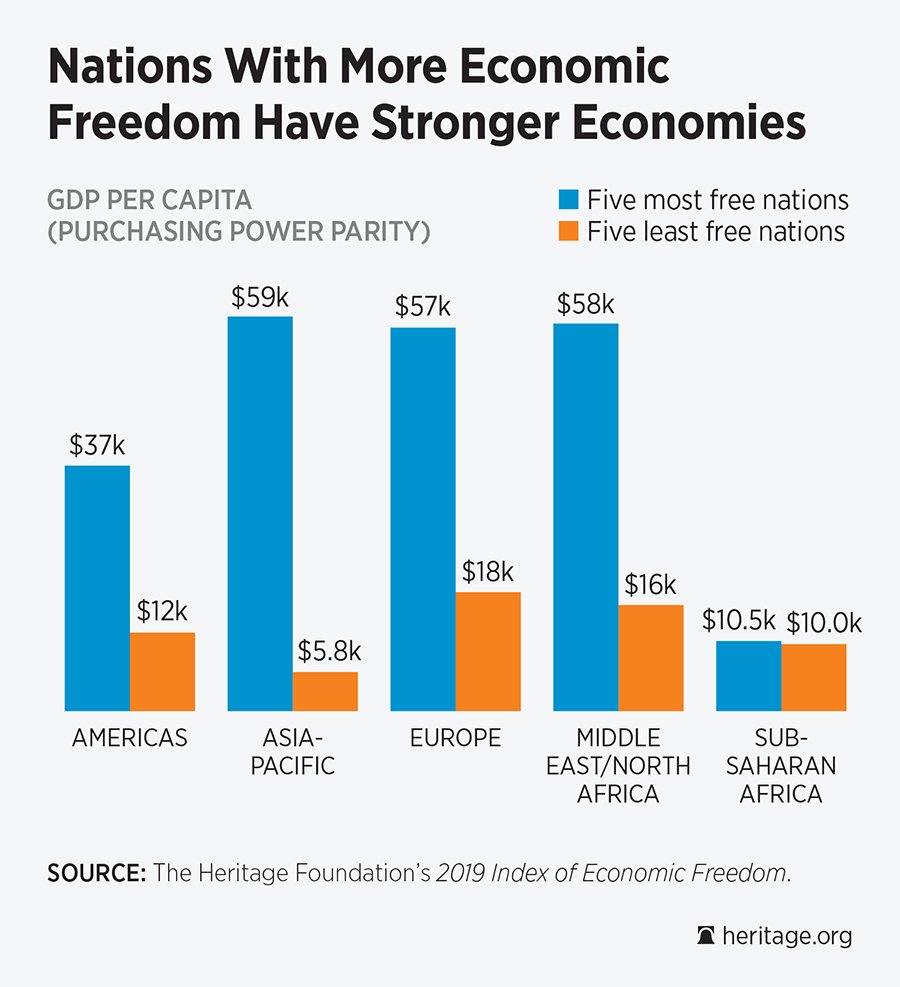
No matter where you go, more freedom means more prosperity

I want to recommend to everyone a famous book about how socialism leads to mass murder by government. The book is written by Nobel prize winner F. A. Hayek. This is one of my favorite books on economics. The full PDF of the book is available for download on archive.org.

The audio version is available FOR FREE on YouTube:

Outline:

  • 00:17 Foreword
  • 37:58 Preface
  • 41:51 Preface 1976
  • 50:09 Introduction
  • 1:08:46 Ch1 The Abandoned Road
  • 1:37:31 Ch2 The Great Utopia
  • 1:54:46 Ch3 Individualism and Collectivism
  • 2:18:32 Ch4 The Inevitability of Planning
  • 2:45:52 Ch5 Planning and Democracy
  • 3:20:06 Ch6 Planning and the Rule of Law
  • 3:54:33 Ch7 Economic Control and Totalitarianism
  • 4:23:01 Ch8 Who, Whom
  • 5:00:49 Ch9 Security and Freedom
  • 5:31:27 Ch10 Why the Worst Get On Top
  • 6:11:01 Ch11 The End of Truth
  • 6:38:41 Ch12 The Socialist Roots of Nazism
  • 7:09:40 Ch13 The Totalitarians in Our Midst
  • 7:54:43 Ch14 Material Conditions and Ideal Ends
  • 8:33:17 Ch15 The Prospects of International Order
  • 9:14:55 Ch16 Conclusion

All you need is 8.5 hours to listen to it. You won’t regret it, I promise. I have listened to the audiobook at least a dozen times. If that’s too long, there is a condensed version of the book.

They Hayek Center talks about condensed version of the book:

Max Eastman and the editors of Reader’s Digest wrote the condensed version of Friedrich Hayek’s “The Road to Serfdom” (pdf), which was read by millions of Americans at home and by servicemen all of the world when it was published in April of 1945.  It was the Reader’s Digest condensed version which turned Hayek’s little book into an American sensation — and Hayek into a public celebrity.  The Reader’s Digest had a circulation at the time of more the 5 million copies, and the little journal was provided to each American serviceman, at home and abroad.

[…]An additional 600,000 copies of the condensed version were later printed and distributed through the Book of the Month club and by non-profit civic groups.

Can you imagine what it would have been like to live at a time where everyone clearly understood the danger of letting government administrators centrally plan an economy? But the new generation of young Americans have lost that knowledge, and they are voting for the people who will lead them down the road to serfdom.

Desiring God asks: is socialism in conflict with Christianity?

Bible study that hits the spot

My friend Kevin sent me this amazing article about socialism, which appeared at Desiring God (!!!), of all places. It was authored by Phillip Holmes, who – I see from his picture -has dark skin like me, which is awesome!

In the past, I have given Desiring God and John Piper a lot of heat for not connecting Christianity to the real world. This was especially annoying to me during elections, or when legislation of interest to conservatives was being debated. But I’ve noted that Piper is now much better than he was before.

Anyway, here’s the intro to the article:

Socialism is trending in the minds of many Americans. Some love it, some hate it, and others are indifferent to it. Some Christians argue that it’s evil, while others argue that it’s morally good or neutral. Those that argue for its wickedness often fail to condemn the crony capitalism and corporate welfare that is widespread in the United States; therefore, their arguments often fall on deaf ears with socialist sympathizers. The arguments for its moral good or neutrality typically appeals to emotion, rather than evidence, which is considered insufficient for those that oppose it.

Then they quote John Piper for the definition of socialism – and it’s a great definition, it really captures what is interesting for us as Christians about socialism:

A social and economic system that through legal or governmental or military coercion — in other words, you go to jail if you don’t do this — establishes social ownership at the expense of private or personal ownership and/or you could say where coercion is used to establish social control — if not ownership, at least control of the means of production in society. And thus, through control, you effectively eliminate many of the implications and motivations of private ownership.

In other words, Socialism borrows the compassionate aims of Christianity in meeting people’s needs while rejecting the Christian expectation that this compassion not be coerced or forced. Socialism, therefore, gets its attractiveness at certain points in history where people are drawn to the entitlements that Socialism brings, and where people are ignorant or forgetful of the coercion and the force required to implement it — and whether or not that coercion might, in fact, backfire and result in greater poverty or drab uniformity or, worse, the abuse of the coercion as we saw in the murderous states like USSR and Cambodia.

F. A. Hayek says that the rule of law and private property are the foundations for all other rights, even religious liberty. So, Piper’s focus on property rights is right on the money. This is what we should care about when it comes to socialism, because it impacts our other liberties. The more free the free market is, the most Christians can follow their consciences. But the more the government takes hold of private industry, the harder it is for Christians to earn a living without toeing the secular government’s line. Take a look at what is happening to doctors and nurses in socialist countries like Canada. They are forced to perform abortions, they are forced to assist with assisted suicide. Why? Because government is running the health care system, and there is no other company you can run to that will respect your views. There is no escape when a secular government takes over large parts of the private sector.

This part is my favorite part, the author quotes my favorite economist, Thomas Sowell:

Despite the good they seem to do in some cases, I can’t in good conscience embrace them as a necessary means to escaping poverty. In my experience, I’ve witnessed it hinder more families than it has helped. We give social programs too much credit and the importance of family and faith too little. As a matter of fact, some economists assert that it was during the welfare state the condition of a particular group of its recipients began to decelerate. As the black economist Thomas Sowell pointed out:

The black family, which had survived centuries of slavery and discrimination, began rapidly disintegrating in the liberal welfare state that subsidized unwed pregnancy and changed welfare from an emergency rescue to a way of life.

Sowell continues to attack the myth that social programs improved the conditions of blacks in America:

The economic rise of blacks began decades earlier, before any of the legislation and policies that are credited with producing that rise. The continuation of the rise of blacks out of poverty did not — repeat, did not — accelerate during the 1960s.

The poverty rate among black families fell from 87 percent in 1940 to 47 percent in 1960, during an era of virtually no major civil rights legislation or anti-poverty programs.

Evidence seems to suggest that the families that have eliminated the poverty cycle while on social programs would have very likely done the same without the programs. While there have been numerous instances of grave injustices towards minority groups in our country that have hindered progress (slavery, Jim Crow), social programs don’t seem to be the cause of any significant improvements. Therefore, I want to humbly provide three practical reasons, based on my Christian worldview, why more social programs could actually substitute the family, empower the government, and hinder the church.

This is correct. Attempts to help the poor by redistributing wealth from those who produce to those who cannot or will not actually make things worse – by drawing more people “on the margin” into dependency.

One last snip:

Social programs are a slippery slope that could lead to unjust governments, more broken homes, and dead churches. Therefore, I simply can’t embrace them. A free society under a just government gives us plenty of options. We love our neighbors by starting non-profits, building hospitals, and opening schools that address the needs of the people without using the force of the government. What I’m proposing is not easy, but it is a biblical alternative that will require sacrifice, vision, newfound conviction, and a radical shift in how we view church, family, and government.

See, he sees private, voluntary charity as an option to government-run redistribution. An option that encourages economic growth, while safeguarding liberty and conscience for Christians.

I really love this article. The problem with me is that I don’t think enough about how to make my views palatable to well-meaning people on the other side. The author of this article does know how to defuse potential objections gently and graciously.