
Tag Archives: Enrollment

Obama voters face choice between an expensive fine and an expensive Bronze plan

Should we pick a candidate based on our emotional response to his confidence?

Obama told us during his election campaigns that health care premiums would go down an average of $2,500. How did he intend to achieve that? By reducing choice and competition, and require insurance companies to cover more stuff, like drug addiction therapy, onto every health care plan.

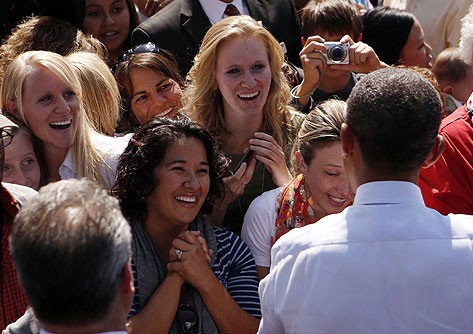
Here he is promising things to young voters:

So what happened? Health care premiums went up, because the more stuff that your health care plan has to cover (e.g. – drug addiction treatment) the more you have to pay for that health care plan. And so, as I blogged about before, health care premiums have actually gone up $4,865 on average, per year. Yes, this is another case of keep your doctor / keep your health plan lies.

Well, that’s all fine and good, because this is America, and no one will be forced to buy these expensive plans that cover things that you don’t want or need, right? Well, not so much. See, there is this Obamacare thing called the “individual mandate”, and it says that everyone has to buy health care, or they have to pay a fine. Even single young men in their 30s who don’t even need health care have to buy health care.

Investors Business Daily explains:

Millions of people who will start shopping for ObamaCare plans as early as Sunday will have one question in mind: How much is the cheapest plan for avoiding a $695 individual mandate penalty?

For the vast majority, that means the cheapest bronze plan. The next question they’ll consider, taking into account the deductible that will rise as high as $6,850 in 2016, is whether they would be better off paying a penalty.

A lot of factors will play into the decision, but for most relatively young and healthy adults, the biggest will be just how much more it will cost to get insurance than to go without coverage.

An IBD review of 2016 rates in one major metro area in each of the 37 states using HealthCare.gov reveals where higher bronze-plan costs — even after subsidies — will make the mandate penalty look relatively attractive.

So you either have to pay a $695 or you have to buy a bronze plan with a $6,850 deductible. Most people never use that much health care, so they will be paying out of pocket for all their health care anyway. So, either you are paying a fine that covers nothing, or you are paying for a plan that covers nothing.

Here is the chart of bronze health care plans:

Obamacare Bronze plans: and don't forget the $6850 deductibles
Obamacare Bronze plans (click for larger image)

More:

The accompanying chart lists the after-subsidy cost of the cheapest bronze plan for a 30-year-old earning 257% of the poverty level, or about $30,000. At the top of the chart, young adults earning $30,000 in Miami, Atlanta and Jackson, Miss., would have to pay more than $2,200 for the cheapest exchange plan — or more than triple the mandate penalty.

What’s nice about this is the justice of it. It’s the young, hip, middle-class young people who are going to end up with the bill for their Democrat-voting in 2008 and 2012.

The question is whether average moderate-earning 30-year-olds, assuming they have that much money available for insurance, will think it is better to pay an extra $1,130 or so for a plan with a huge deductible or whether it makes sense to hope for the best and hold on to that cash to pay any medical bills that arise.

A logical goal of the individual mandate is to get young and healthy adults with moderate incomes to sign up for coverage, since low-income young adults get pretty big subsidies and may not need as much of a push to enroll. Yet ObamaCare’s individual mandate does not seem well designed to achieve its goal, which helps explain why young-adult enrollment is somewhere around 2 million below target at this point.

Health care reform is a valid goal, and we do need health care to get cheaper. But the way to do that is not to elect someone who has not done it, but who just makes a lot of promises. The way to fix health care is by electing someone who has experience at fixing health care.

Obamacare enrollment of young adults about 50 percent below target

If you remember, Obamacare works by forcing young people (especially young men) to pay for care they don’t need and won’t use. This lowers the costs of health care for younger women and especially for older, sicker people. The target is 2.7 million enrollments of people from age 18-34.  But are young people signing up for this plan in numbers like that?

Investors Business Daily has the answer.

Excerpt:

Data through five months of the open-enrollment period show that slightly fewer than 10% of eligible 18- to 34-year-olds have signed up for coverage. Among young men, roughly 1 in 12 has signed up.

The Kaiser Family Foundation puts the ObamaCare-eligible population at 28.6 million, with 40%, or about 11.4 million, in the 18-to-34 age group.

Compared to the size of the potential market, the first-year target of 7 million enrollees, including about 2.8 million young adults, was relatively modest.

Yet it’s now clear that the initial target is well out of reach. The Avalere Health consultancy projected that sign-ups — paid and unpaid — will end March at around 5.4 million.

Through February, not quite 1.1 million young adults had selected an exchange plan. Among this group, the male-female breakdown was about 45% vs. 55%. That matters because women at child-rearing age are more likely to run up big medical bills.

In February, 268,000 18- to 34-year-olds signed up, so a decent upsurge in March could lift the total close to 1.4 million. But that’s before winnowing out the people who don’t pay.

Anecdotal reports from a handful of states and large insurers now point to a paid rate of about 85%, possibly lower.

While that could improve before the March 31 deadline, there’s reason to suspect that the paid percentage might lag among young adults, since they are showing more reticence about signing up in the first place.

Once the unpaid group is subtracted, it appears likely that young-adult enrollees will fall at least 50% below the first-year target The White House had initially set that target at 2.7 million.

[…]The age mix is important because the exchanges charge younger people higher premiums relative to pre-ObamaCare individual market insurance, so that older people can be charged less without negating insurer profits.

If young adults make up just 25% of the ObamaCare exchange population, it would wipe out much, but not all, of the 3% to 4% profit margin insurers typically allow for in setting premiums, Kaiser Family Foundation experts figure.

Yet that calculation assumes the health status of those who do sign up is about average. In general, an insured pool comprising a smaller share of the eligible group raises concern that the covered group will be costlier than average.

So they are expecting 2.7 million, but even with a late surge of enrollments, they are only going to get 1.4 million young people. That’s bad for Democrats, but I am happy that young men are not signing up for this law. They have nothing to gain from it. Maybe this whole mess will be worth it if young men understand that big government rides on the backs of young men. They are expected to pay the taxes, but without getting any of the benefits. Sex changes? IVF? Maternity? Well woman exam? Birth control pills? We don’t use that. We don’t mind paying for that for our wives, but we don’t want to pay for it for complete strangers.

Health insurance companies will raise rates to comply with Obamacare delay

CNS News explains how health insurance companies will respond to the last-minute attempt by Democrats to delay the implementation of Obamacare.

Excerpt:

After President Obama unilaterally changed his health care law on Thursday, the insurance industry issued a warning.

“Changing the rules after health plans have already met the requirements of the law could destabilize the market and result in higher premiums for consumers,” said Karen Ignagni, president and CEO of America’s Health Insurance Plans (AHIP).

Here’s Ignagni’s full statement:

Making sure consumers have secure, affordable coverage is health plans’ top priority.  The only reason consumers are getting notices about their current coverage changing is because the ACA requires all policies to cover a broad range of benefits that go beyond what many people choose to purchase today.

Premiums have already been set for next year based on an assumption of when consumers will be transitioning to the new marketplace.  If due to these changes fewer younger and healthier people choose to purchase coverage in the exchange, premiums will increase in the marketplace and there will be fewer choices for consumers.  Additional steps must be taken to stabilize the marketplace and mitigate the adverse impact on consumers.

A recent Weekly Standard podcast predicts that the Democrats are going to come down hard on insurance companies, and blame them for the failure of Obamacare.