Tag Archives: Energy Policy

Oil prices rise over tensions between US and Iran

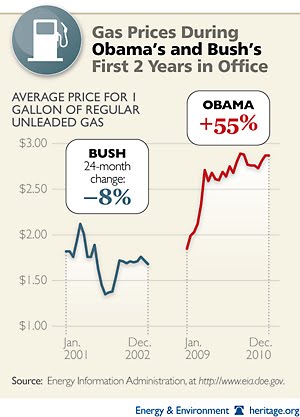
Gas Prices under Obama and Bush

From the liberal Los Angeles Times.

Excerpt:

Oil prices soared Tuesday as tensions grew over key Persian Gulf oil shipments.

In afternoon trading benchmark crude jumped $3.80, or 3.8 percent, to $102.63 per barrel in New York.

Brent crude, which is used to price foreign oil varieties that are imported by U.S. refineries, rose $3.87, or 3.6%, to $111.25 per barrel in London.

Prices climbed as soon as exchanges opened for the first day of 2012 trading. Commodity prices tend to rise at the beginning of January as investors start the new year with a fresh round of trading. This year prices were driven by heightened concerns that Iran might try to close the Strait of Hormuz in the Persian Gulf to oil tankers, if Western nations impose new sanctions.

Iran warned the U.S. to stay out of the strategic waterway, where one-sixth of the world’s oil shipments pass every day. On Monday its navy fired a cruise missile as part of a military exercise.

The U.S. and European nations are mulling further economic sanctions against Iran because of its nuclear program. A standoff could result that would be damaging to the global economy.

A dustup with Iran could slow crucial oil supplies at a time when the world needs every drop. Global oil demand is expected to rise to a record 89.5 million barrels per day in 2012.

Three of the world’s largest economies — the U.S., China and India — continued to grow with increased manufacturing activity in December.

Meanwhile, Obama continues to dither over the Keystone XL pipeline.

WaPo: Obama’s energy policies “infused with politics at every level”

From Hans Bader.

Excerpt: (with the links removed)

Even the liberal Washington Post, which hasn’t endorsed a Republican for President since 1952, seems to be souring on the Obama Administration’s failed energy programs, saying they were “infused with politics at every level.” As it noted in discussing the Solyndra scandal: “Obama’s green-technology program was infused with politics at every level, The Washington Post found in an analysis of thousands of memos, company records and internal ­e-mails. Political considerations were raised repeatedly by company investors, Energy Department bureaucrats and White House officials. The records, some previously unreported, show that when warned that financial disaster might lie ahead, the administration remained steadfast in its support for Solyndra,” which was owned by major Obama backers, like George Kaiser.

As law professor Glenn Harlan Reynolds notes, “all the ‘stimulus’ and ‘green energy’ stuff was never anything but a program to put taxpayer money into the hands of cronies and supporters.”

The Obama Administration hastily approved the  taxpayer subsidies for Solyndra despite obvious danger signs and warnings from accountants about the company’s likely collapse, themisgivings of agency officials, and the company’s mismanagement and lousy-quality products. (Solyndra executives are now pleading the 5th Amendment to avoid disclosing incriminating information.) The Obama administration was determined to shovel taxpayer money to its cronies as fast as it could. As an Obama fundraiser and Solyndra stakeholder exulted,  “there’s never been more money shoved out of the government’s door in world history and probably never will be again than in the last few months and the next 18 months. And our selfish parochial goal is to get as much of it . . . as we possibly can.”  “At the time Solyndra received its grant, Vice President Joe Biden declared that the Solyndra investment is ‘exactly what the [the stimulus package] is all about.’”

While diverting taxpayer money away from productive and efficient businesses to corporate-welfare recipients controlled by political cronies, the Obama Administration is busy wiping out jobs through thousands of pages of counterproductive regulations.  Some of these new regulations are designed to spawn lawsuits that will enrich trial lawyers at businesses’  and consumers’ expense.

Here’s an excerpt from the Washington Post piece he linked:

Since the failure of the company, Obama’s entire $80 billion clean-technology program has begun to look like a political liability for an administration about to enter a bruising reelection campaign.

Meant to create jobs and cut reliance on foreign oil, Obama’s green-technology program was infused with politics at every level, The Washington Post found in an analysis of thousands of memos, company records and internal ­e-mails. Political considerations were raised repeatedly by company investors, Energy Department bureaucrats and White House officials.

The records, some previously unreported, show that when warned that financial disaster might lie ahead, the administration remained steadfast in its support for Solyndra.

The documents reviewed by The Post, which began examining the clean-technology program a year ago, provide a detailed look inside the day-to-day workings of the upper levels of the Obama administration. They also give an unprecedented glimpse into high-level maneuvering by politically connected clean-technology investors.

They show that as Solyndra tottered, officials discussed the political fallout from its troubles, the “optics” in Washington and the impact that the company’s failure could have on the president’s prospects for a second term. Rarely, if ever, was there discussion of the impact that Solyndra’s collapse would have on laid-off workers or on the development of clean-
energy technology.

“What’s so troubling is that politics seems to be the dominant factor,” said Ryan Alexander, president of Taxpayers for Common Sense, a nonpartisan watchdog group. “They’re not talking about what the taxpayers are losing; they’re not talking about the failure of the technology, whether we bet on the wrong horse. What they are talking about is ‘How are we going to manage this politically?’ ”

The administration, which excluded lobbyists from policy-making positions, gave easy access to venture capitalists with stakes in some of the companies backed by the administration, the records show. Many of those investors had given to Obama’s 2008 campaign. Some took jobs in the administration and helped manage the clean-energy program.

Documents show that senior officials pushed career bureaucrats to rush their decision on the loan so Vice President Biden could announce it during a trip to California. The records do not establish that anyone pressured the Energy Department to approve the Solyndra loan to benefit political contributors, but they suggest that there was an unwavering focus on promoting Solyndra and clean energy. Officials with the company and the administration have said that nothing untoward occurred and that the loan was granted on its merits.

I am really surprised to see such a strongly-worded denunciation of Obama’s energy policies in a liberal newspaper.

Take a look at the rest of Hans’ post where he talks about the effects of environmental regulations on job creation and the stimulus’ effect on long-term economic growth. Basically, the only thing that Obama did right in 3 years was sign those free trade deals – and he sat on those for two years so as not to anger his union buddies.  The rest has been a disaster from start to finish.

Iraq plunges into chaos as U.S. troops withdraw

From the Heritage Foundation.

Excerpt:

The Obama Administration’s risky decision to seek the quickest possible exit from Iraq has contributed to a mushrooming political crisis there that is rapidly unraveling the hard-won gains of U.S. troops and threatens to plunge the country into a civil war that will greatly benefit Iran.

Shortly after the December 15 end-of-mission ceremony for U.S. troops, Iraqi Prime Minister Nouri al-Malikipurged many senior Sunni Arab political leaders from his fractious governing coalition. Maliki’s government, dominated by Shiite political parties of various stripes, also announced that it will prosecute Vice President Tareq al-Hashemi, a leader of the predominantly Sunni Arab Iraqiyah party, on terrorism charges. Hashemi, who denounced the allegations as propaganda cover for a political coup, has fled to the semi-autonomous Kurdish region in northern Iraq.

Iraq’s fragile unity is now dissolving in growing political tensions between the leaders of the Shiite majority and Sunni minority and between the Shiite-dominated central government and the non-Arab Kurdish minority. But the Obama Administration, blindsided by simmering tensions that it had downplayed in its rush for the exit, appears to be on auto-pilot.

The Administration gave a higher priority to domestic political considerations than to Iraq’s long-term security needs when it neglected to negotiate an extension of the U.S. troop presence past the end-of-year deadline set by the 2008 Status of Forces Agreement. Although the Bush Administration had envisioned a follow-on agreement to extend the military presence, and the Obama Administration had initially planned for a smaller residual force of military trainers and advisers, in the end politics trumped security in the White House’s deliberations.

Pulling troops out of the Middle East will make it harder for us to gather intelligence and support our allies against Islamic aggression. This decision to pull troops out ahead of the 2012 election is very similar to the decision to delay the Keystone XL pipeline until after the election.

Excerpt:

In November, the White House announced it would delay deciding on the project until after next year’s election. Administration officials claim they need more time to evaluate the potential environmental impacts of the $7 billion, 2,100-mile project to transport crude oil from Alberta, Canada, to major American refineries in the Gulf Coast.

Not content to wait until 2013, Republicans inserted a Keystone approval provision into the payroll tax extension. The result of that move is still in flux, as House Republicans have rejected the Senate’s measure.

Regardless of the outcome, President Obama’s desire to delay the pipeline is just the latest example of his pernicious proclivity for putting politics over sound policy when it comes to energy regulations.

The president simply doesn’t want to bear the political costs of deciding either way on Keystone until after his re-election bid. He’s wants to remain non-committal.

[…]Shambling on Keystone might be smart politics — but there’s no good policy reason to delay approval. And there is a huge cost of delay, which can be captured in just four letters: J-O-B-S.

Keystone XL requires miles of pipe to be welded and installed, and at least 30 new pumping facilities to be constructed. American workers would staff many of those operations.

Indeed, if Keystone XL were allowed to proceed as planned, oil sands development and related operations would directly create thousands of new jobs. Tens of thousands additional positions would be created indirectly at businesses along the pipeline’s pathway.

That same political strategizing driving the Keystone delay also undergirds the White House’s stance on hydraulic fracturing.

Colloquially know as “fracking,” this technique has proven invaluable in extracting natural gas buried under the earth’s surface. It involves pumping a high-pressure mixture of water and sand into the rock surrounding deposits to free up gas for collection.

In the Marcellus shale — a massive reserve running from Ohio and Pennsylvania into New York — fracking is the only way for developers to get access to gas located deep underground. Unfortunately, policymakers high and low have succumbed to environmentalist alarmism on fracking.

New York — with the tacit support of the White House — has instituted a fracking moratorium and effectively prohibited exploration of the parts of the Marcellus that run under the state.

Again, the cost of currying favor with environmentalists? Jobs. According to the Department of Environmental Conservation, Marcellus development in New York could generate up to 80,000 new local positions.

The more we decline to develop our own energy resources here at home, the worse it is for our economy. But it’s also bad for our national security to continue to buy oil from people who don’t like us very much. If we could develop our own energy resources at home – and buy from Canada – then we could use the money we save to keep our commitments in the Middle East. It’s not good for our economy or our national security to make short-sighted decisions that are going to hurt us in the long-run.