
Here’s a photo of the V-22 Osprey – it can change from a helicopter to a plane:
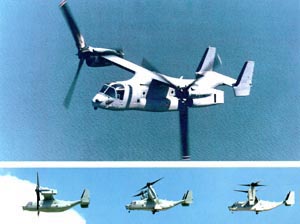
- V-22 Osprey Joint Service Aircraft
Here’s a quick run-down on what the V-22 Osprey can do.
Excerpt:
The V-22 is a tiltrotor aircraft, taking off and landing like a helicopter, but, once airborne, its engine nacelles can be rotated to convert the aircraft to a turboprop airplane capable of high-speed, high-altitude flight.
It can carry 24 combat troops, or up to 20,000 pounds of internal or external cargo, at twice the speed of a helicopter. It includes cross-coupled transmissions so either engine can power the rotors if one engine fails.
The rotors can fold and the wing rotate so the aircraft can be stored aboard an aircraft carrier.
[…]The Osprey has two, large, three-bladed rotors that rotate in opposite directions and produce lift. Because the rotors turn in opposite directions, there is no need for a tail rotor to provide stability as in a helicopter. The wing tilts the rotors between airplane and helicopter modes and generates lift in the airplane mode. The Osprey can convert smoothly from helicopter mode to airplane mode in as few as 12 seconds.
The major advantages of the Osprey over a helicopter are:
- Longer range – The Osprey can fly from 270 to 580 miles (453 to 933 km).
- Higher speed – The Osprey’s top speed is 315 mph (507 kph), which is twice as fast as a helicopter’s top speed.
- Increased cargo capacity – The Osprey can carry 20,000 pounds (4,536 kg) of cargo or 24 troops.
The advantage of the Osprey over an airplane is that it can take off, hover and land like a helicopter. This makes is more versatile than an airplane for such missions as moving troops to remote areas, especially those without landing strips, or conducting long-range rescue operations at sea.
The Hill has battlefield reports about the performance of the USMC V-22 Osprey tiltrotor aircraft.
Excerpt:
Military and industry officials rave about the V-22 tiltrotor’s performance in Afghanistan but know they need to show the aircraft is worth its high price tag.
The Marine Corps are flying V-22 Ospreys in theater and “it’s more effective than we expected,” Maj. Gen. Jon Davis, Second Marine Corps Air Wing commander, told reporters here recently. “We have only scratched the surface with this aircraft. … “We’re doing things with the V-22 we did not plan to do.”
The V-22 takes off vertically but can fly like a plane, allowing it to travel faster than traditional helicopters. The military is using the craft to haul teams of Marines, special operators, combat rescue personnel and cargo.
But there are questions in defense circles about whether — after years of technical delays and cost spikes —such glowing reviews will be enough to avoid future cuts as White House, Pentagon and congressional officials look for ways to trim the annual Defense budget.
Despite rave reviews from war fighters, the program is among the most expensive at the Pentagon.
Each Osprey has a flyaway cost of $65 million. The Pentagon already has spent over $30 billion on the V-22 program, according to the Congressional Research Service.
But some people would rather cut the V-22 than cut Obamacare:
Liberal lawmakers often come after the Osprey initiative when looking for places to trim Pentagon spending.
Last month, Rep. Lynn Woolsey (D-Calif.) offered an amendment to a Pentagon policy bill that would have directed the department to spend no monies on the program in 2012.
Woolsey dubbed the program a “boondoggle” for the “military-industrial complex.” Terminating the program would save more than $12 billion over 10 years, and $2.5 billion in 2012 alone, she claimed.
The House overwhelmingly defeated her amendment, but not before Woolsey said the aircraft has gotten “mediocre marks” from independent auditors and “underperformed across the board.” There are reports the V-22 has struggled in “high-threat environments,” she said.
She also said it has failed to “prove its worth” operationally and has had a number of major crashes. But Davis says it has proven its value, citing the fleet’s strong record in a rugged war theater.
Program officials and advocates are ready to fight back as Washington continues talking about an era of federal spending cuts.
Their embryonic message, as Davis put it: “Why would we terminate something that works?”
Marine Corps and Bell-Boeing officials also say to avoid budget cuts or a reduced buy, they will have to show critics like Woolsey that the fleet is reliable.
Right now, the Osprey’s closely monitored reliability rate in Afghanistan is around 73 percent, according to program officials.
Davis wants to push that figure to 80 percent, saying that would make the V-22 among the military’s most reliable aircraft.
I love the V-22 Osprey. It is a force multiplier, in my opinion. And can you imagine that some people wanted to cancel it just because of some difficulties they had early on in testing?
Related posts
- China unveils new J-20 stealth fighter, rival to the canceled F-22 Raptor
- Is the Obama administration deliberately weakening our military?
- Where does Paul Ryan stand on foreign policy and social issues?
- Thomas Sowell explains how liberal pacifism causes wars
- U.S. Navy sets world record with new electromagnetic rail gun
- Rachel Maddow doesn’t understand modern military weapon systems
- U.S. Army unveils revolutionary XM25 rifle in Afghanistan
- AC-130 gunships now mounting 105mm howitzer
- What is the conservative doctrine of “peace through strength”?

 WINTERY KNIGHT