
Tag Archives: Economy

Republicans introduce national right-to-work legislation

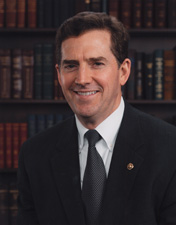
Sen. James Demint

From the Hill.

Excerpt:

Eight Republican Senators introduced a bill Tuesday giving workers a choice as to whether to join labor unions, which they argue will boost the nation’s economy and provide an increase in wages.

Sen. Jim DeMint (R-S.C.), introduced the National Right to Work Act to “reduce workplace discrimination by protecting the free choice of individuals to form, join, or assist labor organizations, or to refrain from such activities,” according to a statement.

Seven other Republicans signed onto the effort: Sens. Tom Coburn (Okla.), Orrin Hatch (Utah), Mike Lee (Utah), Rand Paul (Ky.), James Risch (Idaho), Pat Toomey (Pa.) and David Vitter (La.).

“Facing a steady decline in membership, unions have turned to strong-arm political tactics to make forced unionization the default position of every American worker, even if they don’t want it,” Hatch said. “This is simply unacceptable. At the very least, it should be the policy of the U.S. government to ensure that no employee will be forced to join a union in order to get or keep their job.

“Republicans cited a recent poll they said shows that 80 percent of union members support having their policy and that “Right to Work” states outperform “forced-union” states in factors that affect worker well being.

From 2000 to 2008, about 4.7 million Americans moved from forced-union to right to work states and a recent study found that there is “a very strong and highly statistically significant relationship between right-to-work laws and economic growth,” and that from 1977 to 2007, right-to-work states experienced a 23 percent faster growth in per capita income than states with forced unionization.

“To see the negative impacts of forced unionization, look no further than the struggling businesses in states whose laws allow it,” Vitter said. “It can’t be a coincidence that right-to-work states have on balance grown in population over the last 10 years, arguably at the expense of heavy union-favoring states.”

DeMint blamed the problems faced by U.S. automakers on the unions.

“Forced-unionism helped lead to GM and Chrysler’s near bankruptcy and their requests for government bailouts as they struggled to compete in a global marketplace,” he said. “When American businesses suffer because of these anti-worker laws, jobs and investment are driven overseas.”

If you want to attract businesses, then you need to have pro-business laws. That’s where jobs come from – businesses.

Here’s an article about states who are trying to pass these laws to attract more employers.

Excerpt:

Currently 14 states beyond Indiana and Wisconsin are considering legislation that would limit union benefits and/or collective bargaining power. They are: Alaska, Hawaii, Maine, Michigan, Minnesota, Missouri, Montana, New Hampshire, New Mexico, Ohio, Pennsylvania, Virginia, Washington (state) and West Virginia. In any number of these states, supporters have planned or held rallies against the measures. But public support might be less than deep. According to a Rasmussen Poll conducted late last week and released Monday, 48 percent of likely U.S. voters sided with Wisconsin Governor Walker whereas only 38 percent sided with his union opponents; the other 14 percent were undecided. And 50 percent of the respondents favored reducing their home state’s government payroll by one percent a year for 10 years either by reducing the work force or reducing their pay. Only 28 percent opposed such action.

This is how we are going to turn the recession around. Cut off the spending on left-wing special interests – NPR, PBS, ACORN, Planned Parenthood, Unions. They all will have to pay their own way, just like the grown-ups do.

Why are Egyptians wealthier in America than they are in Egypt?

Walter Williams
Walter Williams

This is from Walter Williams, my second most favorite economist after Thomas Sowell.

Excerpt:

Why is it that Egyptians do well in the U.S. but not Egypt? We could make that same observation and pose that same question about Nigerians, Cambodians, Jamaicans and others of the underdeveloped world who migrate to the U.S. Until recently, we could make the same observation about Indians in India, and the Chinese citizens of the People’s Republic of China, but not Chinese citizens of Hong Kong and Taiwan.

[…]Much of Egypt’s economic problems are directly related to government interference and control that have resulted in weak institutions vital to prosperity. Hernando De Soto, president of Peru’s Institute for Liberty and Democracy (www.ild.org.pe), laid out much of Egypt’s problem in his Wall Street Journal article (Feb. 3, 2011), “Egypt’s Economic Apartheid.” More than 90 percent of Egyptians hold their property without legal title.

De Soto says, “Without clear legal title to their assets and real estate, in short, these entrepreneurs own what I have called ‘dead capital’ — property that cannot be leveraged as collateral for loans, to obtain investment capital, or as security for long-term contractual deals. And so the majority of these Egyptian enterprises remain small and relatively poor.”

Egypt’s legal private sector employs 6.8 million people and the public sector 5.9 million. More than 9 million people work in the extralegal sector, making Egypt’s underground economy the nation’s biggest employer.

Why are so many Egyptians in the underground economy? De Soto, who’s done extensive study of hampered entrepreneurship, gives a typical example: “To open a small bakery, our investigators found, would take more than 500 days. To get legal title to a vacant piece of land would take more than 10 years of dealing with red tape. To do business in Egypt, an aspiring poor entrepreneur would have to deal with 56 government agencies and repetitive government inspections.”

Poverty in Egypt, or anywhere else, is not very difficult to explain. There are three basic causes: People are poor because they cannot produce anything highly valued by others. They can produce things highly valued by others but are hampered or prevented from doing so. Or, they volunteer to be poor.

Some people use the excuse of colonialism to explain Third World poverty, but that’s nonsense. Some the world’s richest countries are former colonies: United States, Canada, Australia, New Zealand and Hong Kong. Some of the world’s poorest countries were never colonies, at least for not long, such as Ethiopia, Liberia, Tibet and Nepal. Pointing to the U.S., some say that it’s bountiful natural resources that explain wealth. Again nonsense. The two natural resources richest continents, Africa and South America, are home to the world’s most miserably poor. Hong Kong, Great Britain and Japan, poor in natural resources, are among the world’s richest nations.

What is necessary for wealth is a capitalist economy, that emphasizes the rule of law, private property, judicial restraint, limited government, etc. Egypt has none of those, and that’s why Egypt is poor. India and Chile used to be like Egypt, but then they revamped their societies to be more like America. Now India and Chile are more prosperous. Economics is not rocket science.

Capitalism creates wealth, and raises the standard of living of the poor and the wealthy. It doesn’t matter what rung of the social ladder someone is on – as long as they can keep what they earn, instead of having it redistributed by socialists, then they will work hard to create something of value to share with others. Poverty is caused by economic ignorance.

More Walter Williams stuff here, and more Thomas Sowell stuff here. These are the clearest-thinking economists operating today.

Canada created twice the number of jobs as the United States in January

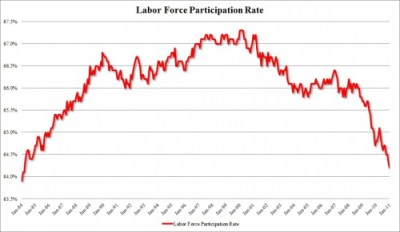
U.S. Labor Force Participation

By now, everyone has heard that Marxist Obama has failed to create jobs again, so that the underemployment rate is at 19.2%. (Underemployment is even higher than employment because it takes into account people working part-time who want to work full-time but can’t). That means that 20% of the population either cannot find work, or cannot find full-time work. The labor force participation under Obama’s socialist regime is now at a 26-year low.

Excerpt:

At 64.2%, the labor force participation rate (as a percentage of the total civilian noninstitutional population) is now at a fresh 26 year low, the lowest since March 1984, and is the only reason why the unemployment rate dropped to 9% (labor force declined from 153,690 to 153,186). Those not in the Labor Force has increased from 83.9 million to 86.2 million, or 2.2 million in one year! As for the numerator in the fraction, the number of unemployed, it has plunged from 15 million to 13.9 million in two months! The only reason for this is due to the increasing disenchantment of those who completely fall off the BLS rolls and no longer even try to look for a job. Lastly, we won’t even show what the labor force is as a percentage of total population. It is a vertical plunge.

But these kinds of failures are not unavoidable. For example, look at Canada’s latest unemployment numbers.

Excerpt:

Canada’s job creation in January was more than four times the median forecast, pushing the Canadian dollar to its strongest level since May 2008 and adding to evidence the country’s economic recovery may be accelerating.

Employment rose by 69,200 and the labor force increased by 106,400, Statistics Canada said today in Ottawa. The jobless rate rose to 7.8 percent from December’s 7.6 percent, as more people sought work. Economists forecast 7.6 percent unemployment and job growth of 15,000, according to the median estimates of 25 and 26 economists surveyed by Bloomberg News.

“This adds confidence to the notion we are headed for a better year for growth and growth in the job market,” said Mark Chandler, head of Canadian currency and rates strategy at Royal Bank of Canada’s RBC Capital Markets unit in Toronto. “There isn’t a lot of slack in the labor market in Canada, certainly on a relative basis to other countries.”

Canadian policy makers have been dealing with the impact of a strong currency and a slowdown in growth of household and government spending that crimped the economic recovery in the second half of last year. Bank of Canada Governor Mark Carney stopped raising interest rates after September and Finance Minister Jim Flaherty scaled back plans to exit stimulus.

“It’s one of these reports that’s strong through and through – it’s hard to find any weakness,” said David Tulk, chief Canada macro strategist at Toronto-Dominion Bank’s TD Securities unit.

“The Bank of Canada would likely just see this as a step towards a stronger recovery, but not a point where they would need to respond,” he said. He predicts a July rate increase.

[…]The report restores Canada’s status as having regained all the jobs lost in the recession, after a Jan. 28 revision based on updated census data reduced Statistics Canada’s estimate of total employment.

The Canadian dollar gained 0.4 percent to 98.75 cents per U.S. dollar at 4:30 p.m. in New York from 99.11 cents yesterday, after earlier touching 98.32 cents, the strongest level since May 2008. The benchmark 10-year Canadian government bond yield increased four basis points to 3.46 percent, the highest since May.

[…]“Too many Canadians are still looking for work, the economic recovery is fragile,” Flaherty said today in response to a question in the House of Commons. “We need to continue with our job-creating, low-tax plan.”

Prime Minister Stephen Harper has said reductions in corporate taxes are the best way to boost employment.

[…]Wal-Mart Stores Inc., the world’s largest retailer, said Jan. 26 it will open 40 “supercenters” in Canada by the end of January 2012, creating 9,200 construction and store jobs.

Basically, the Canadians listened to Obama’s speeches, and then decided to do the EXACT OPPOSITE of what he said. They are drilling for more oil, lowering corporate taxes below 20%, (ours is 36%), cutting spending and raising interest rates to encourage people to spend less and invest more, which supports job creation. This is what Hayek would recommend. In order to create jobs, you need to cut corporate taxes to provide businesses with a profit motive. And you need to make sure that there is capital to borrow for risk-taking, which happens when interest rates are higher because people save more money by giving it to banks to lend to businesses. When a business sees that it can keep profits that it makes then that’s what they’ll do. That’s when they start expanding their businesses and taking risks – when there is money to be made. If you keep banning drilling, imposing health care costs and demonizing businesses in speeches, like Obama does, then they WON’T hire anyone.

I hope that all the young people who voted for the first MTV President are happy with their 18% youth unemployment rate. Ideas have consequences.

But the differences between Canada are even more pronounced. Recall that Canada is ONE TENTH the size of the United States, with one-tenth the population, one-tenth the GDP, and one-twentieth the national debt. A 700,000 increase in the number of jobs is really like a 700,000 increase when projected proportionally to the United States. Canada didn’t spend massive amounts of money on “stimulus” spending, because the prime minister is NOT a Keynesian. He’s a Hayekian, like me. He’s not following the socialist, academic playbook – he’s following the capitalist, real-world playbook. He doesn’t believe that lowering interest rates and wasting money of government public works projects is a way out of a recession. And he’s right.