Tag Archives: Economics

How much does the average American corporation make in profit?

How much profit does the average American corporation make?

A while back, there was a story about how Americans vastly overestimate how many people in the USA are homosexual. According to Gallup polls in 2011, Americans estimated that 25% of the people in America were homosexual. In 2015, it was 23%. The actual number is about 3%. So it’s very clear that Americans can have wildly inaccurate perceptions about reality. Why are Americans so wrong? I think it’s because they see a lot of gay people in high profile areas, particularly in the entertainment industry.

I thought about this failure to perceive reality when I saw a story about how much profit Americans think that corporations make. My guess was that the average corporation makes about 5-10% profit margin. I know this because I used to buy and sell stocks regularly and that’s one of the numbers I would look at. Most Americans own stocks, so I thought they most Americans would know the number as well. But it turns out that American perceptions of corporate profits are wildly off the mark.

Check out this article from the prestigious American Enterprise Institute:

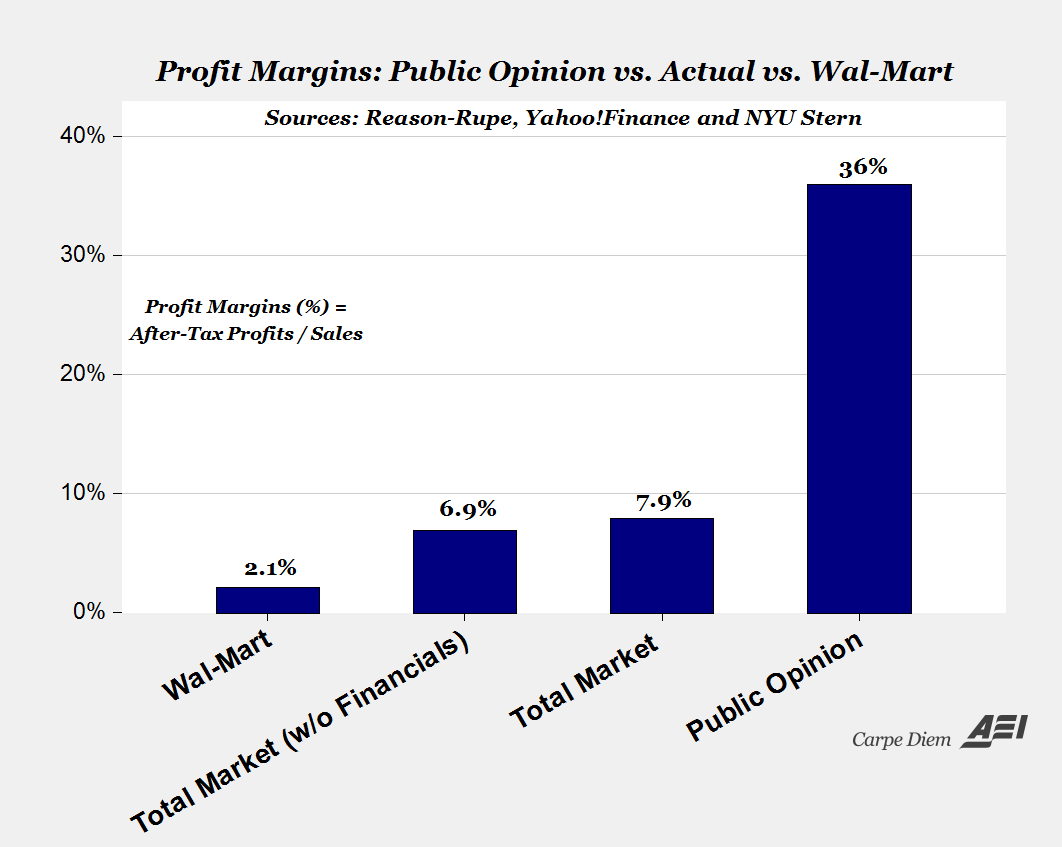
When a random sample of American adults were asked the question “Just a rough guess, what percent profit on each dollar of sales do you think the average company makes after taxes?” for the Reason-Rupe poll in May 2013, the average response was 36%! That response was very close to historical results from the polling organization ORC International polls for a slightly different, but related question: What percent profit on each dollar of sales do you think the average manufacturer makes after taxes? Responses to that question in 9 different polls between 1971 and 1987 ranged from 28% to 37% and averaged 31.6%.

How do the public’s estimates of corporate profit margins compare to reality? Not surprisingly they are off by a huge margin. According to this NYU Stern database for more than 7,000 US companies (updated in January 2018) in many different industries, the average profit margin is 7.9% for all companies and 6.9% for more than 6,000 companies excluding financials (see chart above).

[…]“Big Oil” companies make a lot of profits, right? Well, that industry (Integrated Oil/Gas) had a below-average profit margin of 5.6% in the most recent period analyzed, and separately, the Production and Exploration Oil/Gas industry is losing money, reflected in a -6.6% profit margin. For the general retail sector, the average profit margin is only 2.3% and for the grocery and food retail industry, it’s even lower at only 1.6%. And evil Walmart only made a 2.1% profit margin in 2017 (first three quarters) which is less than the industry average for general retail, possibly because grocery sales now make up more than half of Walmart’s revenue and profit margins are lower on food than general retail.

Sometimes, the government makes MORE from the sale of goods or services than the company that does ALL the work:

Interestingly, Walmart’s profit margin of 2.1% is actually less than one-third of the 6.5% the average state/local government takes of each dollar of Walmart’s retail sales for sales taxes. Think about it – for every $100 in sales for Walmart, the state/local governments get an average of $6.50 in sales taxes (and as much as $10.12 in Louisiana and $9.45 in Tennessee, see data here), while Walmart gets only $2.10 in after-tax profits!

I think that Americans are getting their false anti-corporation views from listening to the mainstream media. The mainstream media is overwhelmingly leftist according to recent studies of their political donations. I think that the anti-corporate views of the average American comes from their uncritical consumption of mainstream media propaganda. They think they are getting objective news reporting, but what they’re really getting is socialist propaganda.

Here is a short little video that explains more about profit margins, and what would happen if a socialist like Bernie Sanders were put in charge of a corporation:

If you’d like to help with this problem of anti-business economic illiteracy, please watch the video and share it, or share the AEI article, which contains the video. America will be a better country when Americans have accurate, informed beliefs about important issues.
How well is socialized health care working in Britain?

The National Health Service is government-run socialist health care

Back in 2009, a radical leftist named Paul Krugman wrote about the health care system in Britain. As a leftist, it’s his view that government-run health care is better than free market health care. Basically, he thinks that people get better health care if it’s run like the US Postal Service is run, instead of how Amazon.com is run.

Let’s see what he says in the far-left extremist New York Times:

In Britain, the government itself runs the hospitals and employs the doctors. We’ve all heard scare stories about how that works in practice; these stories are false. Like every system, the National Health Service has problems, but over all it appears to provide quite good care while spending only about 40 percent as much per person as we do. By the way, our own Veterans Health Administration, which is run somewhat like the British health service, also manages to combine quality care with low costs.

And what about the people who say that the NHS doesn’t provide quality health care, despite getting a huge portion of the all the taxes that are collected in Britain?

At this point, all that stands in the way of universal health care in America are the greed of the medical-industrial complex, the lies of the right-wing propaganda machine, and the gullibility of voters who believe those lies.

Every bad story that you’ve ever heard about socialized health care is a lie, and you’re gullible if you believe those lies.

Well, see, now I’m confused. Because if I turn the page of the New York Times from an editorial to a news story, I read this:

At some emergency wards, patients wait more than 12 hours before they are tended to. Corridors are jammed with beds carrying frail and elderly patients waiting to be admitted to hospital wards. Outpatient appointments were canceled to free up staff members, and by Wednesday morning hospitals had been ordered to postpone nonurgent surgeries until the end of the month.

Cuts to the National Health Service budget in Britain have left hospitals stretched over the winter for years, but this time a flu outbreak, colder weather and high levels of respiratory illnesses have put the N.H.S. under the highest strain in decades.

The situation has become so dire that the head of the health service is warning that the system is overwhelmed.

[…]“The N.H.S. waiting list will grow to five million people by 2021,” Mr. Stevens said in an impassioned speech to health care leaders in November. “That is one million more people, equivalent to one in 10 of us, the highest number ever.”

Over the past week, hospitals have increasingly declared “black alerts,” an admission that they are unable to cope with demand, the health service confirmed, without releasing numbers. Most hospitals have been unable to meet emergency-ward targets of seeing patients within four hours because of a shortage of beds and staff.

Britain spends billions and billions of pounds on health care every year, but it’s never enough. And British citizens already pay far more in taxes than Americans, who get much better care.

Sometimes, statistics are not as good as a good horror story…  On this blog, I’ve written about dozens of NHS horror stories. But Paul Krugman says they are all lies, including this one from the same New York Times article:

“There’s no real system or order; it’s a jungle in here,” said Nancy Harper, who had accompanied her 87-year-old grandmother, who was lying down and complaining of excruciating pain in her lower back.

“It’s been more than five hours,” Ms. Harper said. “We get to the front of the queue and then someone more ill comes in and we get pushed back. It’s outrageous.”

The UK Telegraph had some more information about the NHS health care system:

Every hospital in the country has been ordered to cancel all non-urgent surgery until at least February in an unprecedented step by NHS officials.

The instructions on Tuesday night – which will see result in around 50,000 operations being axed – followed claims by senior doctors that patients were being treated in “third world” conditions, as hospital chief executives warned of the worst winter crisis for three decades.

[…]Trusts have also been told they can abandon efforts to house male and female patients in separate wards, in an effort to protect basic safety, as services become overwhelmed.

50,000 scheduled surgeries canceled. If this were private sector health care, then the patients would have some recourse. But when the government is running health care, good luck trying to sue them for pain and suffering. They’ve already got your money from taxes, too – you can’t get it out to go somewhere else for surgery.

Although this seems horrifying to Americans, this is pretty standard all year round for Canadians, who have a true single payer health care system. According to the Fraser Institute, the average Canadian family pays about $12,000 in taxes for their free health care. And when they need things like MRIs or knee replacements, they have to wait for months. The average wait time there for “medically necessary treatment” is 21.2 weeks. Medically  Necessary Treatment. When I ask for an MRI in America, I get in the same week that I call.

When conservatives like me oppose government-run health care, it’s because we have looked carefully at government-run health care as it exists in comparable countries, and we have decided that it does not work. Progressives need to take a look at reality in countries like Britain and Canada. How well does it work? How much does it cost? It’s no good making policy decisions with feelings instead of facts.

Jay Richards: How to end poverty in 10 tough steps

I saw that Stand to Reason’s Amy Hall blogged about a lecture by Jay Richards, a Christian expert in economics. Amy linked to this post by Justin Taylor which summarizes the talk (above).

Summary:

  1. Establish and maintain the rule of law.
  2. Focus the jurisdiction of government on maintaining the rule of law, and limit its jurisdiction over the economy and the institutions of civil society.
  3. Implement a formal property system with consistent and accessible means for securing a clear title to property one owns.
  4. Encourage economic freedom: Allow people to trade goods and services unencumbered by tariffs, subsidies, price controls, undue regulation, and restrictive immigration policies.
  5. Encourage stable families and other important private institutions that mediate between the individual and the state.
  6. Encourage belief in the truth that the universe is purposeful and makes sense.
  7. Encourage the right cultural mores—orientation to the future and the belief that progress but not utopia is possible in this life; willingness to save and delay gratification; willingness to risk, to respect the rights and property of others, to be diligent, to be thrifty.
  8. Instill a proper understanding of the nature of wealth and poverty—that wealth is created, that free trade is win-win, that risk is essential to enterprise, that trade-offs are unavoidable, that the success of others need not come at your expense, and that you can pursue legitimate self-interest and the common good at the same time.
  9. Focus on your comparative advantage rather than protecting what used to be your competitive advantage.
  10. Work hard.

His book “Money, Greed and God” is a perfect introduction to economics and how it relates to the Christian worldview. I always encourage Christians to move beyond good intentions to good results by studying economics. We are supposed to be helping the poor, but how should we do it? Economics is the science that allows us to understand which policies we should support to do that.