Tag Archives: Economics

Higher taxes for the rich will not pay for Obama’s spending plans

Representative Michele Bachmann

On her official Townhall.com blog, Michele Bachmann asks whether Obama will ever be able to find money to pay for all the spending he has announced.

To pay for the trillions in spending that President Obama and his Congressional Democrat allies have passed and are about to pass in the months ahead, our President has assured us that taxes on Americans making less than $250,000 will not be raised by “one single dime.” His plan is to increase the tax rates on Americans making more than $250k a year to offset the spending. But is this even statistically feasible was the question the Wall Street Journal set out to answer?

She links to this story in the Wall Street Journal. The WSJ piece notes that Obama’s current plans to raise taxes won’t pay for the spending:

Note that federal income taxes are already “progressive” with a 35% top marginal rate, and that Mr. Obama is (so far) proposing to raise it only to 39.6%, plus another two percentage points in hidden deduction phase-outs. He’d also raise capital gains and dividend rates, but those both yield far less revenue than the income tax. These combined increases won’t come close to raising the hundreds of billions of dollars in revenue that Mr. Obama is going to need.

But there just isn’t enough money to pay for the spending even if we take 100% of the earnings of those who make only $75,000 and up.

A tax policy that confiscated 100% of the taxable income of everyone in America earning over $500,000 in 2006 would only have given Congress an extra $1.3 trillion in revenue. That’s less than half the 2006 federal budget of $2.7 trillion and looks tiny compared to the more than $4 trillion Congress will spend in fiscal 2010. Even taking every taxable “dime” of everyone earning more than $75,000 in 2006 would have barely yielded enough to cover that $4 trillion.

And as usual Democrats are ignorant of the fact that when you raise taxes on wealthiest producers, they stop producing, so the tax revenues actually go down. Not only that, but all of this tax and spend socialism destroys economic growth – so that tax revenues are reduced even further.

Fast forward to this year (and 2010) when the Wall Street meltdown and recession are going to mean far few taxpayers earning more than $500,000. Profits are plunging, businesses are cutting or eliminating dividends, hedge funds are rolling up, and, most of all, capital nationwide is on strike. Raising taxes now will thus yield far less revenue than it would have in 2006.

And the cap-and-trade scheme he announced earlier is going to hurt the economy even more by raising prices on energy production.

The bottom line is that Mr. Obama is selling the country on a 2% illusion. Unwinding the U.S. commitment in Iraq and allowing the Bush tax cuts to expire can’t possibly pay for his agenda. Taxes on the not-so-rich will need to rise as well.

On that point, by the way, it’s unclear why Mr. Obama thinks his climate-change scheme won’t hit all Americans with higher taxes. Selling the right to emit greenhouse gases amounts to a steep new tax on most types of energy and, therefore, on all Americans who use energy. There’s a reason that Charlie Rangel’s Ways and Means panel, which writes tax law, is holding hearings this week on cap-and-trade regulation.
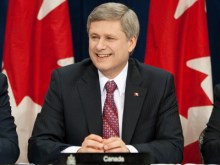
Canadian prime minister Stephen Harper interviewed by Larry Kudlow

Canadian Prime Minister Stephen Harper

Larry Kudlow sat down with Canadian prime minister Stephen Harper and had a conversation about Canada’s economic situation and policies. (Video here)

Kudlow first asks Harper about the banking situation in Canada. Harper says that the banks are run much more tightly in Canada. Harper explains that there are no bailouts planned for Canadian banks because Canadian banks are private institutions.

KUDLOW: Let me begin with an interesting subject here, banking. Everybody’s talking about banking. The Canadian banks appear to be in much better shape than the American banks. They have fewer toxic assets. Their losses aren’t nearly as bad. No one’s talking about bankruptcy up there. I want to learn from our northern cousins. What can you tell us? Why are Canadian banks looking better than our banks?

HARPER: Well first of all I can tell you, it is true. We have, I think, the only banks in the western world where we’re not looking at bailouts or anything like that.

KUDLOW: No TARP money sir, if I’m not mistaken? No TARP money?

HARPER: We haven’t got any TARP money. We’ve gone in and done some market transactions with our banks to improve liquidity. But I think the reasons are really complex, Larry. You know, first of all, our banks are private. We don’t have a Fannie Mae or Freddie Mac equivalent mucking around in the system.

KUDLOW: Is that a lesson right there Prime Minister?

HARPER: Well, I think my observation is those are institutions with a difficult private/public mix. And sometimes private/ public mixes have benefits and sometimes they have the worst of both worlds. We don’t have anything like that. We do have though, a strong system of regulation, and activist regulators, who go and meet with the sector. But they’re macro, prudential kind of regulations. They don’t try and micromanage banks’ decisions. We try and establish good oversight and transparency.

KUDLOW: Do you have leverage and borrowing ratios that might have been enforced? Because that’s clearly one of the breakdowns here in the states?

HARPER: Well, we do have leverage ratios. What’s ironic is that our own banks had not actually achieved those ratios. They were actually working under them. Part of what we…

KUDLOW: They were under leveraged?

HARPER: They were under leveraged.

KUDLOW: Wait, wait. Canadian banks were under leveraged?

HARPER: Under what they could have been.

KUDLOW: I didn’t know there was such a thing on this entire planet earth.

HARPER: Well I think part of what we have done is through the system of regulation we’ve had, we’ve encouraged a fairly cautious culture in the banks. For example, our banks, when they sign mortgages, largely hold those mortgages rather than trading them. So they have a lot more interest in the underlying quality of those mortgages. And we avoided the sub-prime kind of problem.

Kudlow goes on to quiz Harper on individual income tax rates, corporate income tax rates, tax cuts, Canadian energy production, carbon emissions, protectionism/free trade and auto-union bailouts. If you want to know what it is like to have an F.A. Hayek-admiring economist running your country, (BA and MA in Economics from the University of Calgary), read the whole thing!

UPDATE: More interviews with Stephen Harper with CNN, Wall Street Journal and Fox Business are here!

Vladimir Putin tells America that socialism doesn’t work

Found this transcript of Putin’s remarks in the Wall Street Journal. The story was linked over on John Lott’s blog.

Putin opposes protectionism:

We must not revert to isolationism and unrestrained economic egotism. The leaders of the world’s largest economies agreed during the November 2008 G20 summit not to create barriers hindering global trade and capital flows. Russia shares these principles.

Putin opposes state intervention in the economy:

Excessive intervention in economic activity and blind faith in the state’s omnipotence is another possible mistake.

True, the state’s increased role in times of crisis is a natural reaction to market setbacks. Instead of streamlining market mechanisms, some are tempted to expand state economic intervention to the greatest possible extent.

Putin opposes big government:

The concentration of surplus assets in the hands of the state is a negative aspect of anti-crisis measures in virtually every nation.

In the 20th century, the Soviet Union made the state’s role absolute. In the long run, this made the Soviet economy totally uncompetitive. This lesson cost us dearly.

Putin opposes wealth redistribution and welfare:

Nor should we turn a blind eye to the fact that the spirit of free enterprise, including the principle of personal responsibility of businesspeople, investors and shareholders for their decisions, is being eroded in the last few months. There is no reason to believe that we can achieve better results by shifting responsibility onto the state.

Putin opposes bailouts and deficit spending:

And one more point: anti-crisis measures should not escalate into financial populism and a refusal to implement responsible macroeconomic policies. The unjustified swelling of the budgetary deficit and the accumulation of public debts are just as destructive as adventurous stock-jobbing.

Putin goes on to give recommendations on how to solve the problem.

I can’t believe that America and the USSR have switched places. What is the world coming to? Obama has unilaterally plunged us into bankruptcy and angered the entire world with his naive protectionism. How could we have been so ignorant as to have elected someone with no knowledge of economics whatsoever? During an economic crisis!