

Tag Archives: Economic Growth

Jay Richards: eight common myths about wealth, poverty and the free market

I have a key that will unlock a puzzling mystery

Have you read Jay Richards’ book “Money, Greed and God?” Because if you haven’t, he’s written a series of articles that summarize the main points of the book.

The index post is here.

Here are the posts in the series:

  • Part 1: The Eight Most Common Myths about Wealth, Poverty, and Free Enterprise
  • Part 2: Can’t We Build A Just Society?
  • Part 3: The Piety Myth
  • Part 4: The Myth of the Zero Sum Game
  • Part 5: Is Wealth Created or Transferred?
  • Part 6: Is Free Enterprise Based on Greed?
  • Part 7: Hasn’t Christianity Always Opposed Free Enterprise?
  • Part 8: Does Free Enterprise Lead to An Ugly Consumerist Culture?
  • Part 9: Will We Use Up All Our Resources?
  • Part 10: Are Markets An Example of Providence?

Parts 4 and 5 are my favorites. It’s so hard to choose one to excerpt, but I must. I will choose… Part 4.

Here’s the problem:

Myth #3: The Zero Sum Game Myth – believing that trade requires a winner and a loser. 

One reason people believe this myth is because they misunderstand how economic value is determined. Economic thinkers with views as diverse as Adam Smith and Karl Marx believed economic value was determined by the labor theory of value. This theory stipulates that the cost to produce an object determines its economic value.

According to this theory, if you build a house that costs you $500,000 to build, that house is worth $500,000. But what if no one can or wants to buy the house? Then what is it worth?

Medieval church scholars put forth a very different theory, one derived from human nature: economic value is in the eye of the beholder. The economic value of an object is determined by how much someone is willing to give up to get that object. This is the subjective theory of value.

And here’s an example of how to avoid the problem:

How you determine economic value affects whether you view free enterprise as a zero-sum game, or a win-win game in which both participants benefit.

Let’s return to the example of the $500,000 house. As the developer of the house, you hire workers to build the house. You then sell it for more than $500,000. According to the labor theory of value, you have taken more than the good is actually worth. You’ve exploited the buyer and your workers by taking this surplus value. You win, they lose.

Yet this situation looks different according to the subjective theory of value. Here, everybody wins. You market and sell the house for more than it cost to produce, but not more than customers will freely pay. The buyer is not forced to pay a cost he doesn’t agree to. You are rewarded for your entrepreneurial effort. Your workers benefit, because you paid them the wages they agreed to when you hired them.

This illustration brings up a couple important points about free enterprise that are often overlooked:

1. Free exchange is a win-win game.

In win-win games, some players may end up better off than others, but everyone ends up better off than they were at the beginning. As the developer, you might make more than your workers. Yet the workers determined they would be better off by freely exchanging their labor for wages, than if they didn’t have the job at all.

A free market doesn’t guarantee that everyone wins in every competition. Rather, it allows many more win-win encounters than any other alternative.

2. The game is win-win because of rules set-up beforehand. 

A free market is not a free-for-all in which everybody can do what they want. Any exchange must be free on both sides. Rule of law, contracts, and property rights are needed to ensure exchanges are conducted rightly. As the developer of the house, you’d be held accountable if you broke your contract and failed to pay workers what you promised.

An exchange that is free on both sides, in which no one is forced or tricked into participating, is a win-win game.

On this view, what you really need to fear as a consumer is government intervention that restricts your choices in the marketplace, or makes some choices more expensive than they need to be (tariffs).

If you care about poverty, it’s often tempting to think that it can only be solved one way – by transferring wealth from the rich to the poor. But that is a very mistaken view, as any economist will tell you. The right way to create prosperity is by creating laws and policies that unleash individual creativity. Letting individuals create innovative products and services, letting them keep what they earn, making sure that the law doesn’t punish entrepreneurs – that incentivizes wealth creation. Fixing poverty does not mean transferring wealth, it means giving people more freedom to create wealth on their own. Free trade between nations is an important way that we encourage people to create better products and services that what they have available in their own countries.

Economists agree on the benefits of free trade

Who could possibly disagree with free trade? Well, many people on the left do. But economists across the spectrum of ideology (university and private sector and public sector) agree on the benefits of free trade.

Harvard economist Greg Mankiw explains what most professional economists agree on.

Excerpt:

Here is the list, together with the percentage of economists who agree:

  1. A ceiling on rents reduces the quantity and quality of housing available. (93%)
  2. Tariffs and import quotas usually reduce general economic welfare. (93%)
  3. Flexible and floating exchange rates offer an effective international monetary arrangement. (90%)
  4. Fiscal policy (e.g., tax cut and/or government expenditure increase) has a significant stimulative impact on a less than fully employed economy. (90%)
  5. The United States should not restrict employers from outsourcing work to foreign countries. (90%)
  6. The United States should eliminate agricultural subsidies. (85%)
  7. Local and state governments should eliminate subsidies to professional sports franchises. (85%)
  8. If the federal budget is to be balanced, it should be done over the business cycle rather than yearly. (85%)
  9. The gap between Social Security funds and expenditures will become unsustainably large within the next fifty years if current policies remain unchanged. (85%)
  10. Cash payments increase the welfare of recipients to a greater degree than do transfers-in-kind of equal cash value. (84%)
  11. A large federal budget deficit has an adverse effect on the economy. (83%)
  12. A minimum wage increases unemployment among young and unskilled workers. (79%)
  13. The government should restructure the welfare system along the lines of a “negative income tax.” (79%)
  14. Effluent taxes and marketable pollution permits represent a better approach to pollution control than imposition of pollution ceilings. (78%)

Socialist economic policies don’t work because they are making policies that are based on economic myths. We know that these myths are myths because of economics is a mathematical science, and because we have tried good and bad policies in different times and places. We have calculations and we have experience to know what works and what doesn’t work. If you want to help the poor, you have to respect what economists know about how wealth is created. The solution is not to “spread the wealth around”, it’s to encourage people to create more wealth by inventing things that people freely choose to buy.
Jay Richards: eight common myths about wealth, poverty and the free market

I have a key that will unlock a puzzling mystery

Have you read Jay Richards’ book “Money, Greed and God?” Because if you haven’t, he’s written a series of articles that summarize the main points of the book.

The index post is here.

Here are the posts in the series:

  • Part 1: The Eight Most Common Myths about Wealth, Poverty, and Free Enterprise
  • Part 2: Can’t We Build A Just Society?
  • Part 3: The Piety Myth
  • Part 4: The Myth of the Zero Sum Game
  • Part 5: Is Wealth Created or Transferred?
  • Part 6: Is Free Enterprise Based on Greed?
  • Part 7: Hasn’t Christianity Always Opposed Free Enterprise?
  • Part 8: Does Free Enterprise Lead to An Ugly Consumerist Culture?
  • Part 9: Will We Use Up All Our Resources?
  • Part 10: Are Markets An Example of Providence?

Parts 4 and 5 are my favorites. It’s so hard to choose one to excerpt, but I must. I will choose… Part 4.

Here’s the problem:

Myth #3: The Zero Sum Game Myth – believing that trade requires a winner and a loser. 

One reason people believe this myth is because they misunderstand how economic value is determined. Economic thinkers with views as diverse as Adam Smith and Karl Marx believed economic value was determined by the labor theory of value. This theory stipulates that the cost to produce an object determines its economic value.

According to this theory, if you build a house that costs you $500,000 to build, that house is worth $500,000. But what if no one can or wants to buy the house? Then what is it worth?

Medieval church scholars put forth a very different theory, one derived from human nature: economic value is in the eye of the beholder. The economic value of an object is determined by how much someone is willing to give up to get that object. This is the subjective theory of value.

And here’s an example of how to avoid the problem:

How you determine economic value affects whether you view free enterprise as a zero-sum game, or a win-win game in which both participants benefit.

Let’s return to the example of the $500,000 house. As the developer of the house, you hire workers to build the house. You then sell it for more than $500,000. According to the labor theory of value, you have taken more than the good is actually worth. You’ve exploited the buyer and your workers by taking this surplus value. You win, they lose.

Yet this situation looks different according to the subjective theory of value. Here, everybody wins. You market and sell the house for more than it cost to produce, but not more than customers will freely pay. The buyer is not forced to pay a cost he doesn’t agree to. You are rewarded for your entrepreneurial effort. Your workers benefit, because you paid them the wages they agreed to when you hired them.

This illustration brings up a couple important points about free enterprise that are often overlooked:

1. Free exchange is a win-win game.

In win-win games, some players may end up better off than others, but everyone ends up better off than they were at the beginning. As the developer, you might make more than your workers. Yet the workers determined they would be better off by freely exchanging their labor for wages, than if they didn’t have the job at all.

A free market doesn’t guarantee that everyone wins in every competition. Rather, it allows many more win-win encounters than any other alternative.

2. The game is win-win because of rules set-up beforehand. 

A free market is not a free-for-all in which everybody can do what they want. Any exchange must be free on both sides. Rule of law, contracts, and property rights are needed to ensure exchanges are conducted rightly. As the developer of the house, you’d be held accountable if you broke your contract and failed to pay workers what you promised.

An exchange that is free on both sides, in which no one is forced or tricked into participating, is a win-win game.

On this view, what you really need to fear as a consumer is government intervention that restricts your choices in the marketplace, or makes some choices more expensive than they need to be (tariffs).

If you care about poverty, it’s often tempting to think that it can only be solved one way – by transferring wealth from the rich to the poor. But that is a very mistaken view, as any economist will tell you. The right way to create prosperity is by creating laws and policies that unleash individual creativity. Letting individuals create innovative products and services, letting them keep what they earn, making sure that the law doesn’t punish entrepreneurs – that incentivizes wealth creation. Fixing poverty does not mean transferring wealth, it means giving people more freedom to create wealth on their own. Free trade between nations is an important way that we encourage people to create better products and services that what they have available in their own countries.

Economists agree on the benefits of free trade

Who could possibly disagree with free trade? Well, many people on the left do. But economists across the spectrum of ideology (university and private sector and public sector) agree on the benefits of free trade.

Harvard economist Greg Mankiw explains what most professional economists agree on.

Excerpt:

Here is the list, together with the percentage of economists who agree:

  1. A ceiling on rents reduces the quantity and quality of housing available. (93%)
  2. Tariffs and import quotas usually reduce general economic welfare. (93%)
  3. Flexible and floating exchange rates offer an effective international monetary arrangement. (90%)
  4. Fiscal policy (e.g., tax cut and/or government expenditure increase) has a significant stimulative impact on a less than fully employed economy. (90%)
  5. The United States should not restrict employers from outsourcing work to foreign countries. (90%)
  6. The United States should eliminate agricultural subsidies. (85%)
  7. Local and state governments should eliminate subsidies to professional sports franchises. (85%)
  8. If the federal budget is to be balanced, it should be done over the business cycle rather than yearly. (85%)
  9. The gap between Social Security funds and expenditures will become unsustainably large within the next fifty years if current policies remain unchanged. (85%)
  10. Cash payments increase the welfare of recipients to a greater degree than do transfers-in-kind of equal cash value. (84%)
  11. A large federal budget deficit has an adverse effect on the economy. (83%)
  12. A minimum wage increases unemployment among young and unskilled workers. (79%)
  13. The government should restructure the welfare system along the lines of a “negative income tax.” (79%)
  14. Effluent taxes and marketable pollution permits represent a better approach to pollution control than imposition of pollution ceilings. (78%)

Socialist economic policies don’t work because they are making policies that are based on economic myths. We know that these myths are myths because of economics is a mathematical science, and because we have tried good and bad policies in different times and places. We have calculations and we have experience to know what works and what doesn’t work. If you want to help the poor, you have to respect what economists know about how wealth is created. The solution is not to “spread the wealth around”, it’s to encourage people to create more wealth by inventing things that people freely choose to buy.

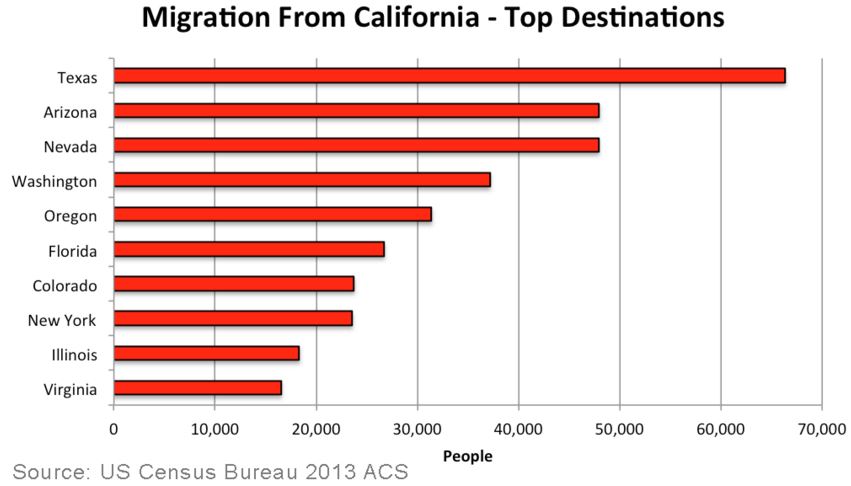
If socialism is so great, why are people moving from blue California to red Texas?

Migration from California to other states
Migration from California to other states – top 3 states are conservative states

A lot of young people seem to be really excited about socialism, and they want the United States to give it a try. They don’t know where socialism has been tried, and they don’t know what happens with it is tried. It just sounds nice to them.

Well, if you were going to pick one of the most socialist states in the United States, no one would fault you for picking California, where Democrats are running everything, and have been for a long time.

The Washington Free Beacon explains what happened next:

The number of Californians leaving the state and moving to Texas is at its highest level in nearly a decade, according to data from the Internal Revenue Service.

According to IRS migration data, which uses individual income tax returns to record year-to-year address changes, over 250,000 California residents moved out of the state between 2013 and 2014, the latest period for which data was available. The tax returns reported more than $21 billion in adjusted gross income to the IRS.

Of the returns, 33,626 reported address changes from California to Texas, which has been the top destination for individuals leaving California since 2007. Californians who moved to Texas between 2013 and 2014 reported $2.19 billion in adjusted gross income.

[…]“California’s taxes and regulations are crushing businesses, and there are more opportunities in Texas for people to start new companies, get good jobs, and create better lives for their families,” said Nathan Nascimento, the director of state initiatives at Freedom Partners. “When tax and regulatory climates are bad, people will move to better economic environments—this phenomenon isn’t a mystery, it’s how marketplaces work. Not only should other state governments take note of this, but so should the federal government.”

According to Tom Gray of the Manhattan Institute, people may be leaving California for the employment opportunities, tax breaks, or less crowded living arrangements that other states offer.

“States with low unemployment rates, such as Texas, are drawing people from California, whose rate is above the national average,” Gray wrote. “Taxation also appears to be a factor, especially as it contributes to the business climate and, in turn, jobs.”

“Most of the destination states favored by Californians have lower taxes,” Gray wrote. “States that have gained the most at California’s expense are rated as having better business climates. The data suggest that may cost drivers—taxes, regulations, the high price of housing and commercial real estate, costly electricity, union power, and high labor costs—are prompting businesses to locate outside California, thus helping to drive the exodus.”

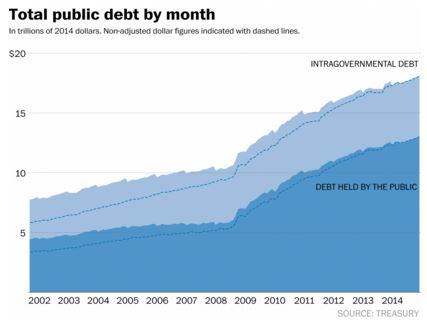
Just recently, I heard some of my Democrat co-workers laughing to each other about “trickle-down economics”, which is the “ridiculous” idea that if you allow businesses and workers to keep what they earn, then you’ll get more economic growth than if the government takes the money to study the drug use patterns of sex workers in the far East. Actually, we’ve been trying socialism-lite in this country for the past 7 years. How has it worked? Well, Obama has averaged 1.2% GDP growth through his presidency, far below average. And in order to get even that little growth, Obama will double the debt from 10 to 20 trillion in just 8 years.

Debt increase under Barack Obama

But what about tax cuts? Do tax cuts create economic growth?

The conservative Heritage Foundation think tank describes the effects of the Bush tax cuts.

Excerpt:

President Bush signed the first wave of tax cuts in 2001, cutting rates and providing tax relief for families by, for example, doubling of the child tax credit to $1,000.

At Congress’ insistence, the tax relief was initially phased in over many years, so the economy continued to lose jobs. In 2003, realizing its error, Congress made the earlier tax relief effective immediately. Congress also lowered tax rates on capital gains and dividends to encourage business investment, which had been lagging.

It was the then that the economy turned around. Within months of enactment, job growth shot up, eventually creating 8.1 million jobs through 2007. Tax revenues also increased after the Bush tax cuts, due to economic growth.

[…]The CBO incorrectly calculated that the post-March 2003 tax cuts would lower 2006 revenues by $75 billion. Revenues for 2006 came in $47 billion above the pre-tax cut baseline.

Here’s what else happened after the 2003 tax cuts lowered the rates on income, capital gains and dividend taxes:

  • GDP grew at an annual rate of just 1.7% in the six quarters before the 2003 tax cuts. In the six quarters following the tax cuts, the growth rate was 4.1%.
  • The S&P 500 dropped 18% in the six quarters before the 2003 tax cuts but increased by 32% over the next six quarters.
  • The economy lost 267,000 jobs in the six quarters before the 2003 tax cuts. In the next six quarters, it added 307,000 jobs, followed by 5 million jobs in the next seven quarters.

The timing of the lower tax rates coincides almost exactly with the stark acceleration in the economy. Nor was this experience unique. The famous Clinton economic boom began when Congress passed legislation cutting spending and cutting the capital gains tax rate.

Regarding the “Clinton economic boom”, that was caused by supply-sider Newt Gingrich passing tax cuts through the House and Senate. Bill Clinton merely signed the bills into law.

Very important to compare times and places where socialism has been tried to times and places where free enterprise and limited government have been tried. We know what works. It may not be what makes us feel smug, but we know what works.