Tag Archives: Deficit

Calls for Geithner resignation in wake of credit downgrade

Obama Budget Deficit 2011

First, some details about the recent downgrade of America’s credit rating by Standard & Poor’s.

Excerpt:

Standard & Poor’s announced Friday night that it has downgraded the U.S. credit rating for the first time, dealing a symbolic blow to the world’s economic superpower in what was a sharply worded critique of the American political system.

Lowering the nation’s rating to one notch below AAA, the credit rating company said “political brinkmanship” in the debate over the debt had made the U.S. government’s ability to manage its finances “less stable, less effective and less predictable.” It said the bipartisan agreement reached this week to find at least $2.1 trillion in budget savings “fell short” of what was necessary to tame the nation’s debt over time and predicted that leaders would not be likely to achieve more savings in the future.

[…]The downgrade to AA+ will push the global financial markets into uncharted territory after a volatile week fueled by concerns over a worsening debt crisis in Europe and a faltering economy in the United States.The AAA rating has made the U.S. Treasury bond one of the world’s safest investments — and has helped the nation borrow at extraordinarily cheap rates to finance its government operations, including two wars and an expensive social safety net for retirees.

Treasury bonds have also been a stalwart of stability amid the economic upheaval of the past few years. The nation has had a AAA rating for 70 years.

Analysts say that, over time, the downgrade could push up borrowing costs for the U.S. government, costing taxpayers tens of billions of dollars a year. It could also drive up interest rates for consumers and companies seeking mortgages, credit cards and business loans.

A downgrade could also have a cascading series of effects on states and localities, including nearly all of those in the Washington metro area. These governments could lose their AAA credit ratings as well, potentially raising the cost of borrowing for schools, roads and parks.

Jim Demint responds by calling for Tim Geithner’s resignation.

Excerpt:

Sen. Jim DeMint (R-S.C.) responded to the nation’s downgrade at the hands of Standard & Poor’s by calling for the resignation of Treasury Secretary Timothy Geithner.

Saying “enough is enough,” the Tea Party favorite pressured President Obama to remove his top economic official and adopt a new perspective.

“The President should demand that Secretary Geithner resign and immediately replace him with someone who will help Washington focus on balancing our budget and allowing the private sector to create jobs,” he said in a statement. “For months he opposed all efforts to reduce the debt in return for a debt ceiling increase. His opposition to serious spending and debt reforms has been reckless and now the American people will pay the price.”

After S&P put the nation’s rating on negative watch back in April, Geithner said there was “no risk” the US would be downgraded.

“No risk of that, no risk,” he said at the time in an interview with Fox Business Network.

Yes, there is no risk the same way that the 864 billion stimulus was supposed to keep unemployment below 8% – except that unemployment shot up over 10%.

I saw this status update from a friend on Facebook:

If you don’t understand the current financial crisis in our country, here’s a simplified explanation: “If the US Government was a family, they would be making $58,000 a year, they spend $75,000 a year, & have $327,000 in credit card debt. They are currently proposing BIG spending cuts to reduce their spending to $72,000 a year. These are the actual proportions of the federal budget & debt, reduced to a level that we can understand.” – Dave Ramsey

The Obama administration has had three one-and-a-half trillion dollar deficits in a row. That is nearly TEN TIMES the last Republican budget deficit in 2007. That was the last year that the Republicans held the House and Senate. The last year before Nancy Pelosi and Harry Reid came into power.
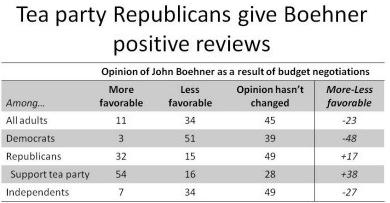
Tea party voters are pleased with John Boehner’s deal

Boehner's deal pleases the Tea Party

From the liberal Washington Post.

Excerpt:

A majority of Republicans who agree with the tea party movement give House Speaker John A. Boehner (R-Ohio) positive reviews for his role in debt negotiations in a new Washington Post-Pew Research Center poll. The speaker’s high marks represent a crucial link between the highly energized political movement and the Republican establishment as attention pivots back to the 2012 election cycle.

[…]After Republicans cut a deal on Sunday reducing the deficit with spending cuts alone – a key GOP and tea party priority – there is little doubt that the tea party movement has emerged as a powerful and sustained force in national politics.

[…]Tea party Republicans are significantly more tuned in than others to the 2012 presidential contest, according to another survey. Overall, more than eight in 10 are closely following the campaign, said the latest Washington Post-ABC News poll. Some 42 percent of Republicans who strongly support the tea party said they’re following it “very closely,” roughly twice the number of Democrats (17 percent), independents (19 percent) and Republicans overall (21 percent) who say so.

Tea party Republicans make up nearly one-quarter of registered voters in swing states. While tea party Republicans make up 17 percent of registered voters in states that favored Obama by 10 points or more according to June and July Post-ABC polls, they make up 23 percent of voters in states decided by single digit margins. That’s identical to the 23 percent of voters in heavily McCain states who identify as tea party Republicans.

Elections matter. Make sure you start engaging your friends now.

A closer look at the budget deal

Here’s a good article in the Wall Street Journal about the budget deal struck by the House, Senate and White House on the weekend.

Excerpt:

The big picture is that the deal is a victory for the cause of smaller government, arguably the biggest since welfare reform in 1996. Most bipartisan budget deals trade tax increases that are immediate for spending cuts that turn out to be fictional. This one includes no immediate tax increases, despite President Obama’s demand as recently as last Monday. The immediate spending cuts are real, if smaller than we’d prefer, and the longer-term cuts could be real if Republicans hold Congress and continue to enforce the deal’s spending caps.

The framework (we haven’t seen all the details) calls for an initial step of some $900 billion in domestic discretionary cuts over 10 years from the Congressional Budget Office (CBO) baseline puffed up by recent spending. If the cuts hold, this would go some way to erasing the fiscal damage from the Obama-Nancy Pelosi stimulus.

[…]The second phase of the deal is less clear cut, though it also could turn out to shrink Leviathan. Party leaders in both houses of Congress will each appoint three Members to a special committee that will recommend another round of deficit reduction of between $1.2 trillion and $1.5 trillion, also over 10 years. Their mandate is broad, and we’re told very little is off the table, but at least seven of the 12 Members would have to agree on a package to force an up-or-down vote in Congress.

If the committee can’t agree on enough deficit reduction, then automatic spending cuts would ensue to make up the difference to reach the $1.2 trillion minimum deficit-reduction target. One key point is that the committee’s failure to agree would not automatically “trigger” (in Beltway parlance) revenue increases, as the White House was insisting on as recently as this weekend. That would have guaranteed that Democrats would never agree to enough cuts, and Republicans were right to resist.

Instead the automatic cuts would be divided equally between defense and nondefense. So, for example, if the committee agrees to deficit reduction of only $600 billion, then another $300 billion would be cut automatically from defense and domestic accounts (excluding Medicare beneficiaries) to reach at least $1.2 trillion.

One reason to think tax increases are unlikely, however, is that the 12-Member committee will operate from CBO’s baseline that assumes that the Bush tax rates expire in 2013. CBO assumes that taxes will rise by $3.5 trillion over the next decade, including huge increases for middle-class earners. Since any elimination of those tax increases would increase the deficit under CBO’s math, the strong incentive for the Members will be to avoid the tax issue. This increases the political incentive for deficit reduction to come from spending cuts.

Mr. Obama’s biggest gain in the deal is that he gets his highest priority of not having to repeat this debt-limit fight again before the 2012 election. The deal stipulates that the debt ceiling will rise automatically by $900 billion this year, and at least $1.2 trillion next year, unless two-thirds of Congress disapproves it. Congress will not do so.

I don’t like the deal because I wanted Obama to have to face this problem with this again in May of 2012, but it may be the best deal we could get with control of only the House.