
Tag Archives: Deficit Spending

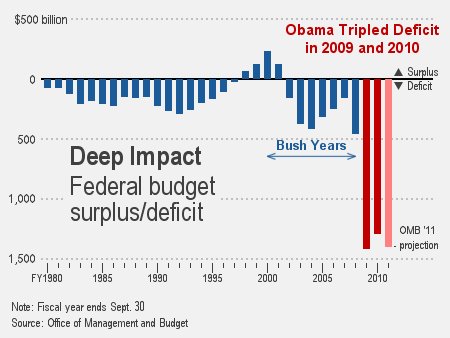
Obama budget is a ten-year, $1.5 trillion tax hike over present law

Here’s the analysis of Obama’s budget. (H/T The Blog Prof)

Excerpt:

President Obama released his budget this morning.  Rather than focusing on Washington’s over-spending problem, the budget calls for higher taxes on families and small businesses to pay for even more government spending.  Under the Obama budget, tax revenues will grow from 14.4% of GDP in 2011 to 20% of GDP in 2021.  By comparison, the historical average is only 18% of GDP.

Tax hike lowlights include:

  • Raising the top marginal income tax rate (at which a majority of small business profits face taxation) from 35% to 39.6%.  This is a $709 billion/10 year tax hike
  • Raising the capital gains and dividends rate from 15% to 20%
  • Raising the death tax rate from 35% to 45% and lowering the death tax exemption amount from $5 million ($10 million for couples) to $3.5 million.  This is a $98 billion/ten year tax hike
  • Capping the value of itemized deductions at the 28% bracket rate.  This will effectively cut tax deductions for mortgage interest, charitable contributions, property taxes, state and local income or sales taxes, out-of-pocket medical expenses, and unreimbursed employee business expenses.  A new means-tested phaseout of itemized deductions limits them even more.  This is a $321 billion/ten year tax hike
  • New bank taxes totaling $33 billion over ten years
  • New international corporate tax hikes totaling $129 billion over ten years
  • New life insurance company taxes totaling $14 billion over ten years
  • Massive new taxes on energy, including LIFO repeal, Superfund, domestic energy manufacturing, and many others totaling $120 billion over ten years
  • Increasing unemployment payroll taxes by $15 billion over ten years
  • Taxing management capital gains in an investment partnership (“carried interest”) as ordinary income.  This is a tax hike of $15 billion over ten years
  • A giveaway to the trial lawyers—not letting companies deduct the cost of punitive damages from a lawsuit settlement.  This is a tax hike of $300 million over ten years
  • Increasing tax penalties, information reporting, and IRS information sharing.  This is a ten-year tax hike of $20 billion.

Add it all together, and this budget is a ten-year, $1.5 trillion tax hike over present law. That’s $1.5 trillion taken out of the economy and spent on government instead of being used to create jobs.

The “tax relief” in the budget is mostly just an extension of present law, and also some refundable credit outlay spending in the tax code.  There is virtually no new tax relief relative to present law in the President’s budget.

So then how can the Obama administration claim that they are being fiscally responsible? Let’s see how. (H/T Hyscience)

Excerpt:

The Obama administration’s statement that the government will not be adding to the debt by the middle of the decade clashes hard against the facts, Republicans say, leaving officials straining to justify the budget claim they’ve pushed repeatedly over the past few days.

As it turns out, the administration is not counting interest payments. That means the budget team plans to have enough money to pay for ordinary spending programs by the middle of the decade. But it won’t have the money to pay off those pesky — rather, gargantuan — interest payments. So it will have to borrow some more, in turn increasing the debt and increasing the size of future interest payments year after year.

So how then, visibly agitated Republicans asked, can the administration claim that its 2012 spending plan sets the country on a course to “pay for what we spend” in just a few years?

Hyscience also linked to this McClatchy news article.

Excerpt:

He overlooks the fact that the government still would have to borrow to pay interest on the debt, much of it run up on his watch. Despite achieving “primary balance” in fiscal 2017, the government would have to borrow $627 billion to pay $627 billion in interest. Interest payments would rise annually through 2021.

Debt would rise as well, according to Obama’s proposed budget. Despite the budget reaching “primary balance,” the total gross government debt would rise from $21.9 trillion in fiscal 2017 to $22.9 trillion in 2018, $24 trillion in 2019, $25.2 trillion in 2020 and $26.3 trillion in 2021.

In all, the debt would jump by nearly $4.5 trillion in the four years after the government supposedly would stop adding to the debt because it had achieved “primary balance” – and that’s according to his own budget.

And a non-partisan fact-checking organization has found that Obama is lying about the budget. You can bet that the mainstream media will be backing him up, though.
Have the Democrats finally stopped spending money on bailouts?

The AP reports that bailout spending is ongoing, despite Treasury Department claims that bailouts are over. (H/T ECM)

Excerpt:

The Treasury Department says its bank bailouts are over, but the spending continues.

In a Sept. 22 speech, Treasury Secretary Timothy Geithner said the bailouts “are completely behind us.”

That’s not quite correct. In the final six months in which it could spend money from the Troubled Asset Relief Program, Treasury set aside $243 million for new contracts for law firms, accountants and money managers to help run what’s left of the bailouts – on top of the $529 million already spent on work by staff, private companies and other agencies. Many of the contracts last until 2019, and there’s nothing to stop the government from hiring even more help if it’s needed to chase down the remaining bailout money.

Treasury’s authority to spend more from the $700 billion fund expired on Oct. 3. The law requires officials to recoup as much as possible of the $185 billion still in the hands of shaky private companies. After all collections are made, the government expects to be out about $51 billion, mostly from housing programs.

Rising voter anger ahead of next week’s elections has made Obama administration officials reluctant to speak candidly about the ongoing cost of managing TARP. Politicians who voted for the TARP law now face tough re-election fights. By downplaying their efforts, officials sidestep criticism of bailouts that helped Wall Street without easing lending or keeping many people in their homes.

A government watchdog said this week that public statements by Treasury officials around the Oct. 3 deadline appeared designed to create a mistaken sense that TARP is over.

“The idea that TARP is dead is just not accurate,” said Neil Barofsky, the special inspector general overseeing the program, in an interview. “People can write its obituary, people can declare that it’s been put out of its misery, but there’s still close to $180 billion of TARP money outstanding, and $82 billion obligated to be spent.”

ECM also sent me this article from the Heritage Foundation which explains how to cut $343 billion from the federal budget without breaking a sweat.


Debt has increased 5 trillion since Pelosi became Speaker of the House

Nancy Pelosi becomes House Speaker in Jan 2007

Debt has increased 5 trillion since Nancy Pelosi became Speaker of the House in January 2007.

Excerpt:

When Rep. Nancy Pelosi (D-Calif.) gave her inaugural address as speaker of the House in 2007, she vowed there would be “no new deficit spending.” Since that day, the national debt has increased by $5 trillion, according to the U.S. Treasury Department.

“After years of historic deficits, this 110th Congress will commit itself to a higher standard: Pay as you go, no new deficit spending,” Pelosi said in her speech from the speaker’s podium. “Our new America will provide unlimited opportunity for future generations, not burden them with mountains of debt.”

Pelosi has served as speaker in the 110th and 111th Congresses.

At the close of business on Jan. 4, 2007, Pelosi’s first day as speaker, the national debt was $8,670,596,242,973.04 (8.67 trillion), according to the Bureau of the Public Debt, a division of the U.S. Treasury Department.  At the close of business on Oct. 22, it stood at $13,667,983,325,978.31 (13.67 trillion), an increase of 4,997,387,083,005.27 (or approximately $5 trillion).

Pelosi, the 60th speaker of the U.S. House of Representatives, has added more to the national debt than the first 57 House speakers combined.

The $4.997-trillion increase in the national debt since she took the gavel is more debt than the federal government amassed from the speakership of Rep. Frederick Muhlenberg of Pennsylvania, who became the first speaker of the House on April 1, 1789, to the start of the speakership of Rep. Newt Gingrich of Georgia, the 58th speaker, who took up the gavel on Jan. 4, 1995.

The national debt first topped $5 trillion on Feb. 23, 1996, more than a year into Gingrich’s speakership.

FIVE TRILLION since January 2007.

UPDATE: More from Hans Bader at the Competitive Enterprise Institute on the unemployment rate.

Excerpt:

As noted earlier, the stimulus package contained wasteful “green jobs” funding, 79 percent of which went to foreign firms, effectively sending American jobs overseas.  A recent biofuel program actually wiped out jobs rather than creating them as intended, while costing taxpayers a lot of money.  New EPA rules are expected to wipe out at least 800,000 jobs, and the EPA is considering new ozone rules that could wipe out 7.3 million jobs. The stimulus package contained provisions that wiped out thousands of jobs in America’s export sector.  New laws backed by Obama, and Obama Administration regulations governing employers, have discouraged employers from hiring new employees.

Businesses understand that more spending means inflation or taxes or both – so they stop hiring and stop expanding.