
Tag Archives: Defense

Interview with one of my favorite Christian scholars, Paul Copan

I found the interview here, thanks to Brian Auten’s weekly Apologetics 315 round-up, which is a must-read every week.

Excerpt:

Dayton: Outside of my apologetic endeavors, I work with middle school and high school students. As a rule, I keep copies of your book “True For You But Not For Me” on hand to give away to either students interested in learning more about apologetics or to unbelievers looking to explore Christianity. What other books have written that you could recommend be used in this manner?

Paul Copan: I appreciate your keeping copies of “True for You” handy!  I’ve written several books at a more popular level that either deal with a wide range of common criticisms or slogans leveled against Christianity, and I try to make more accessible topics like Christian philosophy of religion or dealing with Old Testament ethical problems.  So here are the other books to check out:

“That’s Just Your Interpretation” (Baker)
“How Do You Know You’re Not Wrong?” (Baker)
“When God Goes to Starbucks: An Introduction to Everyday Apologetics” (Baker)
“Loving Wisdom: Christian Philosophy of Religion” (Chalice Press)
“Is God a Moral Monster? Understanding the Old Testament God” (Baker, January 2011)

Dayton: Speaking of books you have written, is there anything new in the works? Do you have any forthcoming books you could tell us about?

Paul Copan: For a fuller picture of what I’m working on, people can check out my website: www.paulcopan.com.  I’m on Twitter (I tweet weekly); so people can keep up with my writings and speaking engagements that way.  I’m very excited about my book, Is God a Moral Monster? (forthcoming with Baker in January 2011).  The noted Old Testament scholar Gordon Wenham (University of Gloucestershire) has given this endorsement:  “Lucid, lively, and very well informed, this book is the best defence of Old Testament ethics that I have read.  A must-read for all preachers and Bible study leaders.”  Christopher J.H. Wright, a noted Old Testament scholar (specializing in Old Testament ethics) and author of Old Testament Ethics for the People of God and The God I Don’t Understand, has this blurb: “This is the book I wish I had written myself. It is simply the best book I have read that tackles the many difficulties that the Old Testament presents to thinking and sensitive Christians and that give such ammunition to the opponents of all religious faith…. I strongly recommend this book. We have wanted and needed it for a long time.”

I am coediting another book with William Lane Craig: Come Let Us Reason.  This is the third apologetics book we’ve edited for B&H Academic (the other two are Passionate Conviction and Contending with Christianity’s Critics); it is filled with cutting-edge essays on important topics such as issues surrounding the Qur’an’s authority, Jesus’ resurrection as a pagan myth, postmodernism, problems with naturalism, and so on.

I’m coauthoring a book on the moral argument with Mark Linville (Continuum), and another book on biblical ethics with Robertson McQuilkin called Living Wisdom (InterVarsity Press).  I’m also contributing several chapters to various books: on the Protestant view on human dignity (Routledge); on why ethics needs God (Oxford University Press); on theism’s contribution to bioethics (Routledge); two on the problem of the Canaanites (B&H Academic and another to be determined); on the moral argument (a short article) in The Dictionary of Christian Theology (Cambridge).  I’ve also contributed a series of articles on Old Testament ethics to Enrichment Journal.

I recently contributed a chapter “A Time for Truth” in The Complete Christian Guidebook to Understanding Homosexuality, edited by Joe Dallas and Nancy Heche (Harvest House) and a chapter on the moral argument to Mike Licona’s and Bill Dembski’s The Evidence for God (Baker).

Paul Copan is not only one the nicest guys, but he is also quite tough and combative about his faith. A real fire-breathing evangelical who writes about things that are relevant to rank and file. Whenever I send out beginner apologetics packages, I always include lots of Paul Copan books because his books are the most practical. For evangelicals who like to defend their faith to their co-workers and friends, Paul Copan is a must-read.

The other guys who write good books for beginners are Lee Strobel and Sean McDowell. All practical evangelicals used to fielding questions.
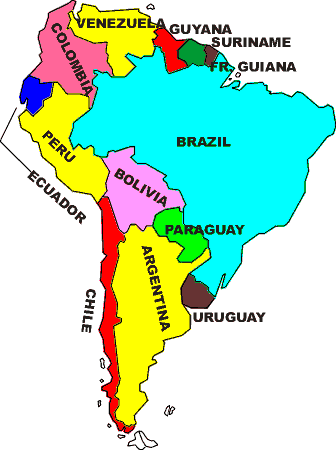
Colombia’s war on terrorism and Chile’s war on poverty

Map of South America

A magnificent column about Colombia’s war on FARC.

Excerpt:

When Juan Manuel Santos came into office as Colombia’s president and emphasized economic issues over the fight against terrorist guerrillas, he was suspected of going soft on those he had combated as minister of defense under the previous administration. Little did his critics know that he was planning the “coup de grace” against the Revolutionary Armed Forces of Colombia (FARC).

The devastating Sept. 22 attack on FARC headquarters in Colombia’s central Meta province all but signifies the end of the five-decade-old conflict. It will take a little while for the official end to be declared, but this war is pretty much over.

[…]For decades, politicians, academics, human rights activists and journalists on both sides of the Atlantic failed to see that there was nothing romantic, “bien-pensant” or Robin Hoodesque about an organization that killed, maimed, kidnapped and extorted for a totalitarian objective.

Colombia’s solitude was such that even the U.S. began to lose faith in its ally a couple of years ago, refusing to approve a free-trade agreement that Bogota had negotiated at a major political cost.

Colombians did not give up and continued to reclaim territory for civilian rule. Much like the defeat of Venezuela’s Cuba-inspired terrorist guerrillas in the 1960s, Colombia’s victory against FARC is the result of civilians awakening to the evil of totalitarian terror.

We get to hear about spectacular military feats, but how many outside Colombia realize that peasants, factory workers, teachers, students and others joined the struggle to defeat FARC, beautifully symbolized by the hundreds of thousands who took to the streets inside Colombia and around the world in 2008 to clamor for the end of terror?

There are still many challenges ahead. The lesson in courage and perseverance that Colombians have given us suggests they are ready to meet them.

I wish that we could sign a free trade deal with them like Canada’s conservative government. Canada is led by a conservative business-friendly economist, and they are very supportive of capitalist democracies like Colombia. Stephen Harper is Canada’s prime minister. He has economics degrees from the University of Calgary. Like Santos, he is very, very tough on terrorism – favoring increased defense spending to protect Canadian interests abroad. And guess what? Canada also has a free trade agreement with another South American country – Chile.

And Chile is also doing very well, even after the massive earthquake.

Excerpt:

Chile’s peso rose to a 27-month high after a report showed the country’s industrial growth accelerated to the fastest since 2006.

The peso appreciated 0.2 percent to 485.23 per U.S. dollar at 11:43 a.m. New York time, from 486.17 yesterday. The currency touched 483.61, the strongest since June 11, 2008. The peso has risen 13 percent during the quarter and 3.6 percent this month.

Chile’s economy is accelerating after the fifth-largest earthquake in a century struck in February, delaying its recovery from a 2009 recession.

“Retail sales grew and industrial production was better than expected,” said Roberto Melzi, a strategist at Barclays Capital in New York.

Retail sales expanded 13 percent in August from a year earlier, and industrial output grew 6.9 percent, the National Statistics Institute said in Santiago. That’s the most since January 2006. Industrial production shrank 17 percent after the 8.8-magnitude Feb. 27 earthquake and its accompanying tsunami, which caused damage worth more than a sixth of Chile’s gross domestic product.

Chile and Colombia are my two favorite South American countries. Both are led by conservative business-friendly economists. Chile’s president Sebastián Piñerahas a Masters and a Ph.D in economics from Harvard, and is successful in the private sector. The Colombian President Juan Manuel Santos specializes in business and economics, with graduate degrees from Harvard and the London School of Economics.

NY man arrested for defending home with firearm

From CBS News.

Excerpt:

George Grier said he had to use his rifle on Sunday night to stop what he thought was going to be an invasion of his Uniondale home by a gang he thought might have been the vicious “MS-13.” He said the whole deal happened as he was about to drive his cousin home.

“I went around and went into the house, ran upstairs and told my wife to call the police. I get the gun and I go outside and I come into the doorway and now, by this time, they are in the driveway, back here near the house. I tell them, you know, ‘Can you please leave?’ Grier said.

Grier said the five men dared him to use the gun; and that their shouts brought another larger group of gang members in front of his house.

“He starts threatening my family, my life. ‘Oh you’re dead. I’m gonna kill your family and your babies. You’re dead.’ So when he says that, 20 others guys come rushing around the corner. And so I fired four warning shots into the grass,” Grier said.

Grier was later arrested.

[…]Police determined Grier had the gun legally. He has no criminal record. And so he was not charged for the weapon.

Only the criminals can have guns, not the law-abiding people. Because criminals are victims of social inequalities, and the law-abiding people cause crime by having “more” than the criminals.