Tag Archives: Consumer-Driven Health Care

We have single-payer health care already in the VA system – is it working?

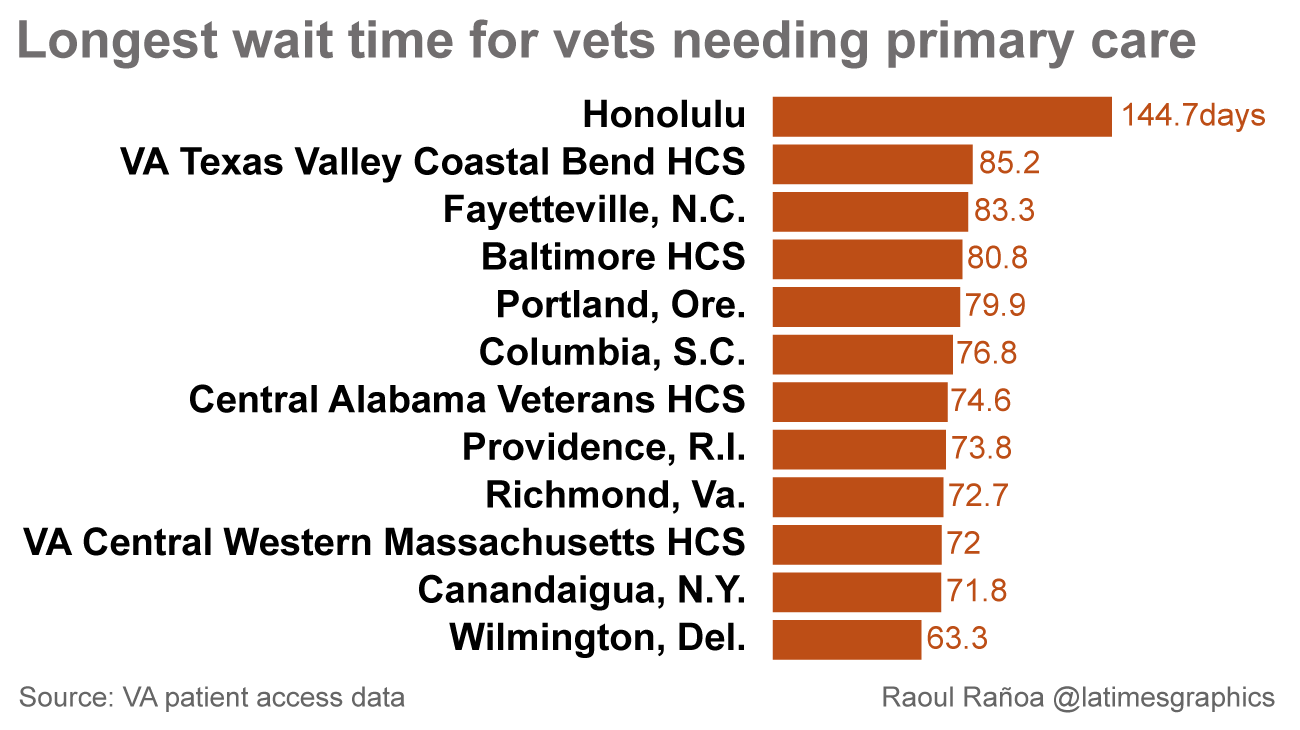
VA health care wait times

This is health care policy expert Sally Pipes, writing in Investors Business Daily.

She writes:

new report from the Government Accountability Office has confirmed that the Department of Veterans Affairs can’t take care of those it’s supposed to serve.

The GAO has placed the VA’s health system on the “high risk” list of federal programs that are vulnerable to “fraud, waste, abuse, and mismanagement.” The agency is still struggling to recover from an 8-month-old internal audit that revealed that returning soldiers had to wait more than 90 days for care. Some patients died while waiting.

The GAO’s findings apply far beyond the VA. The agency’s problems — which include long wait-times and out-of-control costs — demonstrate what happens in any government-run, single-payer health care system.

The VA’s failings ought to give pause to the liberal politicians and policy analysts who would love to introduce single-payer health care for all Americans. But they don’t seem to have heeded the GAO report. Within a week of its release, Rep. John Conyers, D-Mich., called for “Medicare for All.”

Champions of socialized medicine used to point to the VA as proof that single-payer worked. In 2011, economist Paul Krugman called it “a huge policy success story, which offers important lessons for future health reform.” In a 2009 debate with me, Princeton professor Uwe Reinhardt said that there’s an example of a single-payer system in the U.S. that works — the VA.

The VA offers lessons about health reform — just not the ones single-payer’s proponents have in mind.

Defenders of government-run health care claim that it will control costs by cutting out middlemen such as insurance companies. The evidence shows otherwise. According to the GAO, the VA budget more than doubled between 2002 and 2013 even as enrollment increased by less than a third.

Single-payer’s “guarantee” of access to high-quality care is a myth, too.

“Despite these substantial budget increases,” the GAO report says, “for more than a decade there have been numerous reports … of VA facilities failing to provide timely health care.”

Over the last decade, more than 63,000 veterans have been unable to get a doctor’s appointment. At least 40 veterans have died because of long waits.

Things aren’t likely to get better anytime soon. The VA has yet to act on more than 100 GAO recommendations for improving care.

Last summer, lawmakers allocated $10 billion to a program intended to reduce wait times by permitting veterans to see private doctors outside the VA system. So far, the agency has only authorized 31,000 vets to seek private care — out of a possible 8.5 million.

That has to change — 88% of veterans say that they want the ability to choose where they receive their care.

However, there is one military person who is getting health care – convicted traitor Bradley Manning. He’s getting sex-change surgery while he is in jail for leaking national security secrets to our enemies. He won’t have to wait at all for his health care. This is what happens when you take money out of your wallet, give it to the government, and then hope that when you get sick, someone in the government will decide that you are worthy of treatment. Which you aren’t, unless they want your vote.

It’s not just the VA health care system – government-run health care doesn’t work in other places:

The United Kingdom’s National Health Service, for instance, is notorious for denying patients everything from certain cancer medications to hip replacements.

The program is also financially unsustainable. According to its own medical director, Bruce Keogh, “if the NHS continues to function as it does now, it’s going to really struggle to cope because the model of delivery and service that we have at the moment is not fit for the future.”

In Canada’s single-payer system, the average wait time between referral from a general practitioner and the actual receipt of treatment by a specialist was more than four months in 2014. That’s nearly double the wait time of two decades ago.

The Canadian system is the one that Democrats want to emulate – but Canada’s rich left-wing politicians come here when they want care. They don’t want to wait in line. Why should we want to wait in line? We need to prefer consumer-driven health care over government-controlled health care.

Republicans introduce Obamacare alternative: American Health Care Reform Act

Endorsements for the American Healthcare Reform Act

The Daily Caller has an overview of what the bill would do.

There are 6 main sections:

  1. Repeal of Obamacare
  2. Increasing Access to Portable, Affordable Health Insurance
  3. Improving Access to Insurance for Vulnerable Americans
  4. Encouraging a More Competitive Health Care Market
  5. Reforming Medical Liability Law
  6. Respecting Human Life

I am a big supporter of making healthcare more consumer driven and less expensive, and of not violating conscience rights of medical workers. Does this bill do any of these things?

Section 4 addresses the need to make health  care consumer-driven:

Our bill would take steps toward creating a competitive health care marketplace. This legislation would take steps to address this problem by, most notably, allowing Americans to purchase health insurance products across state lines and by permitting small businesses to pool together to negotiate better rates.

Other pro-patient reforms include amending the McCarran-Ferguson Act to ensure that federal anti-trust law applies to health insurance, making Medicare claims and payment data publicly available so that patients and taxpayers alike can better understand what they are being charged, helping states develop transparency portals with useful information on insurance plans, and stopping the federal government from denying coverage for health care services based upon comparative effectiveness data.

Just like with any area of the free market, increasing competition among sellers reduces prices and increases quality.

Section 5 caps non-economic damages in medical liability lawsuits at $250,000:

This bill attempts to address the medical liability crisis that has played a role in the escalating cost of health care by implementing meaningful legal reforms that include caps on non- economic damages and limits to attorneys’ fees. These provisions set no caps on economic damages, which are often the largest component of liability awards, thus patients will continue to have their rights to economic damages protected.

Why didn’t Obamacare take that step? Because trial lawyers pressured them not to do it.

Section 6 should be of interest to anyone who believes in protecting the unborn:

Provides that nothing in this act requires health plans to provide coverage of abortion services, or permits any government official to require coverage of abortion. Prohibits federal funds authorized or appropriated by this act from covering abortion, except in the case of rape, incest, or when the life of the mother is jeopardized. Ensures that no state pro-life or conscience protection laws will be preempted.

Pro-abortion groups made sure that Obamacare would offer free condoms and free abortion-causing drugs. That needs to be fixed.

So that’s what health care reform would look like if Republicans did it. You can click here to find out more about the bill.

Where I found out about this

I found out about this bill from the Family Research Council Washington Watch Weekly podcast.

Details:

On this week’s edition of Washington Watch Weekly, I will be joined by veteran sportscaster, Craig James, who will tell us why he was sacked by Fox Sports and why he is fighting back, not only for himself, but for all Christians. The media continues to say that Republicans and Conservatives who are against Obamacare are ignoring the problems in our health care system and really don’t care about the uninsured. Short response: they’re wrong. Rep. Phil Roe (R-Tenn.) tells us why. Also, Tom Fitton with Judicial Watch tells us about the latest lawsuit against the Obama administration, who tries to say they are transparent. Well, this time, Tom and his team are suing the Pentagon over their relationship with the anti-Christian crusader, Mikey Weinstein.

Here is my full list of favorite podcasts.

How privatization turned the worst-performing NHS hospital around

From the American Spectator.

Excerpt:

[T]he most successful of the “drastic” experiments put in place is that much-hated bête noire of progressives and Obamacare supporters everywhere: privatization. The Mail Onlinereports that Hinchingbrooke Hospital, “The first NHS trust to be operated entirely by a private company has recorded one of the highest levels of patient satisfaction in the country.”

In other words, the Brits were so desperate to fix their crumbling health care system, they experimented with the private market and it is outperforming government-run health care without breaking a sweat. Hinchingbrooke was, like so many hospitals in the UK, about to go under when a private company called Circle Holdings was awarded a 10-year contract to run it. This is the first time such a company has been given control of an NHS hospital and the results will not come as a surprise to anyone who understands free enterprise.

As the Mail Online goes on to report, “The company running the trust has slashed losses at the hospital by 60 per cent and will soon begin to pay… debts built up over years of mismanagement.” Though will be no surprise to free market advocates, it has been a real eye-opener to the NHS. Privatization isn’t the dirty word it once was in the much-maligned health system: “The takeover deal … is seen as a blueprint for the future of many NHS trusts. The George Eliot Hospital in Warwickshire is already considering adopting the model.”

It will also come as no surprise to those who believe the market provides the most efficient health care delivery model that, in addition to dramatically improving the financial prospects, privatization has improved patient satisfaction. Before Hinchingbrooke was taken over by Circle Holdings, patients had a very low opinion of the hospital and the care it provided. Now, this perception is dramatically improved: “Patient satisfaction has risen to 85 per cent, placing Hinchingbrooke in the top six of the East of England’s 46 hospitals.”

I took a look at the UK Daily Mail article and found an interesting section:

Patient satisfaction has risen to 85 per cent, placing Hinchingbrooke in the top six of the East of England’s 46 hospitals. The feedback is calculated by asking families and patients whether they would recommend the hospital, then weighting the answers compared to local peers.

Previously the trust was among the lowest ranking for satisfaction.

Figures also show that Hinchingbrooke has risen from being one of the worst performing trusts to one of the best under the private firm’s management.When Circle took over, the hospital was consistently near the bottom of the 46 trusts, with many patients waiting more than four hours in A&E.

It now tops the list for short waiting times, seeing 98.2 per cent of patients within the required window.
The hospital also ranks fifth for the proportion of patients with suspected cancer having tests within a fortnight.

Before the takeover it had missed targets every month since June 2010.

It now treats 89 per cent of cancer patients within 62 days, beating the 85 per cent target.

Circle saved millions of pounds a year by cutting out arduous paperwork and middle management.

Under the former ownership, a lengthy form had to be filled out every time a lightbulb needed changing, in a process that often took more than a week.

The group, which runs independent hospitals in Reading and Bath, inherited debts of £39million with the project.

The hospital had been expected to lose £10million last year, but this has been whittled down to  £3.7million by the Circle group.

It made up the deficit from its own coffers, rather than taxpayer funds, and is expected to break even in the current year.

Do you think that we might consider privatizing Medicaid and Medicare, since we know that privatization is good for health care consumers and taxpayers? Of course not, because privatization is bad for politicians, who want to retain control of health care. Privatization is good, but we’re not going to get it unless we vote the socialists out.