

Tag Archives: Compassion

Study: sex-reassignment surgery does not improve mental health of transgender people

Investigation in progress

I found this peer-reviewed PLOS study while reading an article from CNS News.

The study takes a look at sex-reassigned people in pro-LGBT Sweden, between 1973 and 2003. Specifically, they aim to measure “mortality, morbidity, and criminal rate after surgical sex reassignment of transsexual persons” over a 30 year period.

The setting is important because Sweden has a much higher tolerance for gay rights than other Western countries, e.g. – America. There’s virtually no dissent from the gay rights agenda in Sweden – certainly no organized dissent.

Here are the results and the conclusion:

Results

The overall mortality for sex-reassigned persons was higher during follow-up (aHR 2.8; 95% CI 1.8–4.3) than for controls of the same birth sex, particularly death from suicide (aHR 19.1; 95% CI 5.8–62.9). Sex-reassigned persons also had an increased risk for suicide attempts (aHR 4.9; 95% CI 2.9–8.5) and psychiatric inpatient care (aHR 2.8; 95% CI 2.0–3.9). Comparisons with controls matched on reassigned sex yielded similar results. Female-to-males, but not male-to-females, had a higher risk for criminal convictions than their respective birth sex controls.

Conclusions

Persons with transsexualism, after sex reassignment, have considerably higher risks for mortality, suicidal behaviour, and psychiatric morbidity than the general population. Our findings suggest that sex reassignment, although alleviating gender dysphoria, may not suffice as treatment for transsexualism, and should inspire improved psychiatric and somatic care after sex reassignment for this patient group.

So, there were higher risks of death, higher risk of suicidal behavior, and higher mental illness.

The CNS News article interviewed a Johns Hopkins University scientist who is familiar with the history of sex-reassignment surgery.

Excerpt:

Dr. Paul R. McHugh, the Distinguished Service Professor of Psychiatry at Johns Hopkins University and former psychiatrist–in-chief for Johns Hopkins Hospital, who has studied transgendered people for 40 years, said it is a scientific fact that “transgendered men do not become women, nor do transgendered women become men.”

[…]Dr. McHugh, who was psychiatrist-in-chief at Johns Hopkins Hospital for 26 years, the medical institute that had initially pioneered sex-change surgery – and later ceased the practice – stressed that the cultural meme, or idea that “one’s sex is fluid and a matter of choice” is extremely damaging, especially to young people.

[…][T]here is plenty of evidence showing that “transgendering” is a “psychological rather than a biological matter,” said Dr. McHugh.

“In fact, gender dysphoria—the official psychiatric term for feeling oneself to be of the opposite sex—belongs in the family of similarly disordered assumptions about the body, such as anorexia nervosa and body dysmorphic disorder,” said McHugh.

“Its treatment should not be directed at the body as with surgery and hormones any more than one treats obesity-fearing anorexic patients with liposuction,” he said.

In fact, at Johns Hopkins, where they pioneered sex-change-surgery, “we demonstrated that the practice brought no important benefits,” said Dr. McHugh. “As a result, we stopped offering that form of treatment in the 1970s.”

Regarding the study, McHugh says this:

The most thorough follow-up of sex-reassigned people—extending over 30 years and conducted in Sweden, where the culture is strongly supportive of the transgendered—documents their lifelong mental unrest.”

“Ten to 15 years after surgical reassignment, the suicide rate of those who had undergone sex-reassignment surgery rose to 20 times that of comparable peers,” said McHugh.

Normally, when it comes to questions like these, I think it’s best to be guided by the evidence. What good would it do to tell someone to do something that makes them like you today (“you’re so tolerant and compassionate”) if they commit suicide tomorrow? Although people today think that being truthful and setting boundaries is “intolerant”, it can actually save someone’s life. When you stop someone from going further in a direction that will expose them to harm, you’re actually doing the right thing – even if they hate you right now for disagreeing with them. (That hatred of dissent is a sign that they are wrong, by the way)
Analysis: how much did each Obamacare mandate drive up health insurance premiums?

How each Obamacare mandate affected the health insurance premiums

Since 2010, we were inundated with reports and studies from various groups that argued that the new mandates in Obamacare would drive up the cost of health insurance. And that was actually observed to happen. Year after year, health insurance costs rose – usually by double digits. We knew why this was happening, too: Obamacare required health insurers to cover more conditions, many of them not even related to health insurance.

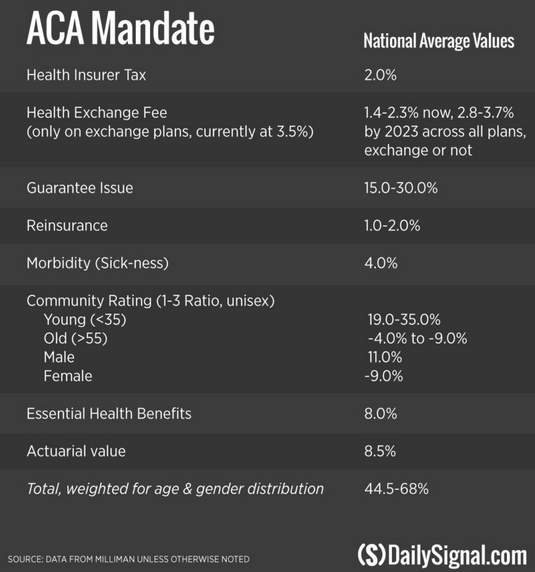
Here is an an analysis of which mandates caused health insurance costs to rise the most from the Daily Signal.

Excerpt:

Obamacare caused premiums to rise for various reasons, chief among them being the vast new regulations the law imposed on insurance markets. A new analysis from Milliman backs this up. The study provided estimates of the average impact that various Obamacare regulations had on premiums.

[…]Changes in morbidity (or the sickness of the population) due to newly uninsured by itself caused 4 percent increases in premiums nationally, but in Ohio it raised premiums by 35-40 percent.

Age is also a factor in premium prices, and Obamacare disrupted the natural order by dictating the age banding, which disproportionately harmed young people. (Age banding here refers to how much the most expensive plans can be in comparison to the cheapest.)

Before Obamacare, the national rate of age banding was 1-to-5. In other words, the most expensive plan was five times more costly than the cheapest plan, with expense increasing with age.

Obamacare mandated that the rate be set at 1-to-3, so that the most expensive plan could be no more than three times as expensive. While elderly people’s premiums might have seen fewer increases—which is both due to banding and the fact that Obamacare is close to a death spiral—young people have suffered.

Overall, young people can expect to have rate increases between 58.9 percent and 91.8 percent using national averages. However, not every state had a 1-to-5 age band.

In places like Ohio, the effects are far worse—it had a 1-to-6 age band. Even accounting for the differences in its population from the national average, young people in Ohio can still expect to pay an average of 7.7 percent more on top of other increases.

In addition to this “youth tax,” mandates like the “essential health benefits” and actuarial requirements further punish all Americans with benefits that they don’t need, at prices they can’t afford. While in places like Maryland these mandates might only contribute 8 to 10 percent to premium increases, nationally they raise premiums by an average of 16.5 percent, up to 32 percent.

Overall, accounting for gender, age, and the relative proportions of all those groups, Americans are paying 44.5 to 68 percent more in premiums owing just to Title I regulations. That number is even higher when factoring all the other adverse effects of Obamacare.

Notice that “guaranteed issue”, which is so popular with those who feel that they can somehow be generous by spending other people’s money, is one of the biggest drivers of health insurance costs. When pollsters ask people whether they want to keep these provisions, they mostly say yes. But when the pollsters ask whether they want to keep these provisions if it means that their own health insurance costs will go up, they mostly say no. It’s amazing how American voters, especially Democrats, love the idea of spending other people’s money. As long as they don’t have to pay for it, then it’s a great idea to spend someone else’s money in order to buy the feeling (and the peer approval) of being generous and compassionate.

And after 8 years of Obama offering that feeling to his supporters, we now have a national debt of $20 trillion, instead of $10 trillion. Mind you, in decades of asking my co-workers, I’ve never yet met one Democrat who could tell me what the national debt was. I guess that would interrupt their feelings of generosity and compassion.


Psychiatrist Paul McHugh explains the troubles with transgender activism

Lets take a closer look at a puzzle

In the Wall Street Journal.

Excerpt:

The transgendered suffer a disorder of “assumption” like those in other disorders familiar to psychiatrists. With the transgendered, the disordered assumption is that the individual differs from what seems given in nature—namely one’s maleness or femaleness. Other kinds of disordered assumptions are held by those who suffer from anorexia and bulimia nervosa, where the assumption that departs from physical reality is the belief by the dangerously thin that they are overweight.

With body dysmorphic disorder, an often socially crippling condition, the individual is consumed by the assumption “I’m ugly.” These disorders occur in subjects who have come to believe that some of their psycho-social conflicts or problems will be resolved if they can change the way that they appear to others. Such ideas work like ruling passions in their subjects’ minds and tend to be accompanied by a solipsistic argument.

For the transgendered, this argument holds that one’s feeling of “gender” is a conscious, subjective sense that, being in one’s mind, cannot be questioned by others. The individual often seeks not just society’s tolerance of this “personal truth” but affirmation of it. Here rests the support for “transgender equality,” the demands for government payment for medical and surgical treatments, and for access to all sex-based public roles and privileges.

With this argument, advocates for the transgendered have persuaded several states—including California, New Jersey and Massachusetts—to pass laws barring psychiatrists, even with parental permission, from striving to restore natural gender feelings to a transgender minor. That government can intrude into parents’ rights to seek help in guiding their children indicates how powerful these advocates have become.

How to respond? Psychiatrists obviously must challenge the solipsistic concept that what is in the mind cannot be questioned. Disorders of consciousness, after all, represent psychiatry’s domain; declaring them off-limits would eliminate the field. Many will recall how, in the 1990s, an accusation of parental sex abuse of children was deemed unquestionable by the solipsists of the “recovered memory” craze.

You won’t hear it from those championing transgender equality, but controlled and follow-up studies reveal fundamental problems with this movement. When children who reported transgender feelings were tracked without medical or surgical treatment at both Vanderbilt University and London’s Portman Clinic, 70%-80% of them spontaneously lost those feelings. Some 25% did have persisting feelings; what differentiates those individuals remains to be discerned.

We at Johns Hopkins University—which in the 1960s was the first American medical center to venture into “sex-reassignment surgery”—launched a study in the 1970s comparing the outcomes of transgendered people who had the surgery with the outcomes of those who did not. Most of the surgically treated patients described themselves as “satisfied” by the results, but their subsequent psycho-social adjustments were no better than those who didn’t have the surgery. And so at Hopkins we stopped doing sex-reassignment surgery, since producing a “satisfied” but still troubled patient seemed an inadequate reason for surgically amputating normal organs.

It now appears that our long-ago decision was a wise one. A 2011 study at the Karolinska Institute in Sweden produced the most illuminating results yet regarding the transgendered, evidence that should give advocates pause. The long-term study—up to 30 years—followed 324 people who had sex-reassignment surgery. The study revealed that beginning about 10 years after having the surgery, the transgendered began to experience increasing mental difficulties. Most shockingly, their suicide mortality rose almost 20-fold above the comparable nontransgender population. This disturbing result has as yet no explanation but probably reflects the growing sense of isolation reported by the aging transgendered after surgery. The high suicide rate certainly challenges the surgery prescription.

We seem to have this popular idea in our culture now that the loving thing to do in every case is to just affirm whatever anyone feels like doing. Want to have sex-reassignment surgery? No problem. Want to be surgically altered to look like a cat? No problem. Want to have an amputation because you don’t like your arm? No problem. Want to have taxpayer-provided heroine injected by nurses? No problem. Want to adopt a lifestyle that involves having risky sex with hundreds of unprotected partners? We’ll wave a rainbow flag for you. Want to get drunk and have sex before you (and they) have even graduated high school? Here are free condoms and free abortions to fix anything that might go wrong.

The really, really bad thing that we must never, ever do, apparently, is to tell someone “it’s wrong”.

I am really struggling to understand why telling people NOT to do things that are bad for them is a bad thing. I set boundaries on myself to keep myself out of trouble. Why can’t I let other people know what they are? Why do I have to pay taxes so that other people can afford to do risky and/or immoral things that I would never do?