
Reuters reports on a statement by 150 economists backing Republican demands for spending cuts.
Excerpt:
More than 150 economists back House of Representatives Speaker John Boehner’s call to match any increase in the debt limit with spending cuts of equal size, according to a letter released by the Republican leader’s office on Wednesday.
The letter will give Boehner an important talking point as he and his fellow House Republicans meet with President Barack Obama at 10 a.m. to discuss the debt limit and other fiscal issues.
“An increase in the national debt limit that is not accompanied by significant spending cuts and budget reforms to address our government’s spending addiction will harm private-sector job creation in America,” the letter said.
Signatories include Nobel laureate Robert Mundell of Columbia University and economists from schools like New York University and Georgetown University, as well as conservative think tanks like the American Enterprise Institute.
The Treasury Department has warned that the country could face a default that could push it back into recession and roil markets across the globe if it does not raise the $14.3 trillion debt limit by Aug 2. Treasury has been tapping federal employee pensions and other funds to pay the nation’s bills since it reached the current debt limit on May 16.
Republicans say they will not back any increase that does not include steep spending cuts and other limits to ensure that debt stays at a manageable level.
The Republican-controlled House on Tuesday defeated a bill that called for a debt-limit increase without conditions.
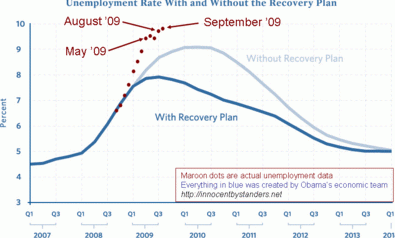
This Wall Street Journal article quotes a few economists responding to the recent disappointing job report.
Excerpt:
–What appeared to be a sustainable level of job growth seems to have faded hard in May. Yes nonfarm payrolls increased for the month, but that increase is actually a net-negative considering population growth that adds 75,000 – 85,000 workers to the labor force in an average month. Job growth is (was?) the only thing going for consumer incomes and spending, and this most recent result will throw said spending, responsible for 70% of economic activity, into a questionable state. –Guy LeBas, Janney Montgomery Scott
–There is no way to put lipstick on that pig: That was an extremely weak employment report. Nonfarm payrolls rose at the slowest pace since last September and private payrolls (+83,000) even posted their smallest increase since last June. One important factor behind the sudden deterioration between April and May was the swing in retail employment. The latter fell by 9,000 in May after still rising 64,000 in April. That pattern corroborates our view that the unusually late Easter lifted payrolls in April and were a corresponding drag in May… One sector that has to be highlighted here is “leisure & hospitality”. After creating 132,000 jobs (44,000 per month) between January and April, the sector cut 6,000 jobs in May — a monthly swing of -50,000 jobs. The reasons for this could be manifold: Households had to cut back on spending for arts, entertainment etc. amid soaring gasoline prices, or they were reluctant to visit restaurants amid higher food prices. –Harm Bandholz, Unicredit
–The slowdown in the pace of growth has clearly rattled the confidence of small and medium size firms that have been responsible for much of the hiring over the past few months.. Beneath the headline the data was just as dreary. Goods producers essentially slammed the brakes on hiring, with manufacturers culling 5,000 workers from the payrolls. Seasonal adjustments at the BLS likely accounted for the increase in hiring in the food and beverage sector, thus negating whatever McDonalds effect on retail hiring that might have occurred. The only real positives in the report were hiring by health care firms and in business services which modestly decelerated below their respective three month averages of 40,000 and 56,000 respectively. –Joseph Brusuelas, Bloomberg
–It is fairly clear that in the face of increasing uncertainty, against the backdrop of a deep recession and shallow recovery, firms decided to stop hiring. The bigger question remains whether this is a temporary hold or the pause before renewed layoffs on a broad scale. Looking at the underlying metrics of the economy, the June employment report will likely be worse than May. Going past the next the several months the economy is in the nexus of a temporary squall today created by the supply chain disruption and higher food and energy prices. All else being equal these issues will resolve themselves and the economy should rebound later in the summer. All else is not equal, however, as China is slowing, QE2 is ending, and no one really knows what fiscal policy is beginning. In sum, these factors will build increasing headwinds to growth whose full effect on real activity is unlikely to be felt for several more months.–Steven Blitz, ITG Investment Research
–The critical importance of continued labor market improvement cannot be overstated, as the wage and salary income that a labor market recovery, even a sub-par one by historical standards, provides to consumers will be key in providing fuel for ongoing economic growth in 2011. Therefore, today’s payroll figures, along with other evidence pointing to labor market woes in May (higher initial unemployment claims and a reduction in small business hiring plans being the two most important) are bad news indeed. To be fair, all was not terrible in this report, as the average workweek held steady from an upward revised 34.4 hour level in April and the manufacturing workweek increased to a robust 40.6 hours. –Joshua Shapiro, MFR Inc.
We’re in serious trouble, and the Democrats are oblivious.

 WINTERY KNIGHT