
Tag Archives: Colombia

GOP plan would create 1.2 million new jobs by expanding energy production

From the Pittsburgh Post-Gazette. (H/T Reuben, indirectly)

Excerpt:

Americans are angry and with good reason. They are hurting from unemployment, uncertainty in stock market investments and declining retirement funds. And they are weary of waiting for a real workable plan to get us out of this rut.

This is not a time to try the same failed policies of borrowing, debt and calls for tax increases. So we offer these ideas as President Barack Obama prepares to address Congress Thursday if he really wants to make some major bipartisan moves to get our country moving again.

[…]First, allow U.S. employers to repatriate $1 trillion sitting in overseas banks. The current tax rate of 35 percent is a huge barrier blocking those dollars from being invested in jobs, boosting the stock market and raising the value of retirement funds.

Some companies use armies of attorneys and accountants to find ways to cut those taxes, followed by the Internal Revenue Service tracking them down. Stop the nonsense. Offer a lower tax rate, perhaps 15 percent, for a limited time (maybe even a lower rate if the money is invested in job creation or in purchasing U.S. goods).

[…]Second, freeze the massive number of proposed regulations until Congress can review and approve them. Regulations cost U.S. employers more than $1.75 trillion per year. Federal agencies are moving forward with more than 4,257 new regulations that will add tens of billions in regulatory costs — more than tripling the burden of agency mandates from 2009.Employers are worried how this tsunami of new regulations will overwhelm their businesses so they are holding back on growth and hiring. Unless a regulation is absolutely necessary to protect the public’s health and safety, it should be stopped now. Enactment of House Resolution 10, the REINS Act, would require congressional review and approval for any mandate costing the economy more than $100 million annually.

Third, pass our bipartisan Infrastructure Jobs and Energy Independence Act (H.R. 1861), to expand safe offshore oil and gas exploration, create 1.2 million new jobs annually and launch $8 trillion in economic output. Our bipartisan bill dedicates a portion of up to $3.7 trillion in federal oil and gas revenues from the new exploration for investments in new energy technologies, power generation and grid modernization to help put us on a path to energy independence.

[…]Finally, to preserve a free global market for trade, we must hold foreign nations accountable to abide by international agreements. This year, America will lose its position as the global manufacturing leader to China, in large part because Beijing illegally gives its exports a 20 percent to 40 percent discount by manipulating and devaluing its currency.

Another good idea would be to sign the free trade deals with Panama, South Korea and Colombia. Heritage explains what would happen if we did.

Excerpt:

The Obama Administration—after allowing U.S. free trade agreements (FTAs) with South Korea, Colombia, and Panama to languish unapproved for nearly four years—lately appears eager to push Congress to ratify all three soon. The problem now is that some in Congress are trying to make their approval contingent upon an extension of the Trade Adjustment Act (TAA).

That would be a mistake. The three FTAs are intrinsically worth passing without any strings. Congress should act on them without further delay.

The Korea-U.S. Free Trade Agreement (KORUS) would be America’s largest free trade agreement in Asia. It would increase U.S. exports by an estimated $10 billion annually, increase U.S. gross domestic product (GDP) by $11 billion, and add 70,000 U.S. jobs—all without a dime in federal government spending.[1] The accord would also serve as a powerful statement of the U.S. commitment to East Asia at a time when many perceive declining American interest, presence, and influence in the region. The FTA would strengthen U.S. commercial ties and expand the bilateral relationship with South Korea beyond traditional military ties or the North Korean threat.

[…]Rejecting KORUS would disadvantage U.S. companies by locking in discriminatory trade barriers. During the four years the agreement was held hostage by special interest groups and congressional protectionists, the U.S. lost $40 billion in potential exports. American companies continued to lose market share to foreign competitors. The U.S. used to be South Korea’s largest trade partner, but in less than a decade it has been displaced by China, the European Union, and Japan. As Korea’s market opens further, it will be foreign competitors and not U.S. companies that will benefit.

[…]Until this year, the Obama Administration and congressional leadership took its orders on the U.S.–Colombia FTA from protectionist U.S. labor unions and U.S. anti-globalization groups, joined by far-left allies in the region, who succeeded in delaying congressional approval of the FTA. The cost of delay has been significant. So far, according to the Latin America Trade Coalition’s “Colombia Tariff Ticker,”[2] U.S. companies have paid $3.5 billion (as of this writing) in unnecessary duties to the Colombian treasury in the more than 1,600 days since the FTA was signed.

That $3.5 billion has translated into higher prices in Colombia for U.S. goods and services, which are now at a competitive disadvantage in the Colombian market. It has also meant reduced profits for U.S. companies and lost jobs at home.

There are plenty of good ideas from people who live in the real world where real economic laws apply. Keynesianism has been tried since Pelosi and Reid were elected in 2007. It has failed. We need to move on to what works.
Colombia’s war on terrorism and Chile’s war on poverty

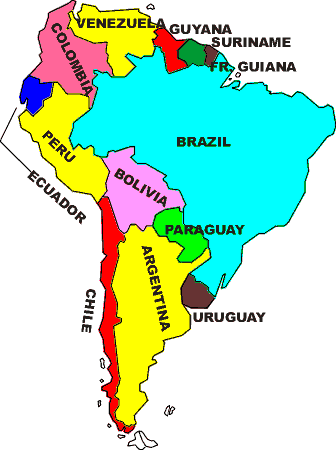
Map of South America

A magnificent column about Colombia’s war on FARC.

Excerpt:

When Juan Manuel Santos came into office as Colombia’s president and emphasized economic issues over the fight against terrorist guerrillas, he was suspected of going soft on those he had combated as minister of defense under the previous administration. Little did his critics know that he was planning the “coup de grace” against the Revolutionary Armed Forces of Colombia (FARC).

The devastating Sept. 22 attack on FARC headquarters in Colombia’s central Meta province all but signifies the end of the five-decade-old conflict. It will take a little while for the official end to be declared, but this war is pretty much over.

[…]For decades, politicians, academics, human rights activists and journalists on both sides of the Atlantic failed to see that there was nothing romantic, “bien-pensant” or Robin Hoodesque about an organization that killed, maimed, kidnapped and extorted for a totalitarian objective.

Colombia’s solitude was such that even the U.S. began to lose faith in its ally a couple of years ago, refusing to approve a free-trade agreement that Bogota had negotiated at a major political cost.

Colombians did not give up and continued to reclaim territory for civilian rule. Much like the defeat of Venezuela’s Cuba-inspired terrorist guerrillas in the 1960s, Colombia’s victory against FARC is the result of civilians awakening to the evil of totalitarian terror.

We get to hear about spectacular military feats, but how many outside Colombia realize that peasants, factory workers, teachers, students and others joined the struggle to defeat FARC, beautifully symbolized by the hundreds of thousands who took to the streets inside Colombia and around the world in 2008 to clamor for the end of terror?

There are still many challenges ahead. The lesson in courage and perseverance that Colombians have given us suggests they are ready to meet them.

I wish that we could sign a free trade deal with them like Canada’s conservative government. Canada is led by a conservative business-friendly economist, and they are very supportive of capitalist democracies like Colombia. Stephen Harper is Canada’s prime minister. He has economics degrees from the University of Calgary. Like Santos, he is very, very tough on terrorism – favoring increased defense spending to protect Canadian interests abroad. And guess what? Canada also has a free trade agreement with another South American country – Chile.

And Chile is also doing very well, even after the massive earthquake.

Excerpt:

Chile’s peso rose to a 27-month high after a report showed the country’s industrial growth accelerated to the fastest since 2006.

The peso appreciated 0.2 percent to 485.23 per U.S. dollar at 11:43 a.m. New York time, from 486.17 yesterday. The currency touched 483.61, the strongest since June 11, 2008. The peso has risen 13 percent during the quarter and 3.6 percent this month.

Chile’s economy is accelerating after the fifth-largest earthquake in a century struck in February, delaying its recovery from a 2009 recession.

“Retail sales grew and industrial production was better than expected,” said Roberto Melzi, a strategist at Barclays Capital in New York.

Retail sales expanded 13 percent in August from a year earlier, and industrial output grew 6.9 percent, the National Statistics Institute said in Santiago. That’s the most since January 2006. Industrial production shrank 17 percent after the 8.8-magnitude Feb. 27 earthquake and its accompanying tsunami, which caused damage worth more than a sixth of Chile’s gross domestic product.

Chile and Colombia are my two favorite South American countries. Both are led by conservative business-friendly economists. Chile’s president Sebastián Piñerahas a Masters and a Ph.D in economics from Harvard, and is successful in the private sector. The Colombian President Juan Manuel Santos specializes in business and economics, with graduate degrees from Harvard and the London School of Economics.

Is Colombia or Mexico better at dealing with criminal gangs?

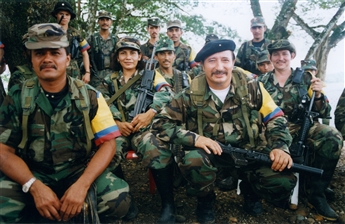
Colombian soldiers strike against FARC

Here’s a good story from Investors Business Daily.

Excerpt:

Colombia’s army blew away the field marshal of FARC’s narco-terror war Wednesday, showing with a jolt that to win, it’s terrorists who must “absorb” attacks, not innocents. Mexico and the U.S. have much to learn.

Seems the adage that Colombia is the only country where guerrillas die of old age isn’t true anymore.

On Thursday, Colombia celebrated news of the demise of Jorge Briceno, military commander and second-highest chief of FARC. The 57-year-old terrorist went down in a hail of bombs and gunfire over three days in a jungle bunker near La Macarena.

The Colombian army suffered no deaths and left at least 20 guerrillas dead on the jungle floor. Briceno’s demise marks the fourth knockout of FARC’s seven-man “Politburo”since 2008.

“This is the most crushing blow against the FARC in its entire history,” said Colombia’s president, Juan Manuel Santos, speaking from the sidelines at the United Nations in New York.

[…]Colombia’s war is in reality the southern flank of the same war that Mexico is fighting with its cartels — and that war is spilling over into the U.S. This is why Americans must pay attention.

The growing lawlessness on our border encompasses drugs, but also alien smuggling, kidnapping, counterfeiting and other acts of organized crime, with ties to global terror.

In Colombia’s case, it brooks no talk about “absorbing” terror attacks, as President Obama recently suggested in the U.S. If anything, Colombia seems to have taken lessons from Gen. David Petraeus’ surge in Iraq that took the war to the terrorists — and made sure they were the ones to worry about “absorbing” the attacks.

FARC is a left-wing Marxist terrorist group that traffics in cocaine. Hmmm. Cocaine? Terrorism? Marxism? That reminds me of someone. Who could it be?

Do you know what we should do to help Colombia defeat the Marxist-terrorist-drug cartel? We should sign a free trade deal so they can buy our stuff and we can buy their stuff. That will help them to grow more prosperous, and we’ll be more prosperous too! In fact, Canada has already done that. Canada likes Colombia. That’s why they signed a free trade agreement with Colombia. But the Democrats don’t like Colombia. Obama and the Democrats have delayed the signing of a free trade agreement with Colombia since they came into office.