Tag Archives: Cognitive Science

New collection of essays published to defend mind-body dualism

Here’s the new book on J.P. Moreland’s web site.

Full text:

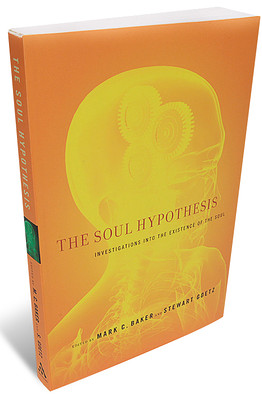
In the Soul Hypothesis: Investigations into the Existence of the Soul (Continuum), co-editors Mark C. Baker and Stewart Goetz have assembled an impressive interdisciplinary team of scholars to address questions about the existence and nature of the soul.

“The Soul of the Matter” – Charles Taliaferro
“Minds, Brains and Brains in Vats” – Daniel N. Robinson
“Brains and Souls; Grammar and Speaking” – Mark Baker
“Making Things Happen: Souls in Action” – Stewart Goetz
“Energy of the Soul” – Robin Collins
“The Measure of All Things: Quantum Mechanics and the Soul” – Dean Zimmerman
“From Seeing to Seer” – Hans Halvorson
“Souls Beastly and Human” – William Hasker
“A Scientific Case for the Soul” – Robin Collins

You can preview the book here.

The book is unique is combining philosophical and scientific arguments for dualism, and the result is a rigorous, exciting, persuasive presentation of the issues and a stimulating challenge to so much of the reductionism that reigns in the sciences. As was noted in a recent review of the book in the WSJ,

Sooner or later, the contributors to “The Soul Hypothesis” warn, scientists will pinpoint the exact three neurons whose firing accompanies the thought of our deciding to make a phone call or, if you prefer, deciding to get up and get a beer from the refrigerator. As ever more such micro-couplings are observed, we will—so scientists tell us with unseemly glee— gradually come to see that our cherished conscious life is nothing but a long series of electrical impulses, not an autonomous realm of free will and free thought. Co-editor Mark C. Baker cites the psychologist Steven Pinker, who finds it plausible to say that neural “activity in the brain” simply “is the mind.”

The book’s contributors set out this scientific challenge fully and engagingly, but they also expose its fallacies. They note, for instance, that even if two things differ in their essential nature, as do mental thoughts and physical actions—or legislatures and laws—there is no reason why the one can’t cause the other. As David Hume argued, what establishes our idea of cause and effect is the regular “conjunction” of two events. That a physical act regularly follows a mental decision suggests, as co-editor Stewart Goetz writes, that the one is “causing” the other and that voluntary human action exists.

The Soul Hypothesis is an excellent text that is sure to provoke a vigorous dialog about its content. I highly recommend it.

I really would like to be able to use this argument more – I just need a good book. I’m a big admirer of Charles Taliaferro. I even met him once at a conference!

Is belief in God explained by chemicals in the brain?

Greg Koukl of Stand to Reason explains. (H/T Melissa)

As Greg often says, before you can show WHY a belief is false, you know to show THAT a belief is false.

For those of us who are stuck behind a firewall, you can read this article by Paul Copan instead.

Here’s the problem:

Evolutionary biologist Richard Dawkins suggests that our “extraordinary predisposition” to “insist on believing in God” is that we, like computers, tend to do what we’re told. Young minds are susceptible to “infection” and mental “viruses” especially when they latch on to the bad or worthless religious ideas of charismatic preachers and other adults.1 Anthropologist Pascal Boyer believes that the latest “scientific” developments reveal that our “central metaphysical urge”—an “irredeemable human propensity toward superstition, myth and faith, or a special emotion that only religion provides”2 stands at the root of all religion. Author Matthew Alper considers humans to be religious animals whose brains are hard-wired for “God,” though no God exists, and maintains that the “spiritual” is really the “scientific.”3

And here’s the solution:

To say God doesn’t exist because people believe for inferior reasons or motivations is to commit the genetic fallacy—to say that a view is true/false based on its origin. God’s existence, however, is logically independent of how people come to believe in Him.

Consider the strong reasons for God’s existence distinct from human hard-wiring and psychology. The existence of valuable, morally responsible, self-aware, reasoning, living human beings who inhabit a finely tuned universe that came to exist a finite time ago is not plausibly explained naturalistically—namely, as the result of disparate valueless, mindless, lifeless physical processes in a universe that came into existence uncaused out of nothing. The better unifying explanation is a supremely valuable, supremely aware, reasoning, truthful, powerful, intelligent, beautiful Being. Such a context robustly explains—and unifies—a wide range of factors where naturalism fails. If God exists and leaves clues of his existence, then CSR’s reductionistic claims about theistic belief lose their force.

There is a LOT more in the Paul Copan essay on cognitive science of religion (CSR).

And Michael Murray published a book with Oxford University Press on his solution to this problem.

Excerpt:

Critics argue that belief in God is unwarranted because it arises from evolved, hard-wired cognitive mechanism. But, if these psychologists are right, so are many (if not all) of our other beliefs.

“Surely the critic doesn’t want to say that any belief that is the output of our mental tools—our cognitive tools—is unwarranted,” Murray notes, because “we can’t reasonably think that all of our beliefs are unreliable.” Further,

most of these critics think that our cognitive tools usually get things just right. To see this, just substitute the following words (or phrases) into the argument [above] and see if the critic would still find the underlying reasoning acceptable: human minds, rocks, rainbow, or science’s ability to discover the truth.

In other words, “Why do they think it’s fair to single out belief in the existence of God as the one thing that turns out to be unreliable or unwarranted?”

Hence, Murray notes, this sweeping argument is self-defeating. For if all brain-dependent beliefs are unwarranted, then the idea that “belief in God is unwarranted” is itself unwarranted.

Dawkins and many of his peers think this argument shows belief in God to be “merely” a “by-product” of human evolutionary development. Theistic intellectuals like Murray conclude that “God instead, designed us so that belief in him is easy and natural. The human mind is naturally constructed in such a way that we have a tendency to form beliefs in God concepts, and even of a somewhat specific sort.”

So if you believe Koukl, the argument commits the genetic fallacy. But even if you allow it to go through, like Michael Murray does, it’s self-refuting. (You can read more about Murray’s views in “Contending With Christianity’s Critics” and “Passionate Conviction” – and don’t worry about chastising him about his moderate views of intelligent design, I already wrote to him and beat him up about that, and he said it was just a bias / preference he had against intervening acts of fine-tuning subsequent to the moment of creation).

You may also be interested on the original “wish-fulfillment” objection, which Greg Koukl demolishes here. And another Greg Koukl article on whether you are your physical brain, or whether you are your non-physical mind and you have a brain.