Tag Archives: Clinton Foundation

Only 10% of money given to Clinton Foundation goes to charity

Astonishing article from The Federalist.

It says:

After a week of being attacked for shady bookkeeping and questionable expenditures, the Clinton Foundation is fighting back. In a tweet posted last week, the Clinton Foundation claimed that 88 percent of its expenditures went “directly to [the foundation’s] life-changing work.”

There’s only one problem: that claim is demonstrably false. And it is false not according to some partisan spin on the numbers, but because the organization’s own tax filings contradict the claim.

Look:
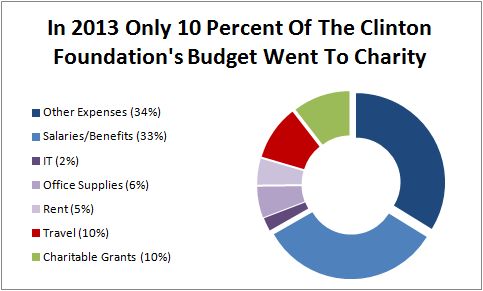
Only 10% of their income goes to charity

And:

In order for the 88 percent claim to be even remotely close to the truth, the words “directly” and “life-changing” have to mean something other than “directly” and “life-changing.” For example, the Clinton Foundation spent nearly $8.5 million–10 percent of all 2013 expenditures–on travel. Do plane tickets and hotel accommodations directly change lives? Nearly $4.8 million–5.6 percent of all expenditures–was spent on office supplies. Are ink cartridges and staplers “life-changing” commodities?

Those two categories alone comprise over 15 percent of all Clinton Foundation expenses in 2013, and we haven’t even examined other spending categories like employee fringe benefits ($3.7 million), IT costs ($2.1 million), rent ($4 million) or conferences and conventions ($9.2 million). Yet, the tax-exempt organization claimed in its tweet that no more than 12 percent of its expenditures went to these overhead expenses.

How can both claims be true? Easy: they’re not. The claim from the Clinton Foundation that 88 percent of all expenditures go directly to life-changing work is demonstrably false. Office chairs do not directly save lives. The internet connection for the group’s headquarters does not directly change lives.

[…][T]he IRS 990 forms submitted by the Clinton Foundation include a specific and detailed accounting of these programmatic expenses. And even using extremely broad definitions–definitions that allow office supply, rent, travel, and IT costs to be counted as programmatic costs–the Clinton Foundation fails its own test.

According to 2013 tax forms filed by the Clinton Foundation, a mere 80 percent of the organization’s expenditures were characterized as functional programmatic expenses. That’s a far cry from the 88 percent claimed by the organization just last week.

[…]In 2013, for example, only 10 percent of the Clinton Foundation’s expenditures were for direct charitable grants. The amount it spent on charitable grants–$8.8 million–was dwarfed by the $17.2 million it cumulatively spent on travel, rent, and office supplies. Between 2011 and 2013, the organization spent only 9.9 percent of the $252 million it collected on direct charitable grants.

While some may claim that the Clinton Foundation does its charity by itself, rather than outsourcing to other organizations in the form of grants, there appears to be little evidence of that activity in 2013. In 2008, for example, the Clinton Foundation spent nearly $100 million purchasing and distributing medicine and working with its care partners. In 2009, the organization spent $126 million on pharmaceutical and care partner expenses. By 2011, those activities were virtually non-existent. The group spent nothing on pharmaceutical expenses and only $1.2 million on care partner expenses. In 2012 and 2013, the Clinton Foundation spent $0. In just a few short years, the Clinton’s primary philanthropic project transitioned from a massive player in global pharmaceutical distribution to a bloated travel agency and conference organizing business that just happened to be tax-exempt.

As if that were not bad enough, now Bloomberg News is reporting that there were 1100 UNREPORTED DONORS to the Clinton Foundation, most of them non-US residents.

Look:

There are in fact 1,100 undisclosed donors to the Clinton Foundation, Giustra says, most of them non-U.S. residents who donated to CGEP.

[…]The reason this is a politically explosive revelation is because the Clinton Foundation promised to disclose its donors as a condition of Hillary Clinton becoming secretary of state. Shortly after Barack Obama was elected president in 2008, the Clinton Foundation signed a “memorandum of understanding” with the Obama White House agreeing to reveal its contributors every year. The agreement stipulates that the “Clinton Giustra Sustainable Growth Initiative” (as the charity was then known) is part of the Clinton Foundation and must follow “the same protocols.”

It hasn’t.

So, if none of the money from all these foreign donors was being used for charitable activities, then what was it being used for? Hmmmn, what could a Secretary of State who wants to run for President do with all that money?
Mitt Romney: Hillary’s Clinton Foundation Uranium One scandal “looks like bribery”

What looks like bribery? Well, read this story from the radically leftist New York Times, of all places. It should be the end of Hillary’s campaign.

Excerpt:

The headline in the website Pravda trumpeted President Vladimir V. Putin’s latest coup, its nationalistic fervor recalling an era when its precursor served as the official mouthpiece of the Kremlin: “Russian Nuclear Energy Conquers the World.”

The article, in January 2013, detailed how the Russian atomic energy agency, Rosatom, had taken over a Canadian company with uranium-mining stakes stretching from Central Asia to the American West. The deal made Rosatom one of the world’s largest uranium producers and brought Mr. Putin closer to his goal of controlling much of the global uranium supply chain.

But the untold story behind that story is one that involves not just the Russian president, but also a former American president and a woman who would like to be the next one.

At the heart of the tale are several men, leaders of the Canadian mining industry, who have been major donors to the charitable endeavors of former President Bill Clinton and his family. Members of that group built, financed and eventually sold off to the Russians a company that would become known as Uranium One.

Beyond mines in Kazakhstan that are among the most lucrative in the world, the sale gave the Russians control of one-fifth of all uranium production capacity in the United States. Since uranium is considered a strategic asset, with implications for national security, the deal had to be approved by a committee composed of representatives from a number of United States government agencies. Among the agencies that eventually signed off was the State Department, then headed by Mr. Clinton’s wife, Hillary Rodham Clinton.

As the Russians gradually assumed control of Uranium One in three separate transactions from 2009 to 2013, Canadian records show, a flow of cash made its way to the Clinton Foundation. Uranium One’s chairman used his family foundation to make four donations totaling $2.35 million. Those contributions were not publicly disclosed by the Clintons, despite an agreement Mrs. Clinton had struck with the Obama White House to publicly identify all donors. Other people with ties to the company made donations as well.

And shortly after the Russians announced their intention to acquire a majority stake in Uranium One, Mr. Clinton received $500,000 for a Moscow speech from a Russian investment bank with links to the Kremlin that was promoting Uranium One stock.

At the time, both Rosatom and the United States government made promises intended to ease concerns about ceding control of the company’s assets to the Russians. Those promises have been repeatedly broken, records show.

[…]The path to a Russian acquisition of American uranium deposits began in 2005 in Kazakhstan, where the Canadian mining financier Frank Giustra orchestrated his first big uranium deal, with Mr. Clinton at his side.

The two men had flown aboard Mr. Giustra’s private jet to Almaty, Kazakhstan, where they dined with the authoritarian president, Nursultan A. Nazarbayev. Mr. Clinton handed the Kazakh president a propaganda coup when he expressed support for Mr. Nazarbayev’s bid to head an international elections monitoring group, undercutting American foreign policy and criticism of Kazakhstan’s poor human rights record by, among others, his wife, then a senator.

Within days of the visit, Mr. Giustra’s fledgling company, UrAsia Energy Ltd., signed a preliminary deal giving it stakes in three uranium mines controlled by the state-run uranium agency Kazatomprom.

[…][T]he company’s story was hardly front-page news in the United States — until early 2008, in the midst of Mrs. Clinton’s failed presidential campaign, when The Times published an article revealing the 2005 trip’s link to Mr. Giustra’s Kazakhstan mining deal. It also reported that several months later, Mr. Giustra had donated $31.3 million to Mr. Clinton’s foundation.

[…][T]he ultimate authority to approve or reject the Russian acquisition rested with the cabinet officials on the foreign investment committee, including Mrs. Clinton — whose husband was collecting millions of dollars in donations from people associated with Uranium One.

Romney, in his interview with Hugh Hewitt, explained that because Bill and Hillary are married, their assets are co-mingled.

So what’s the problem with this deal?

The national security issue at stake in the Uranium One deal was not primarily about nuclear weapons proliferation; the United States and Russia had for years cooperated on that front, with Russia sending enriched fuel from decommissioned warheads to be used in American nuclear power plants in return for raw uranium. Instead, it concerned American dependence on foreign uranium sources. While the United States gets one-fifth of its electrical power from nuclear plants, it produces only around 20 percent of the uranium it needs, and most plants have only 18 to 36 months of reserves, according to Marin Katusa, author of “The Colder War: How the Global Energy Trade Slipped From America’s Grasp.”

“The Russians are easily winning the uranium war, and nobody’s talking about it,” said Mr. Katusa, who explores the implications of the Uranium One deal in his book. “It’s not just a domestic issue but a foreign policy issue, too.”

It’s a national security issue. We shouldn’t be selling uranium companies to countries like Russia who not only invade their neighbors, but also sell long-range missiles to Iran – and a host of other nasty things, too. This country is not friendly to us.

Hillary Clinton: secretive, entitled, hypoctritical

What was Hillary’s response? It’s a distraction invented by the vast right-wing conspiracy:

That’s some vast right-wing conspiracy that makes its way onto the nation’s most respected leftist national newspaper.

So, does this explain why Hillary Clinton deleted tens of thousands of e-mails and then wiped her private e-mail server clean? We’ll never know, because she destroyed all the evidence. But one thing is for sure – there is no reason to vote for this candidate for President, although some people will:

That’s the only “reason” that people will vote for her, because on the merits, she’s a stinker.

Related posts

New book by Peter Schweizer: Clinton State Department favored foreign donors

Hillary Clinton: secretive, entitled, hypoctritical

This is from the radically leftist New York Times, of all places.

They write:

The book does not hit shelves until May 5, but already the Republican Rand Paul has called its findings “big news” that will “shock people” and make voters “question” the candidacy of Hillary Rodham Clinton.

“Clinton Cash: The Untold Story of How and Why Foreign Governments and Businesses Helped Make Bill and Hillary Rich,” by Peter Schweizer — a 186-page investigation of donations made to the Clinton Foundation by foreign entities — is proving the most anticipated and feared book of a presidential cycle still in its infancy.

The book, a copy of which was obtained by The New York Times, asserts that foreign entities who made payments to the Clinton Foundation and to Mr. Clinton through high speaking fees received favors from Mrs. Clinton’s State Department in return.

“We will see a pattern of financial transactions involving the Clintons that occurred contemporaneous with favorable U.S. policy decisions benefiting those providing the funds,” Mr. Schweizer writes.

His examples include a free-trade agreement in Colombia that benefited a major foundation donor’s natural resource investments in the South American nation, development projects in the aftermath of the Haitian earthquake in 2010, and more than $1 million in payments to Mr. Clinton by a Canadian bank and major shareholder in the Keystone XL oil pipeline around the time the project was being debated in the State Department.

This is the piece that is missing in this Clinton Foundation story – the piece that could sink her, even if she has a $2.5 billion campaign war chest.

The book description from Amazon.com:

In 2000 Bill and Hillary Clinton owed millions of dollars in legal debt. Since then they’ve earned over $130 million. Where did the money come from? Most people assume the Clintons amassed their wealth through lucrative book deals and high-six-figure fees for speaking gigs. Now Peter Schweizer shows who is really behind those enormous payments.

In his New York Times best-selling books Extortion and Throw Them All Out, Schweizer detailed patterns of official corruption in Washington that led to congressional resignations and new ethics laws. In Clinton Cash he follows the Clinton money trail, revealing the connection between their personal fortune, their close personal friends, the Clinton Foundation, foreign nations, and some of the highest ranks of government.

Schweizer reveals the Clintons’ troubling dealings in Kazakhstan, Colombia, Haiti, and other places at the Wild West fringe of the global economy, where business is often conducted on the basis of bribes and personal connections. In this blockbuster exposé, Schweizer does not allege illegal or unethical behavior; he merely presents the troubling facts he’s uncovered. Meticulously researched and scrupulously sourced, filled with headline-making revelations, Clinton Cash raises serious questions of judgment, of possible indebtedness to an array of foreign interests, and ultimately of fitness for high public office.

Peter Schweizer is one of my favorite authors, and his research in his previous books was first class scholarship. I’m excited to see that he is hitting this story with a thorough review right when the story is heating up. He has to do the work that the mainstream media won’t do, or we will end up with another Obama.

Related posts