Tag Archives: Christian Theology

What is the Christian doctrine of the Trinity?

The Christian doctrine of the Trinity

I have a friend who is considering Christianity and he is stuck on the doctrine of the Trinity. Tom, this one’s for you.

Excerpt:

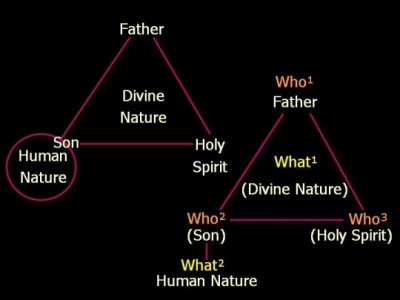
So, what exactly do we mean when we talk about the Trinity? Writing in the early third century, in hisAgainst Praxeas, Tertullian is credited with first employing the words “Trinity”, “person” and “substance” to convey the idea of the Father, Son and Spirit being “one in essence — but not one in person”. Indeed, Tertullian writes,

“Thus the connection of the Father in the Son, and of the Son in the Paraclete, produces three coherent Persons, who are yet distinct One from Another. These Three are, one essence, not one Person, as it is said, “I and my Father are One,” in respect of unity of substance not singularity of number.”

This concept was established as church orthodoxy at the famous Council of Nicaea in A.D. 325. The Nicene Creed speaks of Christ as “God of God, Light of Light, very God of very God, begotten not made, being of one substance with the Father.”

It is this definition that I am going to assume in the discussion that follows. Succinctly, then, the doctrine of the Trinity may be defined thusly: Within the one being or essence that is God, there exists three co-equal and co-divine distinct persons — namely the Father, Son and Holy Spirit — who share that essence fully and completely. This concept is not to be confused with polytheism, which maintains that there are multiple gods. While orthodox Christianity emphatically holds there to be only one God, we nonetheless understand God to be complex in his unity. The concept is also not to be confused with the ancient heresy of modalism, which maintains that God exists in three different modes. The Son has never been the Father and the Holy Spirit has never been the Son or the Father. Modalism is refuted by the picture given to us in all four gospels (Matthew 3:16-17; Mark 1:9-11; Luke 3:21-22; John 1:32-34) in which the Holy Spirit descends on Jesus in the form of a dove and a voice is heard from Heaven “This is my beloved Son. With him I am well pleased.” Similarly, it should be noted that the Father, Son and Spirit do not each make up merely a third of the Godhead. Rather, each of the three persons is God in the full and complete sense of the word.

Having shown that Scripture emphatically rejects the notion that the Father, Son and Spirit are synonymous persons, only five propositions remain to be demonstrated in order to provide Biblical substantiation for the concept of the Trinity. Those propositions are:

  1. There is only one eternal God.
  2. The Father is the eternal God.
  3. The Son is the eternal God.
  4. The Holy Spirit is the eternal God.
  5. Although the Father, Son and Holy Spirit are non-synonymous persons, the concept of the Trinity does not violate the law of non-contradiction.

Let’s take a look at each of these in turn.

He then takes a close look at what the Bible says about God with respect to those assertions. There can be no doubt that the Bible teaches that God is one divine substance, and three persons.

William Lane Craig makes sense of the doctrine of substitutionary atonement

Probably one of the most common questions that you hear from people who don’t fully understand Christianity is this question: “why did Jesus have to die?”. The answer that most Christians seem to hold to is that 1) humans are rebelling against God, 2) Humans deserve punishment for their rebellion, 3) Humans cannot escape the punishment for their rebellion on their own, 4) Jesus was punished in the place of the rebellious humans, 5) Those who accept this sacrifice are forgiven for their rebelling.

Some people think that humans are not really rebellious at all, but it’s actually easy to see. You can see it just by looking at how people spend their time. Some of us have no time for God at all, and instead try to fill our lives with material possessions and experiences in order to have happy feelings. Some of us embrace just the parts of God that make us feel happy, like church and singing and feelings of comfort, while avoiding the hard parts of that vertical relationship; reading, thinking and disagreeing with people who don’t believe the truth about God. And so on.

This condition of being in rebellion is universal, and all of us are guilty of breaking the law at some point. All of us deserve to be separated from God’s goodness and love. Even if we wanted to stop rebelling, we would not be able to make up for the times where we do rebel by being good at other times, any more than we could get out of a speeding ticket by appealing to the times when we drove at the speed limit, (something that I never do, in any case).

This is not to say that all sinners are punished equally – the degree of punishment is proportional to the sins a person commits. However, the standard is perfection. And worse than that, the most important moral obligation is a vertical moral obligation. You can’t satisfy the demands of the moral law just by making your neighbor happy, while treating God like a pariah. The first commandment is to love God, the second is to love your neighbor. Even loving your neighbor requires you to tell your neighbor the truth – not just to make them feel good. The vertical relationship is more important than the horizontal one, and we’ve all screwed up the vertical relationship. We all don’t want God to be there, telling us what’s best for us, interfering with our fun. We’re obstinate tin soldiers, as C.S. Lewis says. We don’t want to relate to a loving God if it means having to care what he thinks about anything.

So how do we get out of this mess that we are all in?

This article from Greg Koukl of Stand to Reason may help you to make sense of it – without any churchy jibber-jabber.

Excerpt:

Christians often say, “if you believe in Jesus you go to Heaven; if you don’t believe in Jesus you go to Hell”. Is that true? Well, it is true, but it doesn’t communicate a sense of the true circumstance. It’s not coherent to most people because it just seems bizarre why what one person thought about some guy who died 2000 years ago has anything to do with their eternal destiny. Whether they believe in him or not seems irrelevant to anything that might happen after we die. So we have often not been careful to communicate the sense of things.

We need to be clear so that someone rejects the real message and not some incoherent mess that some Christian has handed him that they can’t make sense of. So, I don’t say, “if you believe in Jesus you go to Heaven, and if you don’t believe you go to Hell,” because this is misleading. I’d rather try to explain it more accurately.

Many of you are familiar with the conversation I had with a fellow at Barnes and Noble in which he asked me a question. I was giving a talk there as part of the book on relativism that Dr. Frank Beckwith and I co-authored, Relativism: Feet Firmly Planted in Mid-Air. Since I was talking about it in the bookstore, he came up afterwards and started asking questions about Jesus. Instead of unloading this slogan on him, I asked him this question. Do you think that people who commit moral crimes ought to be punished? He said, “Yes.” I said, “Good, so do I.” Second question, “Have you ever committed any moral crimes?” Pause. Then he said, “Yes, I guess I have.” You know what I said to him? “So have I.”

This just took 30 seconds, right? Then I reflected back to him, “Look where we’ve come so far. We both believe that people who commit moral crimes ought to be punished. And we both believe we’ve committed moral crimes. You know what I call that? Bad news.” And it is bad news.

Most people are concerned with doing what is right. That was one of the first things he told me. “I’m Jewish. I believe in morality. I believe in God. Why do I have to believe in your Jesus?” Here is a man who has some level of commitment to the moral life. The problem is, he knows that that commitment does not guarantee that he is going to live a fully moral life and he’s aware of his own moral crimes. And so am I. Now what? That is the issue? We are guilty. That is the bad news.

This is why it is so important to get the bad news before the good news. The bad news gives meaning to the good news. I was able to talk about the fact that now we both admit we have a problem, but that there is a solution that God has ordained. Since He is the one who is offended, He is the one who can call the shots on how to fix the problem. The answer is through His Son Jesus, who provides mercy because he took the rap for our crimes. We got off. He went to jail. A modern metaphor to put it in perspective.

Now I’ve noticed that on some atheist blogs, they don’t like the idea that someone else can take our punishment for us to exonerate us for crimes that we’ve committed. So I’ll quote from this post by the great William Lane Craig, to respond to that objection.

Excerpt:

The central problem of the Penal Theory is, as you point out, understanding how punishing a person other than the perpetrator of the wrong can meet the demands of justice. Indeed, we might even say that it would be wrong to punish some innocent person for the crimes I commit!

It seems to me, however, that in other aspects of human life we do recognize this practice. I remember once sharing the Gospel with a businessman. When I explained that Christ had died to pay the penalty for our sins, he responded, “Oh, yes, that’s imputation.” I was stunned, as I never expected this theological concept to be familiar to this non-Christian businessman. When I asked him how he came to be familiar with this idea, he replied, “Oh, we use imputation all the time in the insurance business.” He explained to me that certain sorts of insurance policy are written so that, for example, if someone else drives my car and gets in an accident, the responsibility is imputed to me rather than to the driver. Even though the driver behaved recklessly, I am the one held liable; it is just as if I had done it.

Now this is parallel to substitutionary atonement. Normally I would be liable for the misdeeds I have done. But through my faith in Christ, I am, as it were, covered by his divine insurance policy, whereby he assumes the liability for my actions. My sin is imputed to him, and he pays its penalty. The demands of justice are fulfilled, just as they are in mundane affairs in which someone pays the penalty for something imputed to him. This is as literal a transaction as those that transpire regularly in the insurance industry.

It might be a good idea to also read this post on CARM, which explains the Bible verses that have led generations of Christians to believe in the doctrine of substitutionary atonement. This isn’t something that the church tells you, it’s something that comes straight out of the Bible, when you just read it alone, by yourself.

Excerpt:

Jesus did what we could not.  He took our place and bore our sins in his body on the cross (1 Pet. 2:24) and made propitiation for our sins.

  • Rom. 3:25, “whom God displayed publicly as a propitiation in His blood through faith.  This was to demonstrate His righteousness, because in the forbearance of God He passed over the sins previously committed.”
  • 1 John 2:2, “and He Himself is the propitiation for our sins; and not for ours only, but also for those of the whole world.”
  • 1 John 4:10, “In this is love, not that we loved God, but that He loved us and sent His Son to be the propitiation for our sins.”

The word propitiation “properly signifies the removal of wrath by the offering of a gift.” Propitiation properly deals with the wrath of God. The wrath of God is due to the legal requirements of punishing the sinner.  Remember, the sinner is someone who has broken the law of God; hence, the legality of punishment, and since Jesus is our propitiation and turns away the lawful wrath of God, we have further evidence that Christ’s sacrifice was to avert God’s righteous wrath against us, the sinners. Since the law of God must be met and cannot be ignored, it is proper that the law be fulfilled.  Jesus is the one who fulfilled the law and never sinned (1 Pet. 2:22).  But, he bore our sins in his body on the cross (1 Pet. 2:24) and became sin on our behalf (2 Cor. 5:21) thereby suffering the penalty of sin, which is death.

I think that the way that a person becomes a Christian is by recognizing that they really are a rebel against God, and that their own made-up standard of what they ought to be doing is insignificant, arbitrary and self-serving. The way forward lies in acknowledging that we need to have a fresh start with God – we need forgiveness. If we are going to start to do what we ought to do, then we need a change from the inside out. And there is only one person who has ever solved that problem – Jesus. He paid the price, and offers us a fresh start. That’s what Christians mean when they talk about “being saved”. They mean that Jesus solved the problem of the rift between God and man that is caused by man’s rebellion. Appropriating his sacrifice on the cross requires a genuine belief that Jesus is who he said he was, and did what he said he did. It’s easy to recognize people who genuinely trust in Jesus, because genuine trust causes the person to re-orient and re-prioritize their lives in light of that sacrifice. That’s what people mean when they talk about being “a follower of Jesus”.

Related posts

Jeffrey Simon on Calvinism, free will and moral responsibility

I spent some time last night chatting with some of my readers on Facebook, and Jeffrey Simon was one. He wrote this essay on Calvinism versus Molinism which I thought was good enough to post. I am in agreement with Jeffrey on this issue, BUT I did include some debates featuring Calvinist James White at the bottom of the post. I just wanted to present an excerpt from his essay that makes a point that I thought would get lots of responses from Calvinists. Jeffrey is quite aggressive.

The essay is here, but you have to be his friend in order to see it.

Excerpt:

When harmonizing man’s perspective and God’s perspective, the Calvinist embraces what is known as theological fatalism.  They redefine free will and embrace compatibilism.  Essentially compatibilism says that determinism and free will are compatible, hence the name compatibilism.  In the same way that the wind blowing causes the trees to move, our desires and environment produce an effect which would be our action.  When we make a decision, we could not have chosen otherwise.  The Calvinist likes to say that we choose according to our greatest desire.  This would explain how God is in control of everything and more specifically our salvation.  How does God ensure the salvation of certain individuals? He changes their desires so they will freely choose Him.  This brings up an objection though.  If God desires that all are saved (1 Tim 2.4) and does not take pleasure in the death of the wicked (Eze. 33.11) and God “can save all whom He chooses to save”, then why are not all saved?  The Calvinist responds by making a distinction in God’s will.  While it is God’s revealed will and desire [thelo] that all men are saved, it is not His decreed will [boulomai] that all will be saved.  Essentially, God desires that all are saved and has a general love for the reprobate, but He has predestined them to Hell because His will [boulomai] trumps His desires [thelo].  Within Calvinism, there is a smaller section that claims regeneration logically precedes faith.  Because we are “dead” in our sin, we must be made alive or regenerated before believing.  How can a dead man believe and make himself alive?  In the same way that Lazarus was commanded to be raised from physical death, we are commanded to be made alive (through regeneration) from our spiritual death.

In my estimation, the main problem with Calvinism is that it embraces a causally deterministic system.  How can we freely make decisions yet God determined them for us?  It is not a mystery, but rather a contradiction.  In fact, at this point Calvinists are in agreement with naturalists because nearly all naturalists embrace compatibilism or determinism due to the fact that naturalism implies physicalism or materialism.  Now, imagine reading through the Bible with the idea that free will does not exist.  It is rather dizzying to imagine such a thing!  Dr.  William Lane Craig sums it up nicely when he says,

”Universal, divine, causal determinism cannot offer a coherent interpretation of Scripture. The classical Reformed divines recognized this. They acknowledge that the reconciliation of Scriptural texts affirming human freedom and contingency with Scriptural texts affirming divine sovereignty is inscrutable. D. A. Carson identifies nine streams of texts affirming human freedom: (1) People face a multitude of divine exhortations and commands, (2) people are said to obey, believe, and choose God, (3) people sin and rebel against God, (4) people’s sins are judged by God, (5) people are tested by God, (6) people receive divine rewards, (7) the elect are responsible to respond to God’s initiative, (8) prayers are not mere showpieces scripted by God, and (9) God literally pleads with sinners to repent and be saved (Divine Sovereignty and Human Responsibility: Biblical Perspectives in Tension, pp. 18-22). These passages rule out a deterministic understanding of divine providence, which would preclude human freedom” (The Only Wise God).

If God has determined our every thought and action, yet those nine things hold true, then it turns the Bible into a charade.  How can anything be expected of us if we can’t make decisions?  In response to this, the Calvinist may say “so what”.  It may violate our fallen sense of justice, but God can do as “He pleases and no one can hold back His hand or say to Him: ‘What have You done?’” (Dan 4.35).  God can determine us to do immoral things and hold us responsible because He is God.  In fact, in the Book of Acts when Peter and John are talking about Christ’s crucifixion, they say that God “anointed, both Herod and Pontius Pilate, along with the Gentiles and the peoples of Israel, to do whatever His hand and His purpose predestined to occur.” Even though God predestined them to crucify Christ, they were held responsible.  While this is possible it surely does not seem plausible.  Turning to the book of Judges, for example, we would find ourselves asking why God determined Israel’s rebellion so many times.  One only has to retort, so God is the author of evil, then?  If I were to pick up a stick and use it to move a rock, what moved the rock? Technically the stick moved the rock; however, no one would say that.  I moved the rock by picking up the stick and using it.  It is no different with God.  Surely those men crucified Christ, but it was really God behind the scenes.  This intrudes upon the holiness of God because He cannot stand sin (Psalm 5.4) and cannot even tempt man (Jas 1.13) yet alone causally determine evil.  Continuing, let’s take this causally deterministic system and God’s will as described by Calvinists to its logical conclusion.  First of all, as I just mentioned, the biggest problem is that God becomes the author of evil.  Second of all, there can be no “well-meant offer” of the Gospel to all persons if God has determined their destruction in hell.  In regards to God’s will, a better way, I think, to understand it would be that while God desires all men to be saved, His will is to save those who believe.  This does well with texts that say that God desires that all men are saved (1 Timothy 2:4) and does not take pleasure in the death of the wicked (Ezekiel 33:11) (and it also does not make God look hypocritical).  There are numerous texts where God exhorts people to believe, yet they reject Him.  For example, in Isaiah 5 God is disappointed with Israel because of their continuous sin and He asks what more could He have done for them.  God had provided all the means for godly living, yet Israel rejected Him.  Why would God waste His time with people whom He predestined to Hell and had no chance of salvation?  Also, if it’s God’s “secret” will to save some and damn some, then how can anyone know about it?

Is there anyone on the Calvinist side reading this who can explain how people can be responsible for sinning if they have no way to avoid it? I am not sure if a person can be responsible in that case because the only way that they can not sin is if God does something, and he chooses not to do it. It’s like giving a person a final exam but locking them out of the classroom all semester long.

Actually, I can see how that might actually be offensive to atheists, as in this debate between William Lane Craig and Edwin Curley of U of Michigan Ann Arbor.

Probably the best way to settle this is with debates. But I think that the only Calvinist who has debated on this issue is James White. So I put his debates below. I don’t think that famous Calvinists like Mark Dricoll and even Wayne Grudem defend Calvinism in formal public debates. Can anyone point out any debates that I may have missed? I want formal debates with good scholars on either side so I can make sure that my mind was made up based on evidence.

Related posts