Tag Archives: Capitalism

How changing prices signal buyers and sellers in a free market economy

Here’s a lesson in capitalism from the New York Times. (H/T ECM)

Excerpt:

The oil industry has been on a hot streak this year, thanks to a series of major discoveries that have rekindled a sense of excitement across the petroleum sector, despite falling prices and a tough economy.

These discoveries, spanning five continents, are the result of hefty investments that began earlier in the decade when oil prices rose, and of new technologies that allow explorers to drill at greater depths and break tougher rocks.

“That’s the wonderful thing about price signals in a free market — it puts people in a better position to take more exploration risk,” said James T. Hackett, chairman and chief executive of Anadarko Petroleum.

And what do we learn from this? Do oil prices go up because of greed? No.

When supply is low or uncertain, but demand is high, then prices must rise. Rising oil prices signal consumers to curtail their consumption, and they signal producers to invest more and take more risks to find more oil.

The government must not interfere to set prices lower when prices rise due to a shortage. Lower prices means that producers will not invest or take risks in order to find more oil for consumers. We have to let producers have their profits in order to for them to invest and take risks to find more oil. And when more oil is found, the price of oil will go down naturally, without the government having to get involved. The more government gets involved, the more opportunity there is for corruption.

Share

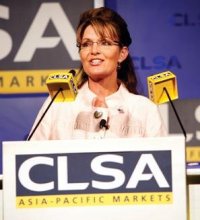
Evaluating Sarah Palin’s speech in Hong Kong

Sarah Palin giving a speech on economic policy

Story from the Wall Street Journal. (H/T Caffeinated Thoughts, Muddling Towards Maturity)

Let’s take a look at her speech.

Somebody has been reading Thomas Sowell’s book “A Conflict of Visions”, in which he talks about “the constrained vision” and “the unconstrained vision”.

We don’t believe that human nature is perfectible; we’re suspicious of government efforts to fix problems because often what it’s trying to fix is human nature, and that is impossible. It is what it is.

Here’s her defense of the free market.

Lack of government wasn’t the problem. Government policies were the problem. The marketplace didn’t fail. It became exactly as common sense would expect it to. The government ordered the loosening of lending standards. The Federal Reserve kept interest rates low. The government forced lending institutions to give loans to people who, as I say, couldn’t afford them. Speculators spotted new investment vehicles, jumped on board and rating agencies underestimated risks.

The speech also discusses cap-and-trade, free trade, and more.

Critical acclaim

Caffeinated Thoughts did a great job of linking some of the reactions from the left.

The New York Times:

A number of people who heard the speech in a packed hotel ballroom, which was closed to the media, said Mrs. Palin spoke from notes for 90 minutes and that she was articulate, well-prepared and even compelling.

“The speech was wide-ranging, very balanced, and she beat all expectations,” said Doug A. Coulter, head of private equity in the Asia-Pacific region for LGT Capital Partners…

[…]Mr. Goodé, a New Yorker who said he would never vote for Mrs. Palin, said she acquitted herself well.

“They really prepared her well,” he said. “She was articulate and she held her own. I give her credit. They’ve tried to categorize her as not being bright. She’s bright.”

My view? I say that Thomas Sowell prepared her. She probably ordered all his books from Amazon.com. Then she read them all at the kitchen table, with her glasses on and a laptop in front of her for her notes.

I am becoming more and more comfortable with her as a solid advocate for my point of view.

Check out her Facebook page where she’s been writing lately.

Share

If government can’t fix health care, then who can?

Story from the New York Post. (H/T Right Klik via Neil Simpson)

Excerpt:

The state is trying to shut down a New York City doctor’s ambitious plan to treat uninsured patients for around $1,000 a year.

Dr. John Muney offers his patients everything from mammograms to mole removal at his AMG Medical Group clinics, which operate in all five boroughs.

“I’m trying to help uninsured people here,” he said.

His patients agree to pay $79 a month for a year in return for unlimited office visits with a $10 co-pay.

[His] plan landed him in the crosshairs of the state Insurance Department, which ordered him to drop his fixed-rate plan – which it claims is equivalent to an insurance policy.

He says he can afford to charge such a small amount because he doesn’t have to process mountains of paperwork and spend hours on billing.

“If they leave me alone, I can serve thousands of patients,” he said.

Government doesn’t like it when private businesses solve problems. Government only wants solutions they can control and regulate. After all, if there is no (government-caused) health care crisis, then these commies would be out of a job. They have to cause the crisis and then market themselves as the only solution.

Right Klik also has a handy list of the problems caused by government.

* “Community Rating” laws, which limit insurers’ ability to charge different prices to different customers, raise prices by 20.3% for individual policies and 27.3% for family policies

* Mandated benefits raise the expected price of an individual policy by approximately 0.4% per mandate. For family policies the increase is approximately 0.5% per mandate. The typical state has about 20 mandates (with a range from 6 to 48) so a reduction from 20 to 10 mandates would imply a 4% decrease in price for individual policies, and a 5% decrease for family policies.

* “Any-Willing-Provider” laws, which limit insurers’ ability to exclude hospitals and doctors from their networks, raise prices by 1.5% for individual policies and 5.3% for family policies.

* Federal law places limits on the discounts employers and insurance companies can provide for healthy, cost-saving behaviors.

* Twelve million Americans go without health insurance because the Federal Government does not allow people to purchase insurance across state lines.

The way insurance works is that people need to pay premiums that take into account the likelihood that they will make claims. The people who make a lot of claims need to pay more. This is what encourages people to take fewer risks and keep costs down. When government gets involved to equalize outcomes regardless of risks, then there is no incentive to live responsibly. The result is a shortage caused by high demand for medical care, and low supply.

How about we just let the free market work instead?