Tag Archives: Canada

What Americans don’t know about Canada’s single-payer health care system

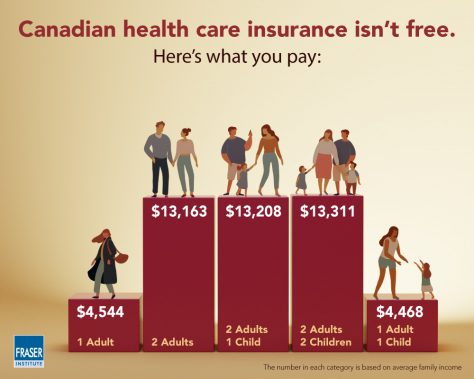
Price of healthcare per Canadian household (Source: Fraser Institute)

I post a lot of research from Canada’s Fraser Institute, but they are not the only think tank that publishes research on the efficiency and costs of single payer health care in Canada. This time, I found a report from the Heritage Foundation, where they go over quality of care, taxes, out of pocket costs, coverage, rationing, waiting lists, staff shortages, substandard equipment, and outdated drugs.

Here’s the report from the Heritage Foundation. I’ll focus on the differences.

Canadians pay slightly less in out of pocket costs:

The OECD calculates that Canadians spend 1.6 percent of GDP on out-of-pocket health spending, compared to 1.9 percent in the U.S.

[…]While these numbers are very close, they are actually getting closer. Since 1970, U.S. out-of-pocket spending as a percentage of total medical spending has been falling steadily, from 33 percent in 1970 to about 10 percent in 2017.19

Meanwhile, Canadian out-of-pocket spending has been falling much slower, so that by 2016 it totaled 15 percent of total medical spending—a higher proportion than in the U.S.20

 As a result, Statistics Canada warned in early 2020 that the percentage of Canadians experiencing large out-of-pocket burdens is growing, writing that “[b]etween 1998 and 2009…the percentage of households spending more than 10% of their total after-tax income on health care rose by 56%.”

Canadians pay more in federal and state taxes:

Federal taxation excluding social security contributions, then, comes to 28 percent of GDP in Canada, compared to just 19 percent in the U.S.—meaning 51 percent more.

[…]This excess taxation is largely a result of health spending, which has bloated provincial budgets to nearly three times the taxes of U.S. states.

Provincial taxes have grown to nearly the same level as federal taxation. Meanwhile, provincial health costs have risen to fully 37 percent of provincial budgets in 2016—up from 33 percent in 1993 – —and range as high as 42 percent.

Canada’s Fraser Institute has estimated this excess tax burden from public health costs at roughly $9,000 for a household of two adults with or without children or $750 per month in additional taxes.
When I wanted an MRI I was scheduled the same week

Canadians wait far longer for treatment than Americans:

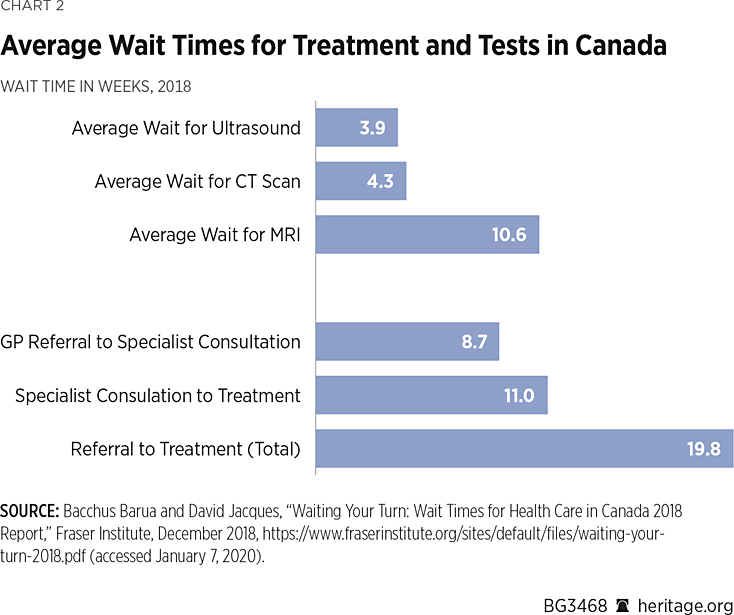
Medical waiting times have become a national crisis in Canada, and continue to worsen. The average wait time for medically necessary treatment between referral from a general practitioner and a consultation with a specialist was 8.7 weeks in 2018, 136 percent longer than in 1993. Patients then have to wait again between seeing the specialist and the actual treatment, another 11 weeks on average, 97 percent longer than in 1993.

From referral to treatment, then, it takes an average of 19.8 weeks (see Chart 2) to be treated, in addition to the original wait to see the family doctor in the first place—this for “medically necessary” treatment, not cosmetic surgery.

In contrast, nearly 77 percent of Americans are treated within four weeks of referral, and only 6 percent of Americans report waiting more than two months to see a specialist.

As for appointments, a 2017 survey of American physicians in the 15 largest U.S. cities found that it took just 24 days on average to schedule a new-patient physician appointment, including 11 days for an orthopedic surgeon and 21 days for a cardiologist.

As a result of these long waits, by one recent estimate, at any given moment, over one million Canadians—3 percent of the entire population—are waiting for a medical treatment.

These lists can average six months, and often much longer in rural areas, which tend to suffer from doctor shortages so severe that many do not even have a family doctor. Overall, 15 percent of Canadians did not have a regular health care provider in 2017.

The shortages ripple through the system; one doctor in Ontario called in a referral to the local hospital, only to be told there was a four-and-a-half year wait to see a neurologist.

In Canada, people die or become inoperable on waiting lists:

A Montreal man was finally called for his long-delayed urgent surgery two months after he had died. One 16-year-old boy in British Columbia waited three years for an “urgent” surgery, during which time his condition deteriorated so much that he became a paraplegic.

Canadians have to travel abroad to countries with functioning health care systems in order to be treated:

These cases are, unfortunately, not isolated; a survey of specialists found that average wait times exceed what is deemed clinically “reasonable” for fully 72 percent of conditions in Canada. The situation continues to worsen every year: In 1994, the average gap between clinically reasonable delay and actual delay was only four days, and by 2018 had grown to 23 days.

[…]With one million waiting, many Canadians turn in desperation to U.S. health care—the very system some U.S. policymakers propose to transform. In 2017 alone, Canadians made 217,500 trips to other countries for health care, of which 52,500 were to the U.S., paying out of pocket to skip the waiting.

Outdated equipment, outdated drugs, staff shortages:

 While the average employer-sponsored private insurance plan in Canada covers between 10,000 and 12,000 drugs, most public plans in Canada only cover 4,000. Canada has 35 percent fewer acute care beds than the U.S., and only one-fourth as many magnetic resonance imaging (MRI) units per capita—indeed, it has fewer MRI units per capita than Turkey, Chile, or Latvia.

[…]Some common treatments are simply unavailable to Canadians. For new pharmaceuticals, for example, Canada’s policy of forcing down prices so that American consumers essentially pay for Canada’s research and development has led to years-long delays for Canadian patients.

[…]Cutting corners on facilities and using outdated drugs show up in Canadian mortality rates. Thirty-day in-hospital mortality rates in Canada are 20 percent higher than in the U.S. for heart attacks, and nearly three times the U.S. level for strokes. Cancer age-standardized mortality is 10 percent higher in Canada than in the U.S.—despite far healthier lifestyles.

[…]When it comes to personnel, Canada underspends on medical staff and doctors, ranking 29th out of 33 among high-income countries for doctors per 1,000 population, accounting for a large part of those wait times. Canada has half as many specialist physicians per capita as the U.S.

[…]With such shortages and waiting lists, Canadian emergency rooms are packed. So packed that Canadians sometimes just give up and go home. Of Canadian ER visitors who are seen, 29 percent report wait times of over four hours, three times the U.S. level.

[…]Canadian seniors are 65 percent more likely to have visited the emergency room (ER) four or more times in the past year than American seniors.

Ultimately, nearly 5 percent of Canadian ER visitors end up leaving without ever being treated, giving up on a medical system that is perennially “free” but out of stock at the moment. In one study at two ERs in Alberta, 14 of the 498 walkaways were subsequently hospitalized, and one died within the week.

And keep in mind how things work in a single payer system. You pay up front through your taxes. The harder you work, the more you pay into the system. When you want treatment, you just get in line behind people who never paid one dime into the system – like all those low-skill refugees that Canada imports from Middle Eastern countries to build up the socialist voting bloc.

What happens in places that adopt Green New Deal Democrat energy policies?

What green energy policies did to electricity costs in California

The secular leftist approach to politics is to suggest policies that make them feel good and look good to others. It doesn’t matter if the policies work for people. Conservatives believe in looking at what has worked in other times and places, and doing what works. After all, a wise man learns from successes and failures of other people. We can’t try everything ourselves, we should just do what works.

Let’s start with California. California has long been at the forefront of converting their energy production to “green” sources.

Here’s an article from Forbes that talks about their results:

At the Democratic National Convention this week, presidential and vice-presidential candidates Joe Biden and Kamala Harris will make the case for spending $2 trillion, or $500 billion per year, to transition the U.S. away from fossil fuels toward renewables like solar and wind.

[…]California’s big bet on renewables, and shunning of natural gas and nuclear, is directly responsible for the state’s blackouts and high electricity prices.

“We will be forced today to ask utilities to cut off power to millions today, and tomorrow, and beyond,” said Stephen Berberich, the President and CEO of California’s Independent System Operator, CAISO, on a Monday morning conference call. “Demand will greatly exceed supply.”

The immediate cause of California’s blackouts is a mismatch between electricity supply and demand.

[…]The underlying reason blackouts are occurring is because California lacks reliable, in-state supply. And the reason for that is California has been closing both natural gas and nuclear power plants.

[…]Despite these capacity shortfalls, the state is moving ahead with plans to remove 2,200-MW of reliable electricity from the grid.  That’s the amount of power produced by Diablo Canyon nuclear power plant, which will be closed in stages in 2024 and 2025.

So, Green New Deal works great… if your goal is to feel good about yourself, and make emotion-driven people like you. But it isn’t very good at generating an abundance of low-cost electricity to power businesses. And it isn’t very good for poor people, who prefer to pay less for their electricity.

Well, how about Germany? They closed down their nuclear power plants in favor of wind and solar. It didn’t work.

Daily Caller explains:

Germany’s power grid almost collapsed in January due to poor performance from wind turbines and solar panels, according to data from a major trade union.

Wind and solar power plants under-performed in January, 2017, because of cloudy weather with little or no wind, setting the stage for massive blackouts.

[…]Green energy approaches failed to meet Germany’s stated energy goals, even after spending over $1.1 trillion. The country’s “Energiewende” plan to boost wind and solar production to fight global warming hasn’t significantly reduced carbon dioxide (CO2) emissions and may have actually caused them to go up.

[…]Due to the inherent unreliable performance of wind power and political opposition to nuclear power plants, Germany has been forced to return to coal to generate electricity. Coal now provides 44 percent of  Germany’s power,  This shift caused Germany’s carbon dioxide (CO2) emissions to actually rise by 28 million tons each year following the policy shift.

All of Germany’s subsidies and support for green energy have sharply increased power prices, with the average German paying 39 cents per kilowatt-hour for electricity. The average American only spends 10.4 cents per kilowatt-hour by comparison.

So, you get less electricity produced, more emissions, and elctricity prices go up. Just like in California.

Well, third try is the charm. How about Canada? They’ve gone Green New Deal for more than a decade. How is that working for them?

The National Post reported this in 2016:

Back in 2010, deep green environmentalist Rick Smith, then head of Environmental Defence Canada, hailed Ontario’s Green Energy and Green Economy Act regime as a cost-free operation that would catapult the province into the big leagues of renewable energy. Through fat subsidies and high prices offered to wind, solar and other renewable industry players, jobs and growth would boom and Ontario would be free of its dirty coal plants. It was the End of Coal, the government said. The birth of a renewable miracle.

Now, Canadians are paying more:

The doubling of electricity prices since 2005 is big politically, but it is just the top-line item on a long list of problems, misconceptions and outright fabrications that lurk within the Liberal government’s decade-long pursuit of radical greenism.

Because they didn’t listened to engineers… they listened to their hearts:

Ontario’s Society of Professional Engineers has issued more than half a dozen critical reports on the Liberals’ tendency to let green talk and politics override sound policy. Instead of following the expert advice of engineers and people who understand the intricacies of electricity production and distribution, the government took to issuing directives right out the Premier’s office.

Now, I know some people on the secular left are going to disagree with these facts. But they don’t have facts to counter these facts. There isn’t a single country that has gone Green New Deal that has lower electricity prices and a net increase in jobs.

We have to do what works. What works is more natural gas (fracking) and more nuclear power.

Canada’s single payer health care: pay up front, take a number and wait until you die

Price of healthcare per Canadian household (Source: Fraser Institute)

I post a lot of research from Canada’s Fraser Institute, but they are not the only think tank that publishes research on the efficiency and costs of single payer health care in Canada. This time, I found a report from the Heritage Foundation, where they go over quality of care, taxes, out of pocket costs, coverage, rationing, waiting lists, staff shortages, substandard equipment, and outdated drugs.

Here’s the report from the Heritage Foundation. I’ll focus on the differences.

Canadians pay slightly less in out of pocket costs:

The OECD calculates that Canadians spend 1.6 percent of GDP on out-of-pocket health spending, compared to 1.9 percent in the U.S.

[…]While these numbers are very close, they are actually getting closer. Since 1970, U.S. out-of-pocket spending as a percentage of total medical spending has been falling steadily, from 33 percent in 1970 to about 10 percent in 2017.19

Meanwhile, Canadian out-of-pocket spending has been falling much slower, so that by 2016 it totaled 15 percent of total medical spending—a higher proportion than in the U.S.20

 As a result, Statistics Canada warned in early 2020 that the percentage of Canadians experiencing large out-of-pocket burdens is growing, writing that “[b]etween 1998 and 2009…the percentage of households spending more than 10% of their total after-tax income on health care rose by 56%.”

Canadians pay more in federal and state taxes:

Federal taxation excluding social security contributions, then, comes to 28 percent of GDP in Canada, compared to just 19 percent in the U.S.—meaning 51 percent more.

[…]This excess taxation is largely a result of health spending, which has bloated provincial budgets to nearly three times the taxes of U.S. states.

Provincial taxes have grown to nearly the same level as federal taxation. Meanwhile, provincial health costs have risen to fully 37 percent of provincial budgets in 2016—up from 33 percent in 1993 – —and range as high as 42 percent.

Canada’s Fraser Institute has estimated this excess tax burden from public health costs at roughly $9,000 for a household of two adults with or without children or $750 per month in additional taxes.

When I wanted an MRI I was scheduled the same week

Canadians wait far longer for treatment than Americans:

Medical waiting times have become a national crisis in Canada, and continue to worsen. The average wait time for medically necessary treatment between referral from a general practitioner and a consultation with a specialist was 8.7 weeks in 2018, 136 percent longer than in 1993. Patients then have to wait again between seeing the specialist and the actual treatment, another 11 weeks on average, 97 percent longer than in 1993.

From referral to treatment, then, it takes an average of 19.8 weeks (see Chart 2) to be treated, in addition to the original wait to see the family doctor in the first place—this for “medically necessary” treatment, not cosmetic surgery.

In contrast, nearly 77 percent of Americans are treated within four weeks of referral, and only 6 percent of Americans report waiting more than two months to see a specialist.

As for appointments, a 2017 survey of American physicians in the 15 largest U.S. cities found that it took just 24 days on average to schedule a new-patient physician appointment, including 11 days for an orthopedic surgeon and 21 days for a cardiologist.

As a result of these long waits, by one recent estimate, at any given moment, over one million Canadians—3 percent of the entire population—are waiting for a medical treatment.

These lists can average six months, and often much longer in rural areas, which tend to suffer from doctor shortages so severe that many do not even have a family doctor. Overall, 15 percent of Canadians did not have a regular health care provider in 2017.

The shortages ripple through the system; one doctor in Ontario called in a referral to the local hospital, only to be told there was a four-and-a-half year wait to see a neurologist.

In Canada, people die or become inoperable on waiting lists:

A Montreal man was finally called for his long-delayed urgent surgery two months after he had died. One 16-year-old boy in British Columbia waited three years for an “urgent” surgery, during which time his condition deteriorated so much that he became a paraplegic.

Canadians have to travel abroad to countries with functioning health care systems in order to be treated:

These cases are, unfortunately, not isolated; a survey of specialists found that average wait times exceed what is deemed clinically “reasonable” for fully 72 percent of conditions in Canada. The situation continues to worsen every year: In 1994, the average gap between clinically reasonable delay and actual delay was only four days, and by 2018 had grown to 23 days.

[…]With one million waiting, many Canadians turn in desperation to U.S. health care—the very system some U.S. policymakers propose to transform. In 2017 alone, Canadians made 217,500 trips to other countries for health care, of which 52,500 were to the U.S., paying out of pocket to skip the waiting.

Outdated equipment, outdated drugs, staff shortages:

 While the average employer-sponsored private insurance plan in Canada covers between 10,000 and 12,000 drugs, most public plans in Canada only cover 4,000. Canada has 35 percent fewer acute care beds than the U.S., and only one-fourth as many magnetic resonance imaging (MRI) units per capita—indeed, it has fewer MRI units per capita than Turkey, Chile, or Latvia.

[…]Some common treatments are simply unavailable to Canadians. For new pharmaceuticals, for example, Canada’s policy of forcing down prices so that American consumers essentially pay for Canada’s research and development has led to years-long delays for Canadian patients.

[…]Cutting corners on facilities and using outdated drugs show up in Canadian mortality rates. Thirty-day in-hospital mortality rates in Canada are 20 percent higher than in the U.S. for heart attacks, and nearly three times the U.S. level for strokes. Cancer age-standardized mortality is 10 percent higher in Canada than in the U.S.—despite far healthier lifestyles.

[…]When it comes to personnel, Canada underspends on medical staff and doctors, ranking 29th out of 33 among high-income countries for doctors per 1,000 population, accounting for a large part of those wait times. Canada has half as many specialist physicians per capita as the U.S.

[…]With such shortages and waiting lists, Canadian emergency rooms are packed. So packed that Canadians sometimes just give up and go home. Of Canadian ER visitors who are seen, 29 percent report wait times of over four hours, three times the U.S. level.

[…]Canadian seniors are 65 percent more likely to have visited the emergency room (ER) four or more times in the past year than American seniors.

Ultimately, nearly 5 percent of Canadian ER visitors end up leaving without ever being treated, giving up on a medical system that is perennially “free” but out of stock at the moment. In one study at two ERs in Alberta, 14 of the 498 walkaways were subsequently hospitalized, and one died within the week.

And keep in mind how things work in a single payer system. You pay up front through your taxes. The harder you work, the more you pay into the system. When you want treatment, you just get in line behind people who never paid one dime into the system – like all those low-skill refugees that Canada imports from Middle Eastern countries to build up the socialist voting bloc.