Tag Archives: Budget Deficit

House Republicans set to unveil $2.5 TRILLION in spending cuts

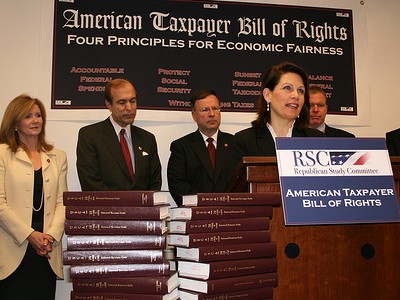
Republican Study Committee

(Michele Bachmann and Marsha Blackburn are members of the RSC)

From the Daily Caller. (H/T Gateway Pundit)

Excerpt:

A number of the House GOP’s leading conservative members on Thursday will announce legislation that would cut $2.5 trillion over 10 years, which will be by far the most ambitious and far-reaching proposal by the new majority to cut federal government spending.

Jordan’s bill, which will have a companion bill introduced in the Senate by Sen. Jim DeMint, South Carolina Republican, would impose deep and broad cuts across the federal government. It includes both budget-wide cuts on non-defense discretionary spending back to 2006 levels and proposes the elimination or drastic reduction of more than 50 government programs.

Jordan’s “Spending Reduction Act” would eliminate such things as the U.S. Agency for International Development and its $1.39 billion annual budget, the $445 million annual subsidy for the Corporation for Public Broadcasting, the $1.5 billion annual subsidy for Amtrak, $2.5 billion in high speed rail grants, the $150 million subsidy for the Washington Metropolitan Area Transit Authority, and it would cut in half to $7.5 billion the federal travel budget.

But the program eliminations and reductions would account for only $330 billion of the $2.5 trillion in cuts. The bulk of the cuts would come from returning non-defense discretionary spending – which is currently $670 billion out of a $3.8 trillion budget for the 2011 fiscal year – to the 2006 level of $496.7 billion, through 2021.

Going back to 2006 levels would reduce spending by $2.3 trillion over ten years. It is a significantly more drastic cut than the one proposed by House Republican leadership in the Pledge to America last fall, which proposed moving non-defense, non-mandatory spending for the current fiscal year back to 2008 levels, which was $522.3 billion. Jordan’s proposal includes the recommendation from the Pledge for the current fiscal year, which ends in September.

The proposal would cut the federal work force by 15 percent and freeze automatic pay raises for government employees for five years.

You’ll remember that 2006 was the last year when the Republicans were in control of the House and Senate. Remember what life was like at the beginning of 2007? Unemployment was around 4% and the budget deficit was around 200 billion dollars. Then Nancy Pelosi and Harry Reid came along and the spending started. Cutting spending can be a positive thing when you take money away from unions. And think of the jobs when companies realize that there will be an end to all this spending and they won’t be on the hook for it. And children will have a standard of living that isn’t worse than the ones that their parents had.

But now the Republican Study Committee wants to put a stop to all of that. The Republican Study Commitee is the conservative wing of the House Republican caucus and that’s where all the good policies come from.

Does the CBO think that repealing Obamacare will help or hurt the deficit?

Gateway Pundit reports that the Democrats have been telling everyone that repealing Obamacare will make the budget deficit worse.

The left-wing Washington Post says:

Rescinding the federal law to overhaul the health-care system, the first objective of House Republicans who ascended to power this week, would ratchet up the federal deficit by about $230 billion over the next decade and leave 32 million more Americans uninsured, according to congressional budget analysts.

The rough estimate by the Congressional Budget Office also predicts that most Americans would pay more for private health insurance if the law were repealed.

The headline of this left-wing Washington Post news article is “CBO says health care repeal would deepen deficit”.

The left-wing New York Times says:

The nonpartisan budget scorekeepers in Congress said on Thursday that the Republican plan to repeal President Obama’s health care law would add $230 billion to federal budget deficits over the next decade, intensifying the first legislative fight of the new session and highlighting the challenge Republicans face in pursuing their agenda.

The budget office estimated that the health care law, including education provisions, would reduce deficits over 10 years by $143 billion. Tax increases and cuts in projected Medicare spending would more than offset the cost of extending health insurance to millions of Americans. The budget office projected that the law would result in even bigger savings beyond 2019.

The headlines of this left-wing New York Times news article is “Republicans Are Given a Price Tag for Health Law Repeal, but Reject It”.

Wow, that sounds bad.

But is it true? Is it possible that the government can cover MILLIONS OF PEOPLE and have health care costs GO DOWN?

Well, look at the latest CBO numbers, straight from the CBO mailing list.

Excerpt:

CBO and the staff of the Joint Committee on Taxation (JCT) have not yet developed a detailed estimate of the budgetary impact of H.R. 2, the Repealing the Job-Killing Health Care Law Act, which would repeal the major health care legislation enacted in March 2010. Yesterday, we released a preliminary analysis of that legislation indicating that, over the 2012-2021 period, the effect of enacting H.R. 2 on the federal budget as a result of changes in direct spending and revenues is likely to be an increase in deficits in the vicinity of $230 billion, plus or minus the effects of forthcoming technical and economic changes to CBO’s and JCT’s projections for that period.

We have been asked to provide the revenue and direct spending components of that total.  Extrapolating the estimated budgetary effects of the original health care legislation and accounting for the effects of subsequent legislation, CBO anticipates that enacting H.R. 2 would probably yield, for the 2012-2021 period, a reduction in revenues in the neighborhood of $770 billion and a reduction in outlays in the vicinity of $540 billion, plus or minus the effects of forthcoming technical and economic changes to CBO’s and JCT’s projections.

Ah. So repealing Obama care would CUT SPENDING by 540 BILLION DOLLARS. And the only way to say that Obamacare can produce a surplus is by RAISING TAXES BY 770 BILLION DOLLARS.

Related posts

What is the cost of extending unemployment benefits?

Consider this piece in the Denver Post. (H/T Michelle Malkin)

Excerpt:

Businesses are being hit with large premium increases to prop up Colorado’s broke unemployment-insurance fund.

In notices that went out over the past two weeks, some firms are facing rates that have more than quadrupled from last year.

“I had to pick myself up off the floor after I opened the letter,” said Linda Greene, owner of Westminster-based Merry Maids North. Her first-quarter premium for 2011 will be $2,200, compared with $497 a year earlier.

“Money doesn’t just fall out of the sky, so I’m going to have to totally rework my budget and hope for the best,” said Greene, who employs 28 workers.

The Colorado Unemployment Insurance Trust Fund covers the cost of payments to jobless workers. Record numbers of unemployment claims caused the fund to go broke this year, forcing Colorado to borrow, so far, $368.5 million from the U.S. government.

At least 40 other states also are borrowing from the federal government to cover their fund deficits.

Colorado’s unemployment-benefit payments rose from $305 million in 2005 to $1.06 billion in 2009.

…In prior years, firms that never had laid off workers had relatively low premiums.

But for 2011, those businesses are facing big increases along with companies that have histories of layoffs.

Colorado labor department executive director Don Mares said many companies with higher claims histories already are near the state’s maximum rate of 5.4 percent of the first $10,000 a worker earns.

As a result, businesses with low claims histories are being required to pay higher rates to make up the deficit.

“This is a huge inequity,” said Chuck Mock, owner of a Longmont-based software-consulting firm. “If you keep paying into the system and don’t take anything out, that should be a good thing. But not in this case.”

Wow. Could it be that it is these constant extensions of unemployment benefits that are scaring small businesses into not hiring anyone? Could it be that this is just another one of Obama’s stealth tax hikes?

You can’t argue with the fact that Obama is the worst jobs President ever. Maybe it’s Obama’s policies that are causing the record unemployment. Maybe effects have causes. Maybe having an ACORN lawyer as President is not the best thing to do in a recession.