
Tag Archives: Book

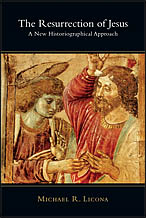
Why we work: to buy Mike Licona’s new resurrection book

Mike's new book on the resurrection

And what a big book it is! 718 pages!

Here are the details from Brian Auten:

Michael Licona, Research Professor of New Testament at Southern Evangelical Seminary, has just released a monumental new book: The Resurrection of Jesus: A New Historiographical Approach.

From the publisher:

Could there be any new and promising approach to the question of the historicity of Jesus’ resurrection? Yes, answers Michael Licona. And he convincingly points us to a significant deficiency in approaching this question: our historiographical orientation and practice. He then carefully and effectively applies his principles and methods to the question of Jesus’ resurrection.

This book is sure to become required reading for anyone exploring this field, as Michael Licona has made an extremely significant contribution to scholarship in this area.

Pick it up today.

The book is $27 dollars on Amazon, but you probably won’t need another book on the resurrection. I try not to buy books by people who haven’t debated anyone on the other side, but that won’t be a problem with Licona. He’s debated everybody on the other side – like Bart Ehrman, Richard Carrier and Shabir Ally. He’s battle-tested.

I took a look at the endorsements, and I recognize tons of historians.

Here’s one:

“Licona has tackled his subject energetically, with near-obsessive thoroughness. He concludes that if one approaches the sources without an a priori commitment to the impossibility of resurrection, the ‘Resurrection Hypothesis’ is the interpretation that most adequately accounts for the evidence. Thus, the book boldly challenges the naturalistic presuppositions of post-Enlightenment historical criticism. At the very least, Licona has shown that the usual naturalistic explanations of the resurrection tradition are, on the whole, weak, speculative and often tendentious. “I am not aware of any scholar who has previously offered such a thorough and fair-minded account of the historiographical prolegomena to the resurrection question. Furthermore, Licona’s discussion of the ‘bedrock’ historical evidence is appropriately nuanced and carefully modulated, not claiming more than can be supported by the consensus findings of qualified scholars. This lends credibility to his conclusions. Licona has presented a fair and vigorous case for his position. No doubt many readers will be unconvinced by his arguments, but no one can accuse him of naivet? or of ignoring counterarguments. “This study spans fields that are too rarely brought into conversation: New Testament studies and historiographical theory. Licona is to be commended for this undertaking and for producing a study that has both wide range and significant depth.”

—Richard B. Hays, George Washington Ivey Professor of New Testament and dean, Duke Divinity School

If you’re looking for a book on the resurrection, this might be a good one. Seems like it will cover everything.

UPDATE: Wow, big Mike Licona post up at Reason to Stand. Lots of Mike Licona videos.

Is Barack Obama a socialist? What is his connection to socialism?

Are Barack Obama and Hugo Chavez very different?

Here is an interview with Stanley Kurtz of National Review regarding his new book exploring the real Barack Obama and his past interest in socialism.  (H/T Muddling Towards Maturity)

The answers to this interview are too awesome to quote here. So I will quote some of the questions, and you should click through and read the WHOLE THING.

Questions:

LOPEZ: Why was the 1983 Socialist Scholars Conference “so formative an influence on Obama’s political career”?

LOPEZ: What actual evidence do you have that Obama attended the annual Socialist Scholars Conferences in New York between 1983 and 1985?

LOPEZ: What is socialism? What is socialism to Barack Obama? How has that changed since 1983? How has it stayed the same?

LOPEZ: How important is black liberation theology to understanding Barack Obama? And where does Jeremiah Wright fit in here?

LOPEZ: Was Bill Ayers his mentor or not?

LOPEZ: How important is ACORN to understanding Barack Obama and the Democratic party today? Is ACORN still a factor?

LOPEZ: Barack Obama wrote in Dreams from My Father: “Political discussions, the kind that at Occidental had once seemed so intense and purposeful, came to take on the flavor of the socialist conferences I sometimes attended at Cooper Union or the African cultural fairs that took place in Harlem and Brooklyn during the summers — a few of the many diversions New York had to offer, like going to a foreign film or ice-skating at Rockefeller Center.” You read a lot into “diversions.” How? Why? Is he really that smart?

LOPEZ: So is Saul Alinsky really, truly important to understanding our president?

LOPEZ: What does the Midwest Academy have to do with the milestone health-care legislation the president signed this March?

LOPEZ: Do you have insights into what exactly Barack Obama makes of the abortion debate and where that fits into a full picture of him? Despite a radicalism there, he’s been stealth about it, somewhat consistently, in his national career.

OK, here is an excerpt from the interview.

LOPEZ: What actual evidence do you have that Obama attended the annual Socialist Scholars Conferences in New York between 1983 and 1985?

KURTZ: Obama tells us himself in Dreams from My Father that he attended socialist conferences at the Cooper Union. Detailed evidence from socialist archives shows that there was only one socialist conference at the Cooper Union, and that was the Socialist Scholars Conference of 1983. Obama’s name also appears on a list of pre-registrants for the 1984 Socialist Scholars Conference. There is less evidence that he attended the Socialist Scholars Conference of 1985, although I think it’s likely that he did. Not only did Obama attend the previous two conferences, evidence indicates that in 1985 he was studying the writings of Harry Boyte, an important theorist of community organizing who spoke at the 1985 conference. Boyte, by the way, advised Obama’s 2008 presidential campaign. I carefully dissect the evidence for Obama’s conference attendance in the book.

LOPEZ: What is socialism? What is socialism to Barack Obama? How has that changed since 1983? How has it stayed the same?

KURTZ: These are the big questions. In the 1980s, the failure of Sixties and Seventies radicalism and the ascent of Ronald Reagan forced America’s socialists to take another tack. They de-emphasized strategies of nationalization and focused instead on local organizing as the way to move the country toward socialism. Now, instead of nationalizing a company, the idea was to get community organizers onto boards of directors, or to force banks to run loans through groups like ACORN. This was socialism “from below,” and it is the strategy that captivated Obama.

Obama’s socialist community-organizing colleagues followed French Marxist theorist André Gorz. Gorz advocated a strategy he called “non-reformist reforms,” proposing a series of seemingly minor tweaks to the system that were in fact designed to undermine capitalism and usher in socialism over time. This led Obama’s socialist mentors to devise an early version of the “public option,” although at the time they applied the idea to the energy sector, not health care. The socialism of Obama’s mentors was incremental and intentionally disguised. In the book, I argue that Obama follows many of his socialist mentors’ ideas to this day.

OK, here is ONE MORE answer at the end of the interview.

LOPEZ: If there’s one thing you could drive home to Americans about the president, what would it be?

KURTZ: He hasn’t been telling us the truth about his political convictions.

We need to start to understand Democrats by looking at their voting records, the policies they push, their positions, their past affiliations, and their life experiences. You don’t know anything about Barack Obama until you read books like these that go beyond the mainstream media puff pieces and Comedy Central slapstick interviews. You need to delve into who the man really is and what he intends to do to this country. The prosperity, liberty and security of your children depends on your diligence today. Inform yourself and persuade others.

And don’t forget to vote on Tuesday, and then buy the Stanley Kurtz book and the David Freddoso book. Then read them.

Frank Turek interviews Jay Richards on Christianity and capitalism

Christian apologist Frank Turek, Ph.D interviews Jay Wesley Richards, Ph.D.

The MP3 file is here.

It’s a great interview, with lots of basic economics. Turek cites quotes from Richards’ book “Money, Greed and God” for Richards to respond to, and Richards provides lots of examples to make his points.

Here’s a quote of Frank, from the beginning of the podcast:

Money, Greed and God. How do those things go together, and why should we even be worried about them? And what does this have to do with apologetics? Well, in a few minutes, friends, you’re going to see that it has everything to do with apologetics. You know, you need money to do apologetics. You’re listening right now to a radio program that takes money to run. When you go buy an apologetics book, you need to pay for it. Somebody has gotten resources together – some of them immaterial resources, some of them material resources – they’ve put them together and they’ve marketed this piece to that you would buy it. That takes money. It takes money to preach the gospel across the world. It takes money to send missionaries overseas. It takes money to put on a TV program. It takes money to run an institute like the Discovery Institute. It takes money to run a seminary like Southern Evangelical Seminary or a ministry like CrossExamined.org. Money is essential to what we do. Well, you say “well, gee, you know, we’re Christians, we can’t really be concerned about money”. NONSENSE!

He’s right. And Christians need to be more careful about the economic environment that they work, save and invest in – because that’s where charity comes from.

Frank mentions that “Money, Greed and God” is now $10 on Amazon. Highly recommended, except for that awful chapter on usury. Skip that!

An easier book for total beginners is “The Virtues of Capitalism“. It’s also $10 on Amazon.com.

Related posts