
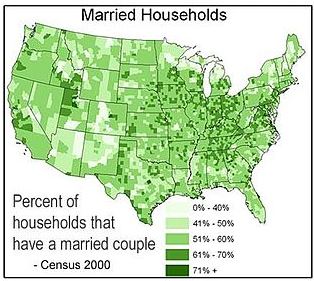
This article from The Daily Signal talks about a recent study.
It says:
According to a study from the Institute for Family Studies, red counties tend to have more married adults, more children born within marriage and higher levels of children living with both biological parents than blue counties.
“The reddest counties have higher rates of family stability, which is surprising because red counties, especially in the South, tend to have higher divorce rates,” said W. Bradford Wilcox, senior fellow with the Institute for Family Studies and author of the study. “But what seems to be happening here is that non-marital childbearing has emerged as a bigger engine of family instability than divorce in America. And this brief indicates that non-marital childbearing is lower in redder counties.”
[…]Wilcox acknowledged in his report some of the most stable families do come from blue states, such as Massachusetts and Minnesota, and that, indeed, the most stable families exist in the most extreme red and blue states.
But Wilcox said the state-level data addresses only part of the equation because it does not explain the “connection between family stability and political culture” at the local level.
“At the local level, red counties typically enjoy somewhat stronger families than do blue counties on at least three measures worth considering: marriage, non-marital childbearing and family stability,” Wilcox wrote in the report.
“The bottom line: The marriage advantage in red America helps explain why children in red counties are somewhat more likely to enjoy stable families than are children in blue counties,” he added.
I’m going to guess that the reason why people in blue states have lower rates of marriage and higher out-of-wedlock birth rates is because of higher tax rates, marriage penalties at the state level, and big government welfare programs that reward single mothers. Smaller government helps economic growth and leaves money in the pockets of responsible people. It’s much easier to take the marriage track when you have more of your own money in your pocket.
I also think that Judeo-Christian values are a huge factor. People who are religious have the habit of unselfishness that is necessary to get married in the first place. Marriage is about self-sacrificially loving another sinner, and that is attractive to religious people. Marriage is not so attractive to people who think that there is no afterlife, that the purpose of life is fun, and selfishness is awesome. If you believe that this life is all there is and there is no objective morality, then there is no rational basis there for serving others when it goes against your self-interest.
Regarding that last point, about how religious people are more suited to unselfishness and cooperation, there is a new study out.
Consider this recent study from the University of Toronto, in Canada.
The abstract says:
A large literature is currently contesting the impact of religion on prosocial behavior. As a window into this discussion, I examine the close social networks of American adults and consider whether religious traditionalists are more likely than other network members to supply several basic forms of social support. Analysis of the Portraits of American Life Survey reveals three main findings. First, a majority of Americans—religious or not—count at least one perceived religious traditionalist among their close network ties. Second, American adults are more likely to receive advice, practical help, and money from ties identified as religious traditionalists than from other types of ties, a pattern that held among both kin and nonkin network ties. Finally, although perceived traditionalist network members appear especially inclined to assist highly religious people, they nevertheless offer social support to Americans across a broad spectrum of religiosity. Beyond its relevance for debates on religion and community life, this study also proposes a novel strategy to assess prosocial behavior. Asking people to recount the deeds of their network members can reduce certain self-reporting biases common to survey research and helps locate prosocial activity in concrete and meaningful social relationships.
So, people who are more religious and traditional already have the character traits to be unselfish. And what is marriage, but the promise to be unselfish, for the sake of your spouse, and eventually, for the sake of your kids?
 WINTERY KNIGHT