Tag Archives: Bible

Does the “legacy of slavery” explain black women’s 72% out-of-wedlock birth rate?

James White asks: does the Bible apply to black women?

I don’t like Calvinist theologian James White very much, but at least he’s willing to defend the moral teachings of the Bible against the woke identity politics that is taking over Christian churches. A few months ago he tweeted something very controversial (see above), and got into a lot of hot water with fake Christians. In this post, I’ll explain why he is right.

So, as you can see above, James is concerned that black women are having so many abortions, and he thinks that the solution to this is to encourage black women to take the Bible’s advice on sexual morality. Shocking, I know.

If you read the replies to his tweet on Twitter, you’ll see millions and millions of comments calling him a racist, and telling him that slavery is to blame for EVERYTHING that black women do wrong. Basically, the James haters say that black women can do anything they want, and should never be told that it’s wrong according to the Bible, because their bad choices are all the fault of slavery. So the Bible doesn’t even apply to them, or something.

Here is an example from a radical feminist progressive named Karen Swallow Prior:
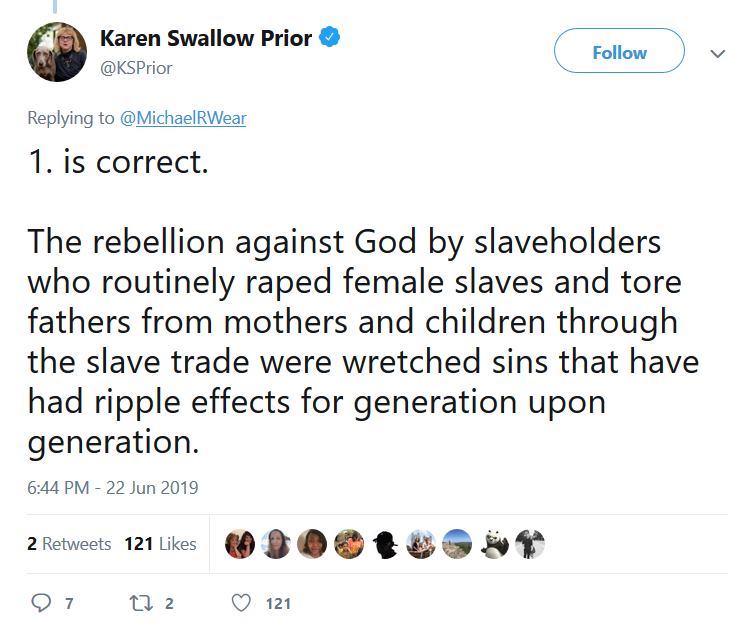
Karen Swallow Prior says that black people have no moral agency
Karen Swallow Prior says that unlike whites, blacks have no moral agency

According to the fake Christians, it’s not that black women make poor choices with sex, it’s that the ghosts of white slavers who raped their great-great-great grandmothers reach through time with magic and force them to have sex with hunky bad boys who won’t commit to them before sex. It’s not rap music calling black women hoes! It’s the ghosts of slavery past. And even if this ghost theory isn’t true, we shouldn’t tell black women not to sin, because… it would hurt their feelings. After all, the Bible isn’t a book that’s designed to set boundaries to prevent self-destructive behaviors. It encourages us to listen to our hearts, be reckless, and sin as much as we can.

So when did black community problems with sex and abortion start? Did it start with slavery times? Actually, blacks were doing GREAT at marriage and sexual matters just 50 years ago.

This reply to James White explained:

Blacks married at rates comparable to whites before welfare

That’s true. Black children weren’t fatherless, so they weren’t having early sex outside of marriage, and so they weren’t getting abortions.

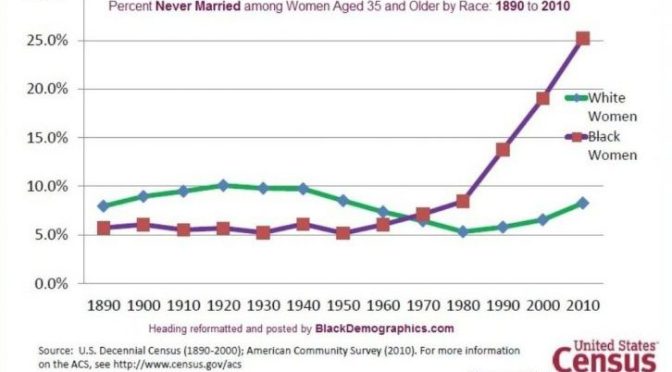
As the header graphic shows, black women were just as likely to be married as white women in the 1960s,  FAR AFTER the days of slavery.

The reason that the graph is going upward is because daughters raised in fatherless homes tend to engage in sexual activity at younger ages, because they are seeking approval from a man which their (single) mother cannot give them. It’s a tragic downwards spiral, and it affects all races. The only way to stop it is to tell women to choose marriage-minded men (not hot bad boys) and marry before having sex, like the Bible says. But woke fake Christians think the Bible is too mean, and better to allow sin by saying that sin is inevitable because slavery ghosts or something.

What’s neat is that black men who take Christianity seriously are totally on board with the facts:
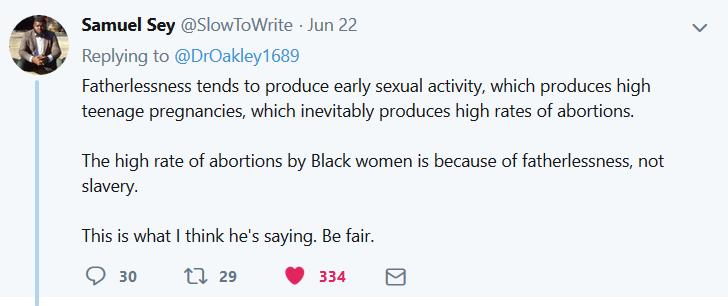
Black man here. Can confirm that the Bible applies to black women.

On this blog, I don’t talk about my ethnicity myself, for confidentiality reasons, but I have said that my skin is darker than Barack Obama. I’m not white or Asian. And the reason that I don’t fall into this trap of causing babies to be born out of wedlock is because I think that when the Bible says that sex outside of marriage is a sin, that this is true. I don’t make excuses or shift blame. It’s incumbent on me to obey, since I claim to be a follower of Jesus.I’m not interested in identity politics. I’m not interested in racial divisions. I’m not interested in blame-shifting. The rules are the rules. And my following of the rules caused me to not cause abortions, according to Christian specifications. Period.

When it comes to sex outside of marriage, the answer of every Bible believing Christian is simple: I’m against it. That is the correct answer, and anything more or less than this answer is demonic. If you are a Christian, sex outside of marriage is always morally wrong. And if you try to justify it, or blame someone else, in order to excuse it, then you’re not a Christian at all. If you try to make excuses for why someone did it, you’re not a Christian. Whether you have had it and been forgiven, or never had it, the answer is always the same: it’s morally wrong. Don’t do it. Never do it.

What I am seeing from people who are critical of James White’s tweet is that they are basically trying to attack those who make moral judgments based on what the Bible says. They want to make room for sinners to sin. The root of abortion sin is sexual sin. Real  Christians discourage sexual sin, and therefore protect unborn children. Fake Christians want to be liked by appearing compassionate, so they make excuses for sexual sin. If you take the Bible seriously on morality, you won’t be liked. Those who try to excuse sin do so because their need to be liked is more important than their need to promote what the Bible teaches.

Some fake Christians will say “oh, but I do think the Bible is right about sex and marriage, but we have to care about slavery reparations and global warming and refugees and illegal immigrants and trasnsgender rights, too”. Baloney. An authentic Christian is concerned about the things that the Bible teaches are “major” things. Drunkenness is a major thing. Sexual immorality is a major thing. Divorce is a major thing. Homosexuality is a major thing. If you meet a Christian who treats those issues as minor issues, and instead majors in what the secular left tells them are major issues, then you’re talking to a fake Christian.

Christianity isn’t a brain-dead faith. You get your priorities from the Bible, and you argue those priorities using facts. The facts about marriage rates are clear and they show that the problems in the black community aren’t caused by slavery. They’re caused by single mother welfare programs. Those welfare programs taught women of all races that they didn’t have to listen to their fathers when choosing men. Those welfare programs taught women that feelings were a better guide in relationships than the Bible. Those welfare programs taught women that their eyes were a better judge of character than performance of traditional marriage roles. Those welfare programs taught women that recreational sex was a way to get a man to commit and stop being a bad boy. We need to go back to the root cause of the problem. The root cause of the problem was making excuses for disobedience to the Bible, and transferring money from married homes to out-of-control women. Of all races.

Podcast: Was Jesus a socialist? Does Christianity teach socialism?

Let's take a deep dive into the Bible
Let’s take a deep dive into the Bible

I noticed that Christianity Today, which has turned hard left in recent years, is now openly endorsing socialism. So, I thought it might be a good idea to listen to this new episode of the Think Biblically podcast, which deals with the issue of Christianity and socialism. The hosts actually brought an economist on to define socialism, then they analyze the teachings of Jesus.

Here’s the description: (H/T Nathan)

It has not been uncommon for advocates of virtually every economic system to invoke Jesus in support of their views, though some of the most ardent advocates for both capitalism and socialism did not have any particular religious views themselves (Rand, Marx). Over the years, some of the more recent advocates of socialist type economic arrangements have appealed to Jesus and the gospels in support of such systems. Economist Lawrence Reed helps us sort out the application of the teaching of Jesus to economics and its relevance for economic life today. Join us for this provocative conversation as he tackles the question of Jesus and socialism.

Show notes, including a full transcript, are available at: biola.edu/thinkbiblically

Topics:

  • who plans the economy in socialism?
  • who should own the means of production in socialism?
  • how should wealth be distributed in socialism?
  • what tools does socialism use to provide people with health care, employment, security, etc.
  • which countries have adopted socialism? North Korea? Cuba? Venezuela? How about the Scandinavian countries?
  • what in the New Testament has caused people to think that Jesus was a socialist?
  • did Jesus ever advocate for concentrating power in the government in order to meet the material needs of people?
  • did Jesus ever advocate for voluntary charity in order to meet the material needs of people?
  • in our experience, is government seen to be more compassionate or less compassionate than individual people?
  • does voluntary charity have any advantages over forced redistribution by a powerful central government?
  • what about the example of common possessions among the earliest Christians?
  • what is the Bible’s view of wealth? is it always bad to be wealthy, or does it matter how you obtained it and how you use it?
  • what does the parable of the talents tell us about socialism vs capitalism?
  • what does the parable of the good Samaritan tell us about socialism vs capitalism?
  • what does the parable of the three different shifts of workers tell us about socialism vs capitalism?
  • what about socialist policies and higher tax rates in countries like Canada and Scandinavian countries?

I have to be honest. I think that some of the economics reasoning about the parables was a stretch, because those parables are talking mainly about other topics, not economics. But it’s true that the parables aren’t friendly to socialism even if they are interpreted as being about economics.

Guest post: Joseph, did you know?

The Son of God became flesh and dwelt among us

Well, I gave the reins of the blog over to my friend the senior software engineer last time, and it was one of the most popular posts of the year. So, we’re doing it again. I don’t know where he finds the time to write these things. This time, he has written a post analyzing the conduct of Joseph during the story of Mary becoming pregnant with a very special child.


If you haven’t heard it already, I encourage you to go listen to the classic holiday song “Mary Did You Know?

Not because it is filled with inspirational content. Quite the opposite. It regularly gets panned, and rightfully so, as an example of a song with a great melody but terrible theology. More can be written about that song along, but I will simply leave you with this: Yes, Mary Knew.

But this post isn’t about Mary. It’s about Joseph. What did he know?

To find out, let’s turn to Matthew 1. Skip past the genealogy. Yes, it contains useful lessons on its own. And let’s look at verses 18-25:

18 Now the birth of Jesus Christ took place in this way. When his mother Mary had been betrothed to Joseph, before they came together she was found to be with child from the Holy Spirit.

19 And her husband Joseph, being a just man and unwilling to put her to shame, resolved to divorce her quietly.

20 But as he considered these things, behold, an angel of the Lord appeared to him in a dream, saying, “Joseph, son of David, do not fear to take Mary as your wife, for that which is conceived in her is from the Holy Spirit.

21 She will bear a son, and you shall call his name Jesus, for he will save his people from their sins.”

22 All this took place to fulfill what the Lord had spoken by the prophet:

23 “Behold, the virgin shall conceive and bear a son,
and they shall call his name Immanuel”
(which means, God with us).

24 When Joseph woke from sleep, he did as the angel of the Lord commanded him: he took his wife,

25 but knew her not until she had given birth to a son. And he called his name Jesus.

After genealogies, Matthew opens not with a focus on Mary, but with the focus on Joseph. We’re likely used to reading this passage in Church and especially at Christmas time knowing what’s going to happen next. But let’s step back and look at this from Joseph’s perspective.

First, we need to understand what Joseph’s relationship was with Mary. We are told that they were betrothed but not married. While we have those same distinctions today, our emphasis on weddings is the opposite to what the emphasis would have been in Joseph and Mary’s time. And that’s because marriage has historically been viewed as a financial transaction.

Until late in the Middle Ages, marriage consisted of two ceremonies that were marked by celebrations at two separate times, with an interval between. First came the betrothal [erusin]; and later, the wedding [nissuin].

[…]Marriage, as with any type of purchase, consisted of two acts. First the price was paid and an agreement reached on the conditions of sale. Sometime later the purchaser took possession of the object. In marriage, the mohar was paid and a detailed agreement reached between the families of the bride and groom. This betrothal was followed by the wedding, when the bride was brought into the home of the groom, who took actual possession of her.

There is no prescribed duration of time between betrothal and wedding but most of the sources I’ve read say the norm (and even recommended by some Rabbis) was a year. However, the interval between betrothal and wedding could be shortened depending on circumstances. So it’s reasonable to think that Matthew’s gospel opens up somewhere in the year between when Joseph and Mary, and their families, have hammered out, signed, and celebrated their betrothal and when Joseph took Mary into the home he was preparing for her.

It was in this time of waiting and anticipation that Mary comes to Joseph and tells him she’s pregnant. We may be tempted to read that in the modern sense of Mary telling Joseph privately, just between the two of them. But the reality is that Mary’s friends and family knew she was pregnant. This wasn’t something that could easily be hidden. Mary claims divine intervention. Although we, in the 21st century, know this is true, put yourself in Joseph’s position for a minute. Nothing like that had ever happened before. There is no prior reason to expect or believe such a claim. So, Joseph is right in rejecting this explanation and instead decides to dissolve the betrothal.

This is the right decision for Joseph to make. We tend to gloss over this point but I think it’s worth considering in our time where the very suggestion that men prefer debt-free virgins without tattoos is met with shock and rage.

It was not merely Joseph but Joseph’s family that had a contract with Mary’s family. In our time we treat engagements and marriages as if they were only the concern of the individuals who fell in love. The Jewish understanding of marriage is not focused on the individual and neither should we be when reading Matthew.

Joseph had three options for dissolving his unconsummated marriage. He could publicly accuse Mary of being promiscuous. He could quietly dissolve the contract by claiming he was displeased with her. And finally, he could move the taking-home ceremony up and claim the child as his own. Each one of these paths is distinctly different and deserves to be examined.

Public accusation and divorce

Since Joseph and Mary had already signed a contract, and the only thing left to do was take her home and consummate the marriage, Joseph could have made a big deal about Mary violating the terms of their contract. Deuteronomy 22:13-30 has a lot to say here and while it’s worth reading I’ll sum it up by saying this route involved an awful lot of drama. And again, unlike modern marriage dissolutions where the state tries to cover over the ugliness of tearing a one-flesh (i.e. consummated) union apart, the law in Deuteronomy 22 was to air all the grievances.

This would necessitate that Joseph accuse not Mary but Mary’s father of not doing his job in guarding Mary’s virtue.

20 If, however, this accusation is true, and no proof of the young woman’s virginity can be found,

21 she shall be brought to the door of her father’s house, and there the men of her city will stone her to death. For she has committed an outrage in Israel by being promiscuous in her father’s house. You must purge the evil from among you.

To go down this route Joseph would first have to come to the conclusion that Mary was evil.

Instead, Joseph’s decision to divorce Mary quietly not only spared Mary’s life. It also spared Mary’s father from a world of pain and shame.

Displeasure

For years I thought this was the only alternative to simply continuing on with the wedding and that Joseph’s decision to put Mary away quietly was a cop-out. But it turns out that a quiet divorce was allowed for exactly this in Deuteronomy 24:1-4

1 If a man marries a woman, but she becomes displeasing to him because he finds some indecency in her, he may write her a certificate of divorce,a hand it to her, and send her away from his house.

2 If, after leaving his house, she goes and becomes another man’s wife,

3 and the second man hates her, writes her a certificate of divorce, hands it to her, and sends her away from his house, or if he dies,

4 the husband who divorced her first may not marry her again after she has been defiled, for that is an abomination to the LORD. You must not bring sin upon the land that the LORD your God is giving you as an inheritance.

This could have been either before the wedding or after but there is a strong indication here that this is before the marriage has been consummated. I would argue that Joseph was still wisely holding this option in reserve even after the angel visited him by refusing to have sex with Mary until after the child was born. We know that Joseph eventually fully accepted Mary and the Angel’s explanation for Jesus’s conception, since he went on to have more children, that were fully his own, with Mary.

Shotgun wedding

It’s not uncommon for couples to fail in resisting the urge to come together sexually prior to their wedding night. As a response, most cultures have an acceptable way to fast-track marriages between couples who fail to wait until the wedding to consummate their union (e.g. Exodus 22:16-17). While such a situation is certainly shameful, it is not irreconcilable. It is certainly more desirable for the couple to go ahead and get married and form a family than it is for the child to be born outside of wedlock in a broken home.

I think it’s worth highlighting that Joseph’s initial decision to divorce Mary on the grounds of displeasure was counted to him as both righteous and loving. Righteous in the sense that he couldn’t simply ignore the fact that his wife had been unfaithful as far as he knew. And loving because, while the evidence of being with child wasn’t hard to deny, he didn’t have the other half of the equation needed to bring a solid charge against Mary. Presumably Mary had not acted dishonorably before and had offered him an explanation, no matter how odd or implausible, for her condition. So in light of this complicated circumstance Joseph decided not to act on the righteous fury he was no doubt feeling.

Enter into this the angel of God.

The angel that appeared to Joseph provided an additional witness and evidence to corroborate Mary’s account of her pregnancy. It’s not that Mary’s word was untrustworthy because she was a woman. Though that is certainly a factor. It’s that without evidence of divine intervention her story makes no sense. And like all miracles in Scripture, Mary’s conception of Jesus comes with God proclaiming his handiwork.

God provided the seeds of doubt in the circumstances of Jesus’s birth for anyone looking for an excuse to not believe Jesus is the promised Messiah. That’s likely why Matthew opens up with a robust genealogy. Because I imagine the #1 argument against Jesus by the Jews of the day was that he wasn’t pure enough to be what they were looking for in the promised messiah. In the New Testament, Christ regularly hides himself and invites men to seek him out. It’s incredible to think that even the circumstance surrounding his birth presents a stumbling block to the hard hearted.

What else did we expect from the promise made in Isaiah 17:14 quoted by Matthew in verse 23? The Hebrew grammar in Isaiah indicates that it will be the child’s mother who provides her son with a name. There’s no socially acceptable way for the promised sign in Isaiah to come about. From the beginning the promised messiah would be controversial.

And that controversy would start in the most intimate human relationship. Between husband and wife. Like Martha and Mary, Joseph was presented a choice. He had to decide whether to trust the angel and take the risk of accepting Mary into his house and the child he knew was not his.

And to counter the terrible song this post started with. Here’s a Christmas song featuring Joseph.