This debate happened on CNN earlier in the week. Thankfully, I was out traveling, so I actually had a TV to watch this in my hotel room.
Here is the full video:
It’s 90 minutes long. No commercials. This was basically a debate of similar substance to the William Lane Craig debates, where actual economic evidence was continuously produced in order to show who was telling the truth, and who was just trying to be popular by saying what people who are uneducated at economics want to hear. In short: there was a clear winner and loser in this debate, and it was clear all the way through, and was reinforced over and over every time evidence was produced. The person producing the evidence would turn his back on the camera, and return to his podium to get the evidence. That person won the debate by being grounded in reality.
Also, the questions were excellent, especially from the small business owners who were impacted by Obamacare. The moderators were biased towards Sanders, but not excessively.
For those who cannot watch, there is an article at the Daily Signal.
Full text:
In a prime-time debate on CNN this week, Sens. Bernie Sanders, I-Vt., and Ted Cruz, R-Texas, discussed “The Future of Obamacare” in America. Cruz, a leading critic of the law, used the moment to outline the law’s failures.
Here are four things Cruz said about Obamacare:
1) “Now, nobody thinks we’re done once Obamacare is repealed. Once Obamacare is repealed, we need commonsense reform that increases competition, that empowers patients, that gives you more choices, that puts you in charge of your health care, rather than empowering government bureaucrats to get in the way. And these have been commonsense ideas.”
2) “Indeed, I don’t know if the cameras can see this, but in 70 percent of the counties in America, on Obamacare exchanges, you have a choice of one or two health insurance plans, that’s it … It’s interesting. You look at this map, this also very much looks like the electoral map that elected Donald Trump. It’s really quite striking that the communities that have been hammered by this disaster of a law said enough already.”
During one of the more powerful moments in the debate, Cruz held up aHeritage Foundation chart showing viewers how many counties in the U.S. have access to only one or two insurers under Obamacare. Additionally, only 11 percent of counties have access to four or more insurance providers.
3) “Whenever you put government in charge of health care, what it means is they ration. They decide you get care and you don’t. I don’t think the government has any business telling you you’re not entitled to receive health care.”
The U.S. should not envy other health care systems, especially Canada and the United Kingdom, Cruz said. He referred to a governor from Canada who came to the U.S. specifically to have heart surgery.
4) “That’s why I think the answer is not more of Obamacare, more government control, more of what got us in this mess. Rather, the answer is empower you. Give you choices. Lower prices. Lower premiums. Lower deductibles. Empower you and put you back in charge of your health care.”
Obamacare is burdening Americans. The average deductible for a family on a bronze plan is $12,393, according to a HealthPocket analysis. According to aneHealth report, the average nationwide premium increase for individuals is 99 percent and 140 percent for families from 2013-2017.
I really recommend you watch this debate, because it these things were done on a weekly or monthly basis, then people would be able to think critically about what they are presented with from the mainstream media, Hollywood elites and liberal academics.
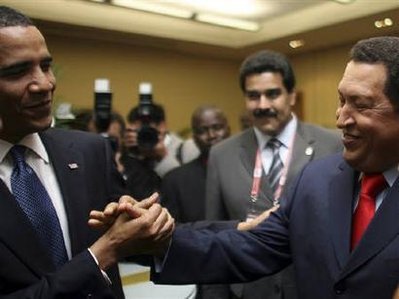
Two socialists shake hands: Barack Obama and Hugo Chavez
I’m very interested in how economic policy in different times and places affects the ability of Christians to carry out their Christian life plans. What economic policies should Christians support in order to be able to carry out their lives? Do Christians need to eat? Do they need to be safe from criminals? Do they need to be able to work or run a business without violating their consciences? Can a Christian be as charitable when he cannot even feed himself or his family?
When I talk to young evangelicals, they seem to be pretty in lockstep with the left on policies like raising the minimum wage, having government take over health care, environmental regulations on private sector energy companies to stop global warming, etc.
So, it’s worth it to look at how things work in places where socialism is actually being tried.
Here is an article from March 2013 from the radically leftist Slate. The headline is “Hugo Chavez’s economic miracle: The Venezuelan leader was often marginalized as a radical. But his brand of socialism achieved real economic gains”. The author is “a senior writer for the International Business Times”.
He writes:
Chavez became the bugaboo of American politics because his full-throated advocacy of socialism and redistributionism at once represented a fundamental critique of neoliberal economics, and also delivered some indisputably positive results. Indeed, as shown by some of the most significant indicators, Chavez racked up an economic record that a legacy-obsessed American president could only dream of achieving.
What did Chavez do, precisely, that caused the Venezuelan economic to boom? Well, he nationalized private industry and redistributed wealth from job creators and entrepreneurs to the poor.
As The Week correctly put it, while “Chavez’s policies of redistribution and nationalization of oil assets endeared him to Venezuela’s working class” and produced many laudable results, the country’s “oil-centric economy has taken away resources from other areas that are badly in need of development.”
Well, what happened next?
Consider this long and detailed article from the left-leaning The Atlantic. I can only quote part of it, but you really need to read this to understand what happens when country attacks all the people who were creating wealth and jobs with regulations, taxes, price controls and property seizure.
It says:
In the last two years Venezuela has experienced the kind of implosion that hardly ever occurs in a middle-income country like it outside of war. Mortality rates are skyrocketing; one public service after another is collapsing; triple-digit inflation has left more than 70 percent of the population in poverty; an unmanageable crime wave keeps people locked indoors at night; shoppers have to stand in line for hours to buy food; babies die in large numbers for lack of simple, inexpensive medicines and equipment in hospitals, as do the elderly and those suffering from chronic illnesses.
But why? It’s not that the country lacked money. Sitting atop the world’s largest reserves of oil at the tail end of a frenzied oil boom, the government led first by Chavez and, since 2013, by Maduro, received over a trillion dollars in oil revenues over the last 17 years. It faced virtually no institutional constraints on how to spend that unprecedented bonanza. It’s true that oil prices have since fallen—a risk many people foresaw, and one that the government made no provision for—but that can hardly explain what’s happened: Venezuela’s garish implosion began well before the price of oil plummeted. Back in 2014, when oil was still trading north of $100 per barrel, Venezuelans were already facing acute shortages of basic things like bread or toiletries.
The real culprit is chavismo, the ruling philosophy named for Chavez and carried forward by Maduro, and its truly breathtaking propensity for mismanagement(the government plowed state money arbitrarily into foolish investments);institutional destruction (as Chavez and then Maduro became more authoritarian and crippled the country’s democratic institutions); nonsense policy-making (like price and currency controls); and plain thievery (as corruption has proliferated among unaccountable officials and their friends and families).
A case in point is the price controls, which have expanded to apply to more and more goods: food and vital medicines, yes, but also car batteries, essential medical services, deodorant, diapers, and, of course, toilet paper. The ostensible goal was to check inflation and keep goods affordable for the poor, but anyone with a basic grasp of economics could have foreseen the consequences: When prices are set below production costs, sellers can’t afford to keep the shelves stocked. Official prices are low, but it’s a mirage: The products have disappeared.
When a state is in the process of collapse, dimensions of decay feed back on each other in an intractable cycle. Populist giveaways, for example, have fed the country’s ruinous flirtation with hyperinflation; the International Monetary Fund now projects that prices will rise by 720 percent this year and 2,200 percent in 2017. The government virtually gives away gasoline for free, even after having raised the price earlier this year. As a result of this and similar policies, the state is chronically short of funds, forced to print ever more money to finance its spending. Consumers, flush with cash and chasing a dwindling supply of goods, are caught in an inflationary spiral.
The rest of the article has horrifying details about what socialism really means: businesses shut down, shortages of food and medicine, government waste, skyrocketing crime, failing education system, Zika epidemic, water rationing, blackouts, and so on.
There was even an article this weekend in the radically leftist New York Times about the horrifying conditions of hospitals in Venezuela:
By morning, three newborns were already dead.
The day had begun with the usual hazards: chronic shortages of antibiotics, intravenous solutions, even food. Then a blackout swept over the city, shutting down the respirators in the maternity ward.
Doctors kept ailing infants alive by pumping air into their lungs by hand for hours. By nightfall, four more newborns had died.
“The death of a baby is our daily bread,” said Dr. Osleidy Camejo, a surgeon in the nation’s capital, Caracas, referring to the toll from Venezuela’s collapsing hospitals.
The economic crisis in this country has exploded into a public health emergency, claiming the lives of untold numbers of Venezuelans. It is just part of a larger unraveling here that has become so widespread it has prompted President Nicolás Maduro to impose a state of emergency and has raised fears of a government collapse.
Hospital wards have become crucibles where the forces tearing apart Venezuela have converged. Gloves and soap have vanished from some hospitals. Cancer medicines are often found only on the black market. There is so little electricity that the government works only two days a week to save what energy is left.
At the University of the Andes Hospital in the mountain city of Mérida, there was not enough water to wash blood from the operating table. Doctors preparing for surgery cleaned their hands with bottles of seltzer water.
“It is like something from the 19th century,” said Dr. Christian Pino, a surgeon at the hospital.
The figures are devastating. The rate of death among babies under a month old increased more than a hundredfold in public hospitals run by the Health Ministry, to just over 2 percent in 2015 from 0.02 percent in 2012, according to a government report provided by lawmakers.
The rate of death among new mothers in those hospitals increased by almost five times in the same period, according to the report.
Here in the Caribbean port town of Barcelona, two premature infants died recently on the way to the main public clinic because the ambulance had no oxygen tanks. The hospital has no fully functioning X-ray or kidney dialysismachines because they broke down long ago. And because there are no open beds, some patients lie on the floor in pools of their own blood.
This is not happening because of capitalism and the greedy rich. It is happening because of hatred and persecution of entrepreneurs and job creating private businesses. But, if you read books on economic policy like “The Spirit Level”, which is written by socialists, countries like Venezuela that have lower income inequality have lower infant mortality, lower crime rates and better health care. Socialism works great in academia, not so well in a North Korean work camp.
It’s not just Venezuela. This article from Investors Business Daily covers how well socialism is going in countries like France, Brazil and Argentina. It never works.
Now, in most churches, pastors are more concerned with making people feel good so that the coins continue to fall into the offering plate. Therefore, they carefully stay clear of topics like economics, business and entrepreneurship. The question that we need to ask ourselves is this: how easy is it for you to live out a Christian life in a country where poverty, crime, and government suppression of free speech and religious liberty are rampant? Shouldn’t part of being a Christian mean voting for public policies that actually help poor people have opportunities, children in broken homes and victims of crime, instead of just embracing what sounds nice and makes us feel good?
In case I need to be clearer, I mean that Christians who embrace socialism are taking us down the road to serfdom because of their ignorance of economics. And it’s not just the Democrats. Christians who support Donald Trump are embracing import tariffs, opposing free trade, raising taxes, raising the minimum wage, government seizing private property, and so on. That’s socialism, too. And we won’t escape the consequences of our economic ignorance anymore than the well-meaning Venezuelan voters did when they elected their strong man to rescue them.
There seems to be a lot of talk among Democrats and native young people to the effect that European countries have less “income inequality” thanks to bigger government, higher taxes, and more social spending. Is there a downside to this?
The battle over the assumed success of European socialism continues. Many European countries like Sweden have gained a reputation as being very wealthy in spite of their highly regulated and taxed economies. From there, many assume that the rest of Europe is more or less similar, even if slightly poorer. But if we look more closely at the data, a very different picture emerges, and we find that the median household in the US is better off (income-wise) than the median household in all but three European countries.
[…]Using the BEA’s regional price parity index, we can take now account for the different cost of living in different states…
[…]We now see that there’s less variation in the median income levels among the US states. That makes sense because many states with low median incomes also have a very low cost of living. At the same time, many states with high median incomes have a very high cost of living.
Now that we’ve accounted for the low cost of living in Mississippi, we find that Mississippi ($26,517) is no longer the state with the lowest median income in real terms. New York ($26,152) is now the state with the lowest median income due to its very high cost of living.
This has had the effect of giving us a more realistic view of the purchasing power of the median household in US states. It is also more helpful in comparing individual states to OECD members, many of which have much higher costs of living than places like the American south and midwest. Now that we recognize how inexpensive it is to live in places like Tennessee, Florida, and Kentucky, we find that residents in those states now have higher median incomes than Sweden (a place that’s 30% more expensive than the US) and most other OECD countries measured.
Once purchasing power among the US states is taken into account, we find that Sweden’s median income ($27,167) is higher than only six states: Arkansas ($26,804), Louisiana ($25,643), Mississippi ($26,517), New Mexico ($26,762), New York ($26,152) and North Carolina ($26,819).
We find something similar when we look at Germany, but in Germany’s case, every single US state shows a higher median income than Germany. Germany’s median income is $25,528. Things look even worse for the United Kingdom which has a median income of $21,033, compared to $26,517 in Mississippi.
Meanwhile, Colorado ($35,059) has a median income nearly identical to Switzerland ($35,083), and ten states (Connecticut, Iowa, Maryland, Minnesota, New Hampshire, North Dakota, South Dakota, Utah, Virginia, and Washington State) show higher median incomes than Switzerland. Luxembourg ($38,502), on the other hand, shows a median income higher than every state except New Hampshire ($39,034).
None of this analysis should really surprise us. According to the OECD’s own numbers (which take into account taxes and social benefits, the US has higher median disposable income than all but three OECD countries. Sweden ranks below the US in this regard, as does Finland and Denmark.
The fact that the median level in the US is above most OECD countries thus makes it no surprise that most of these countries then rank below most US states. The US states that have income level above the median US level will, not surprisingly, outpace many OECD countries by a considerable margin.
What’s going on here? Well, it turns out that when you have fewer regulations on business, lower business taxes, and an emphasis on working rather collecting welfare, that people have more money in their pockets and a better standard of living. The trouble with Europe is that too many able-bodied people can get by without working. In the United States, we put more emphasis on making your own way, earning your own pay, and spending or saving your money as you please.
In America, the system is geared towards equipping each person to serve their fellows in the private sector workplace. More people working means more wealth is produced, and more wealth produced means that people have a higher standard of living. You wouldn’t have a higher standard of living in a country where most people didn’t work, and just relied on the few who did work. There isn’t enough to go around in society where most people don’t work.


 WINTERY KNIGHT