
Tag Archives: Archaeology

Archaeologists discover entrance to city of Gath, home of Goliath

Sherlock Holmes and John Watson: let's take a look at the facts
Sherlock Holmes and John Watson: let’s take a look at the facts

I found a post on James Bishop’s blog thanks to a J. Warner Wallace tweet. It’s about an exciting new archaelogical discovery.

Live Science reports:

A massive gate unearthed in Israel may have marked the entrance to a biblical city that, at its heyday, was the biggest metropolis in the region.

The town, called Gath, was occupied until the ninth century B.C. In biblical accounts, the Philistines — the mortal enemies of the Israelites — ruled the city. The Old Testament also describes Gath as the home of Goliath, the giant warrior whom the Israelite King David felled with a slingshot.

The new findings reveal just how impressive the ancient Philistine city once was, said lead archaeologist of the current excavation, Aren Maeir, of Bar-Ilan University in Israel.

“We knew that Philistine Gath in the 10th to ninth century [B.C.] was a large city, perhaps the largest in the land at that time,” Maeir told Live Science in an email. “These monumental fortifications stress how large and mighty this city was.”

[…]Both the impressive settlement size and mentions in biblical accounts suggest to scholars that the site is the historic city of Gath, which was ruled by the Philistines, who lived next to the Jewish kingdoms of Judah and Israel. Most scholars think that Gath was besieged and laid to waste by Hazael, King of Aram Damascus, in 830 B.C., Maeir said.

[…]The team also found ironworks and a Philistine temple near the monumental gate, with some pottery and other finds typically associated with Philistine culture. Though the pottery represents a distinctive Philistine style, it also shows elements of Israelite technique, suggesting the cultures did influence each other in ways unrelated to war.

James Bishop adds this:

Recently, in 2005, an important inscription was found. Scratched on a shard were two non-Semitic names written in Semitic “Proto-Canaanite” letters. The two names: “ALWT” (אלות) and “WLT” (ולת), are similar to the name Goliath (גלית). Goliath was the feared Philistine warrior champion, who according to the biblical text, was a native of Gath, and was felled by David. Although this is not conclusive historical evidence of the Biblical Goliath’s existence, it provides excellent evidence of the cultural milieu of this period.

The story of David and Goliath is found in 1 Samuel 17. Why don’t you give it a read? It’s a great story.

I was just thinking about going through 1 Samuel myself, for personal reasons. I started this week wishing very much for vindication in a situation where someone completely disregarded my advice and then instead took the advice of a very impractical and inexperienced child. I really wanted to not be affected by this, and it made me think of Saul and David, and Saul’s anger at David. I just have so much disappointment for this one particular person who is making so many mistakes. I am anticipating a real judgment by God against this person in the near future. I expect that when this judgment comes, that this person will really understand the difference between making decisions based on emotions and selfishness, and making decisions based on practical concerns. I really would like to be vindicated.

Anyway, I felt alarmed about how much I was thinking about this expected vindication, so I thought – time to go to the Bible to remind myself what I am supposed to be like. I wanted to inform myself with the Bible in order to have the right response, whatever happens. So, I thought of 1 Samuel, and I thought that if I could just read about Saul’s anger again, then I would get the right perspective on anger and stop worrying about this until it’s all decided. So I was already headed to 1 Samuel this week, to fix my bad character. Then this 1 Samuel discovery came out.

One of the nice things the Bible gives you – when you’ve read it – is a knowledge of where to go when you need to encourage yourself to act the way God wants you to act. I’m supposed to be full of love and forgiveness, I know. But when I am not acting like that, I need to know where to go to find something that will get me back on track.

Any kind of confirmation of the Bible from science or history is just awesome, because it helps us to take the Bible seriously as truth, and then actually adjust our own actions to respect it, since it is true. And it’s true regardless of our needs and feelings. That’s why we need evidence. Evidence makes us less likely to push our feelings and desires onto the Bible, and more likely to adjust our actions so that they are compliant with what the Bible says – just the same way as we might make our computer program comply with the syntax of the language, so that it compiles and runs. The more I look at evidence, the more seriously I take the Bible, and the more I will involve God’s concerns for me in my decision-making – like this case where I need to be patient and wait for everything to come out.

Ironically, I ended up talking to a friend about my vindication-seeking, and she wanted the whole story about why I was angry. And by the time I was done telling her, I felt a lot better. It’s nice when Christians help each other. And we have Bible study tomorrow, too. I want to keep God’s character on my mind so that I make good decisions.

By the way, if you can think of anything else in the Bible that is related to this problem of feeling injustice and wanting vindication, please let me know by e-mail or in the comments.
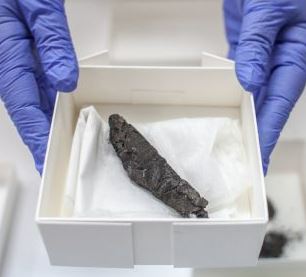
Archaeologists decipher text from burned scroll 1,500 years old

6th century fragment of Leviticus 1

It’s a fragment of Leviticus!

Live Science reports: (H/T ECM)

A burned 1,500-year-old Hebrew scroll found on the shore of the Dead Sea was recently deciphered, 45 years after archaeologists discovered it, researchers in Israel have announced.

“The deciphering of the scroll, which was a puzzle for us for 45 years, is very exciting,” Sefi Porath, the archaeologist who discovered the scroll in 1970 in Ein Gedi, Israel, said in a statement from The Israel Antiquities Authority (IAA).

The Ein Gedi parchment scroll is the oldest scroll discovered from the Hebrew Bible since the Dead Sea Scrolls, which date to the end of the Second Temple period, about 2,000 years ago.

The parchment scroll was so charred that it was illegible to the naked eye. Only with advanced technology did the scroll reveal the opening verses of the book of Leviticus, the third book of the Hebrew Bible.

So, this is the second oldest fragment of the Old Testament, with the Dead Sea Scrolls being earlier, and containing far more material than this fragment. The deciphering was done using micro-CT scanners.

And what’s the text on it?

On the newly deciphered scroll, the text (from the beginning of the book of Leviticus), translated from the original Hebrew, reads as follows:

“The Lord summoned Moses and spoke to him from the tent of meeting, saying: Speak to the people of Israel and say to them: When any of you bring an offering of livestock to the Lord, you shall bring your offering from the herd or from the flock. If the offering is a burnt offering from the herd, you shall offer a male without blemish; you shall bring it to the entrance of the tent of meeting, for acceptance in your behalf before the Lord. You shall lay your hand on the head of the burnt offering, and it shall be acceptable in your behalf as atonement for you. The bull shall be slaughtered before the Lord; and Aaron’s sons the priests shall offer the blood, dashing the blood against all sides of the altar that is at the entrance of the tent of meeting. The burnt offering shall be flayed and cut up into its parts. The sons of the priest Aaron shall put fire on the altar and arrange wood on the fire. Aaron’s sons the priests shall arrange the parts, with the head and the suet, on the wood that is on the fire on the altar.” (Leviticus 1:1-8).

The biblical text marks the first time a Torah scroll was found inside a synagogue in any archaeological excavation, according to the IAA.

The Live Science story notes that other fragments are still being analyzed, so we may get more stories like this sooner, rather than later.

Did the city of Nazareth exist at the time of the birth of Jesus?

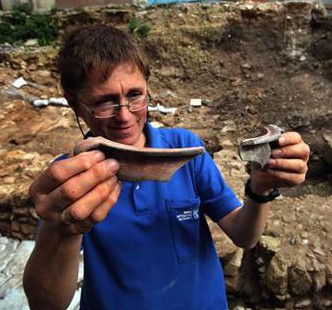
Israeli archaeologist Yardena Alexandre inspects Roman 1st-century pottery found from the city of Nazareth.

I was discussing a recent debate that a friend attended between an atheist musician named Dan Barker and a Christian with a doctorate in New Testament Studies named Justin Bass.

According to my friend’s report, the atheist questioned the existence of Nazareth, and then went on from there to assert that everything we know about Jesus is legendary.

This is what the atheist’s argument sounds like:

  1. If the New Testament contains reliable history about Jesus, then Nazareth must exist.
  2. Nazareth does not exist.
  3. Therefore, the New Testaments does not contain reliable history about Jesus. (M.T. 1,2)

I was able to find a web site where an atheist was making the claim that Nazareth did not exist at the time of Jesus. So this is not completely outside the realm of mainstream atheism. I doubled checked with two more people who attended the debate that Barker indeed made an argument like the one above.

Two things to say about this 3-step argument. First off, when speaking to atheists, Christians only care about making a case for the resurrection. This is for two reasons. One, our goal is to disprove atheism, and the historical argument for the resurrection is the most evidenced miracle claim in the New Testament. Nazareth is not part of that core of minimal facts about the resurrection of Jesus. Second, it’s possible to be a Christian by accepting a core of Christian dogma (e.g. – the Apostle’s Creed), while remaining agnostic or even skeptical of other things in the Bible. Nazareth is not part of that core of minimal facts that must be affirmed in order to become a Christian.

The problem I have with atheists is that they pick and choose from the Bible according to their own agenda. Every Christian has read basic books on the resurrection by people like Lee Strobel, Michael Licona, William Lane Craig, J. Warner Wallace and so on. This is like table stakes for living a Christian life. We all know how to make a case based off of minimal facts for the resurrection. When Christians get into debates about Jesus, we want to make a case for the core of historical knowledge about him, minimal facts that almost no one disagrees with. But many atheists aren’t like that. They want to pick and choose a few verses out of the Old Testament and the New Testament that they personally find distasteful to them, and then deny the minimal facts about Jesus on that basis. I don’t think that it makes sense to deny evidence for widely-accepted facts by bringing up minor problems that are irrelevant to the well-attested core facts.

But it’s worse than that – we actually DO know that Nazareth existed, and we know it not from some fundamentalist preacher, but from atheist Bart Ehrman.

Ehrman writes in his book:

One supposedly legendary feature of the Gospels commonly discussed by mythicists is that the alleged hometown of Jesus, Nazareth did not exist but is itself a myth. The logic of this argument, which is sometimes advanced with considerable vehemence and force, appears to be that if Christians made up Jesus’ hometown, they probably made him up as well.  I could dispose of this argument fairly easily by pointing out that it is irrelevant.  If Jesus existed, as the evidence suggests, but Nazareth did not, as this assertion claims, then he merely came from somewhere else.  Whether Barack Obama was born in the U.S. or not (for what it is worth, he was) is irrelevant to the question of whether he was born.

Since, however, this argument is so widely favored among mythicists, I want to give it a further look and deeper exploration.  The most recent critic to dispute the existence of Nazareth is René Salm, who has devoted an entire book to the question, called The Myth of Nazareth.  Salm sees this issue as highly significant and relevant to the question of the historicity of Jesus: “Upon that determination [i.e., the existence of Nazareth] depends a great deal, perhaps even the entire edifice of Christendom.”

So that seems like a fair representation of the argument I outlined above.

Bart’s response is long, but here’s part of it:

There are numerous compelling pieces of archaeological evidence that in fact Nazareth did exist in Jesus’ day, and that like other villages and towns in that part of Galilee, it was built on the hillside, near where the later rock-cut kokh tombs were built.  For one thing, archaeologists have excavated a farm connected with the village, and it dates to the time of Jesus.  Salm disputes the finding of the archaeologists who did the excavation (it needs to be remembered, he himself is not an archaeologist but is simply basing his views on what the real archaeologists – all of whom disagree with him — have to say).  For one thing, when archaeologist Yardena Alexandre indicated that 165 coins were found in this excavation, she specified in the report that some of them were late, from the fourteenth or fifteenth centuries.  This suits Salm’s purposes just fine.  But as it turns out, there were among the coins some that date to the Hellenistic, Hasmonean, and early Roman period, that is, the days of Jesus.  Salm objected that this was not in Alexandre’s report, but Alexandre has verbally confirmed (to me personally) that in fact it is the case: there were coins in the collection that date to the time prior to the Jewish uprising.

Aalm also claims that the pottery found on the site that is dated to the time of Jesus is not really from this period, even though he is not an expert on pottery.  Two archaeologists who reply to Salm’s protestations say the following:  “Salm’s personal evaluation of the pottery … reveals his lack of expertise in the area as well as his lack of serious research in the sources.”  They go on to state: “By ignoring or dismissing solid ceramic, numismatic [that is, coins], and literary evidence for Nazareth’s existence during the Late Hellenisitic and Early Roman period, it would appear that the analysis which René Salm includes in his review, and his recent book must, in itself, be relegated to the realm of ‘myth.’”

Read Bart’s whole excerpt from his book in his post.

I did a quick double check on the archaeologist Ehrman mentioned, and found an Associated Press story about another archaelogical discovery made by archaeologists in Nazareth. This time, it’s not the coins, but pottery fragments. The date range on the pottery is 100 before Jesus’ birth to 100 years after Jesus’ birth.

Even though Ehrman is an atheist, I think that he understands how to do history. You can’t be a credentialed historian and throw out the early proclamation of Jesus’ resurrection because of doubts about Old Testament violence. You can’t be a credentialed historian and throw out the conversions of Paul and James because you don’t know whether there was one angel or two angels at the empty tomb. Denying the core facts about Jesus by bringing up concerns about peripheral issues is not a responsible way to investigate the historical Jesus.

One final point. This happens when discussing scientific evidence with atheists, too. I was discussing the scientific evidence for the origin of the universe and the cosmic fine-tuning with an atheist – mentioning names, dates and places related to the discoveries – and she cut me off with “Am I going to Hell?”