
Tag Archives: 2016

Do supporters of Donald Trump really support what Trump believes?

Donald Trump and his friends, the Clintons

My friend Doug wrote a post addressed to all the evangelical Christians and Tea Party conservatives who support Trump, to ask them if they really support the actual policies and record of the man.

Doug writes:

Do you support Planned Parenthood, and do you approve of your tax dollars going to fund the abortion giant?

If your answer is, No, then you must ask yourself, Are you willing to overlook that shortcoming in Donald Trump? [1] [2] [3] [4]

I am not.

Do you identify with the Tea Party movement?

If your answer is, Yes, then you must ask yourself, Are you willing to overlook the fact that Donald Trump does not and has actively tried to defeat it? [5] [6] [7]

I am not.

Would you ever under any circumstance help the Democrats retake Congress from the Republicans?

If your answer is, No, then you must ask yourself, Are you willing to overlook that shortcoming in Donald Trump? [8]

I am not.

Do you like the idea of socialized, single-payer, government-run healthcare?

If your answer is, No, then you must ask yourself, Are you willing to overlook that shortcoming in Donald Trump? [9] [10]

I am not.

Do you support amnesty for those who are residing in our country illegally?

If your answer is, No, then you must ask yourself, Are you willing to overlook that shortcoming in Donald Trump? [11] [12]

I am not.

Do you like the ObamaCare mandate?

If your answer is, No, then you must ask yourself, Are you willing to overlook that shortcoming in Donald Trump? [13] [14]

I am not.

Do you want to see another liberal judge placed on the Supreme Court?

If your answer is, No, then you must ask yourself, Are you willing to overlook that shortcoming in Donald Trump? [15]

I am not.

Do you support Israel in the Israel-Palestinian conflict?

If your answer is, Yes, then you must ask yourself, Are you willing to overlook the fact that Donald Trump does not? [16] [17] [18] [19]

I am not.

Do you support gun control?

If your answer is, No, then you must ask yourself, Are you willing to overlook that shortcoming in Donald Trump? [20]

I am not.

Do you support the unconstitutional abuse of eminent domain?

If your answer is, No, then you must ask yourself, Are you willing to overlook that shortcoming in Donald Trump? [21] [22]

I am not.

Do you believe that Bush intentionally lied about Iraq?

If your answer is, No, then you must ask yourself, Are you willing to overlook that shortcoming in Donald Trump? [23]

I am not.

Do you approve of casinos, strip clubs, and extramarital affairs?

If your answer is, No, then you must ask yourself, Are you willing to overlook that shortcoming in Donald Trump? [24] [25]

I am not.

Would you ever under any circumstance donate money to Nancy Pelosi or Harry Reid?

If your answer is, No, then you must ask yourself, Are you willing to overlook that shortcoming in Donald Trump? [26]

I am not.

Do you like the idea of more “forward motion on gay rights”?

If your answer is, No, then you must ask yourself, Are you willing to overlook that shortcoming in Donald Trump? [27] [28] [29]

I am not.

Do you support the legality of partial birth abortion?

If your answer is, No, then you must ask yourself, Are you willing to overlook that shortcoming in Donald Trump? [30] [31] [32]

I am not.

Do you consider yourself a conservative on the most important political matters?

If your answer is, Yes, then you must ask yourself, Are you willing to overlook that shortcoming in Donald Trump? [33]

I am not.

Do you think it’s OK to ban U.S. citizens from entering this country based on religion?

If your answer is, No, then you must ask yourself, Are you willing to overlook that shortcoming in Donald Trump? [34]

I am not.

Do you think that U.S. citizens should be required to register their religion with the government?

If your answer is, No, then you must ask yourself, Are you willing to overlook that shortcoming in Donald Trump? [35]

I am not.

Do you want a President who flip flops on important issues?

If your answer is, No, then you must ask yourself, Are you willing to overlook that shortcoming in Donald Trump? [36] [37] [38]

I am not.

But then, I am a Christian, an evangelical, and a consistent Constitutional conservative, and consequently, I do not support Donald Trump.

The question is, Do you? Do you really support the things that Donald Trump supports?

You can find the footnotes in the original post.

I’ve had conversations with Trump supporters about some of these issues, and the response I get is that Trump is leading in the polls. I actually sent one Trump supporter who told me this to Real Clear Politics, which catalogs all the polls that are done nationally and at the state level. The polls clear show that Trump does not win against Clinton nationally, and he does even worse against Bernie Sanders. The response of the Trump supporter? All the polls are biased. So, the polls that show Trump in the lead in the Republican primary are not biased, but the polls showing Trump losing to Clinton and Sanders are biased.

I’ve tried to speak to the Trump supporters about things like eminent domain, support for bank bailouts, single payer health care, touchback amnesty, Planned Parenthood support,support for Vladimir Putinadultery and divorce, support for the gay rights agenda, four bankruptcies, etc. Their response has been do deny the evidence. Trump never did those things, all the news articles are lies, and all the videos of Trump saying those things are fake.

Anyway, I like listening to Ben Shapiro and Ben has a new 6-minute video where he makes the case against Trump:

Doug, Ben, and myself are all supporters of Ted Cruz. I would urge Trump voters to reconsider their vote. Please share this post, and share the Ben Shapiro video, as well.

Which candidate is best at working with Democrats to get things done?

The Jesus Seminar and their pre-suppositions
Republican voters need to go beyond the surface level in assessing candidates

I have a few friends who I know are supporting either Donald Trump or Marco Rubio in the election. I have asked them specifically what policies, accomplishments and past battles they like best about their candidate.

Donald Trump supporters say this:

  • he’s leading in the polls (vs Republicans)
  • he tells it like it is
  • he’s going to build a fence  and make Mexico pay for it
  • he’s a businessman

Marco Rubio supporters say this:

  • he’s leading in the polls (vs Democrats)
  • he’s handsome
  • I like the way he talks
  • his wife was a Miami Dolphins cheerleader, so she is prettier and funner than nerdy workaholic Harvard MBA Heidi Cruz

My candidate is Ted Cruz, and the Trump supporters tend to have no problem with him. But the Rubio supporters don’t like Cruz. So I made a list of their objections to Cruz.

The Rubio supporters say this:

  • (quoting Donald Trump) not one of his colleagues in the Senate has endorsed him
  • he won’t be able to convince other people to get things done
  • I don’t like the way he talks
  • he has a pickle nose
  • he said he wanted to make Marco Rubio’s amnesty bill “better” but  his amendment actually killed the amnesty bill – that means he’s a liar because his amendment didn’t make the bill better

Regarding the point about Ted Cruz not being able to get along with his colleagues in the Senate, that’s actually false. First, Cruz and Rubio came into the Senate at the same time, and Cruz has passed more legislation than Rubio. That might be because Rubio has the worst attendance record in the Senate.

When Rubio works together with people, he authors an amnesty bill, he supports the failed Libya invasion, he gives in-state tuition to illegal immigrants, he weakens border security, he authors a bill to remove the due process rights of men falsely accused of rape on campus, he skips votes to defund Planned Parenthood, he is liberal on the issue of gay marriage, his deputy campaign manager is a gay activist, and so on. In short, he works with liberals on liberal priorities – that’s why he is likable to them.

Ted Cruz gets into trouble with his colleagues, because he tries to stop the spending, stop amnesty, stop the military interventions in Syria, Libya and Egypt, etc. That’s why he is not likable to them.

What about the point that Cruz would not be persuasive to Democrats, and so would not be able to get anything done? Well, we already saw that Cruz has passed more legislation than Rubio, despite having a pickle nose. But he’s also shown the ability to pull Democrats towards his point of view.

Here’s an article from PJ Media to explain:

Now that Cruz regularly polls toward the top of an ever-shrinking field, his early tenure bears closer scrutiny. Cruz has gained fame as a social conservative and an unwavering opponent of Obamacare. In his first major leadership role, however, he developed economic policy as the director of the Federal Trade Commission’s Office of Policy Planning.

At the FTC, Cruz’s agenda could have been written by Milton Friedman.

Cruz promoted economic liberty and fought government efforts to rig the marketplace in favor of special interests. Most notably, Cruz launched an initiative to study the government’s role in conspiring with established businesses to suppress e-commerce. This initiative ultimately led the U.S. Supreme Court to open up an entire industry to small e-tailers. Based on his early support of disruptive online companies, Cruz has some grounds to call himself the “Uber of American politics.”

Moreover, and perhaps surprising to some, Cruz sought and secured a broad, bipartisan consensus for his agenda. Almost all of Cruz’s initiatives received unanimous support among both Republicans and Democrats.

Ted Cruz a consensus-builder? He was, at the FTC.

[…]Beyond the e-commerce initiative, Cruz also reoriented the FTC’s use of antitrust laws.

[…]Cruz also sent dozens of letters to states to fight new efforts to enshrine crony capitalism.

[…]Perhaps surprisingly, Cruz secured a high degree of consensus in pursuing his agenda.

As an independent agency, the FTC has five commissioners, and during Cruz’s tenure, two of them had served in President Clinton’s administration. All five commissioners voted to support almost all of Cruz’s proposals.

Cruz achieved this consensus by listening to policy experts and political opponents. He listened to the FTC’s economic experts and marshaled empirical economic analysis to support his policy objectives. He solicited input from prominent Democrats, including the late Senator Howard Metzenbaum, who spoke at the e-commerce conference. In addition, Cruz worked to develop personal relationships across the aisle. He regularly met with Democratic commissioners and incorporated their ideas into his policy proposals.

The article explains Cruz’s conservative agenda in detail; increasing competition, protecting consumers, and so on. But he wasn’t likable in the way that Marco Rubio was likable – by pushing a Democrat agenda. He was likable by convincing Democrats to push a conservative agenda. He did it by gathering evidence and making his case. And that’s what you expect from a lawyer who wins cases for conservatives at the Supreme  Court.

Ted Cruz fought Rubio’s amnesty in 2013 and fought Obama’s executive amnesty in 2014

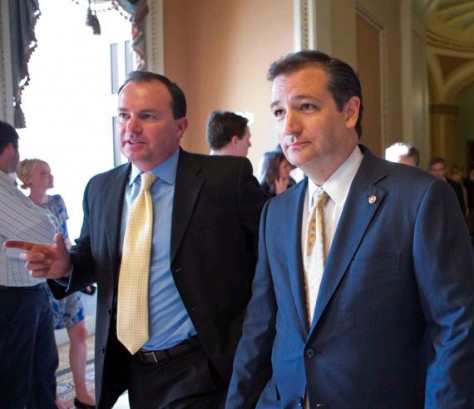
Ted Cruz and Mike Lee go to war against amnesty

Let’s do the 2013 Rubio amnesty first.

The leftist Washington Post reports on how Cruz tried to stop the Rubio amnesty by introducing amendments that would undermine support for the bill, or weaken the bill if it did get passed.

Excerpt:

Cruz has been a staunch opponent of giving a pathway to citizenship for immigrants who entered the United States illegally. In 2013, Cruz introduced five amendments:

  • Cruz 1: To triple the number of Border Patrol agents and quadrupling the equipment along the border.
  • Cruz 2: To deny means-tested government benefits to those who entered illegally.
  • Cruz 3: To strip away the pathway to citizenship.
  • Cruz 4: To expand legal immigration, by increasing employment-based immigration from 140,000 to 1,012,500 per year.
  • Cruz 5: To raise the H-1B high-skilled worker cap from 65,000 visas to 325,000 per year.

Note that “legalizing” someone can mean just giving them a temporary work permit, so that they are in the country legally, but have no permanent right to stay, much less get citizenship. The thing is, it’s not even clear that Cruz would have voted for the bill with his amendments. His goal was to derail the bill by embedding things in it that the supporters did not want. Like the “no path to citizenship” that Rubio wanted. And this is exactly how Democrats saw his amendments.

Here’s what happened:

When pressed about his 2013 statements and the citizenship amendment after the GOP debate, Cruz said: “It’s called calling their bluff.”

And in a Dec. 16, 2015, interview with Bret Baier on Fox News: “You’ve been around Washington long enough. You know how to defeat bad legislation, which is what that amendment did, is it revealed the hypocrisy of Chuck Schumer [D-N.Y.] and the Senate Democrats and the establishment Republicans who were supporting them because they all voted against it.”

[…]Current and former Democratic Senate staffers familiar with the negotiations confirmed to The Fact Checker that Cruz’s bill was, indeed, viewed as a poison pill in 2013. Consider the impact some of his amendments would have had on the fragile agreements the coalition negotiated:

  • Tripling Border Patrol agents: The Senate ultimately approved an amendment to double the number of Border Patrol agents. But tripling the number would’ve gone too far and lost the support of some immigration groups, which believed an even bigger increase would be badly received by border communities and the public.
  • Expanding legal immigration: Such a dramatic increase in employment-based immigration and H-1B visas went far beyond the coalition’s negotiated cap at 65,000. As The Washington Post’s Paul Kane reported, Democrats, Republicans and their allies in the labor movement and corporate America worked for months to agree on this number, which was backed by the AFL-CIO and the U.S. Chamber of Commerce. A slight increase or decrease would have jeopardized support from either the AFL-CIO or the Chamber of Commerce; Cruz’s proposal was a 400 percent increase from the negotiated cap.
  • Removing pathway to citizenship: This was the major negotiation point for the Gang of Eight, and would have killed the bill.

In reference to the citizenship amendment, then-Senate Judiciary Chairman Patrick J. Leahy (D-Vt.) said during the 2013 hearing: “My concern with this, I feel it would virtually gut the bill … and gut what has been a very careful balance by Republicans and Democrats and the sponsors of it.”

Sen. Charles E. Schumer, a Gang of Eight Democrat, echoed the concern at the hearing: “If we do not have a path to citizenship, there is no reform, many of us feel. That is a bottom line here.” The Gang of Eight Republicans on the Judiciary Committee sided with Democrats in rejecting this amendment.

In a statement to The Fact Checker, Schumer confirmed Cruz’s bill was viewed as a poison pill: “This was an attempt to kill the bill, and there was no doubt at the time that Senator Cruz knew it would do exactly that.”

This is what Marco Rubio is getting angry with Cruz about in the debates. Cruz introduced 5 amendments meant to destroy the agreement among supporters of the bill. And the bill died. Rubio actually voted against Cruz’s amendment that would have taken citizenship off the table. He also opposed poison pill amendments by amnesty opponents Mike Lee and Jeff Sessions.

Conservative Mark Levin recently interviewed Jeff Sessions about Ted Cruz’s role in the battle over amnesty, and you can read about it here on the Daily Wire.

The second amnesty battle

Rubio’s amnesty was defeated in 2013, but there was another amnesty to come in 2014. This time, from the pen of Barack Obama.

The Blaze reports:

On Saturday night, Sen. Ted Cruz (R-Texas) won a battle, but not the war, against President Barack Obama’s executive action on immigration.

Cruz led the fight to force a Senate vote on Obama’s immigration plans, as a condition of approving a massive, $1.1 trillion spending bill for 2015. He was able to make that vote happen by arguing that the spending bill violated the Constitution because it would fund Obama’s plan — a plan Cruz and other Republicans say is illegal because it rewrites immigration law without any input from Congress.

“Tonight is the first opportunity that Congress has to express its disapproval,” Cruz said late Saturday of Obama’s immigration plan.

Cruz lost the vote, as expected in a Senate that is still controlled by Democrats for a few more weeks. But Cruz’s tactics — which forced the Senate to work unexpectedly late into Saturday night — also drew criticism from Republicans, and several GOP senators vote against Cruz.

In the final vote, the Senate decided 22-74 against Cruz — less than half of the Senate’s 45 Republicans voted with Cruz.

[…]Cruz raised his constitutional argument against the bill on Friday night, a move that surprised both Republicans and Democrats and forced the Senate back into the office for a rare Saturday session. After several hours of negotiating, Democrats finally agreed to give Cruz his vote.

The vote itself was a victory — many Republicans have been begging for either the House or Senate to go on the record about Obama’s unilateral immigration decision.

This is why Cruz has few friends in the Senate. It’s not because he is a mean person, it’s because he fights hard for what is right. And few stand with him.

Cruz keeps telling the truth, and people keep calling him a liar for citing their actual words and actions:

It’s important to understand that on Washington, most of the politicians in both parties want amnesty. And that’s why they hate Cruz so much. It’s not his personality, it’s his conservatism.