

What theory of truth should a Bible-believing Christian accept?

Investigation in progress

I was just thinking to myself this week about why I keep running into people who identify as Christians who are open and unrepentant about habitual sin. Now, I’m not perfect, but you don’t see me out there in public saying that the Bible is wrong. I would not claim that some behavior that was condemned by all previous generations of Christians is suddenly ok.

So, I thought and thought and thought about it, and here is what I came up with. Somehow, people have come to a view of Christianity that tells them that Christianity is not something that is true about the universe out there. Instead, Christianity is “true” in the sense that it “works for them”.

So they aren’t saying that God actually exists or that Jesus actually rose from the dead, because they don’t know if those things are objectively true. They’re just saying that they like some Christian words and behaviors because those things make them feel good. Christianity is not something they could defend as objectively true to any non-Christian using reason and evidence. They like how the idea of a loving God makes them feel. Or maybe they like invoking the idea of “do not judge” when someone questions their destructive choices or immorality. But they don’t actually submit to these ideas as “true” in the same way that they take the instructions on a medicine bottle as true.

Here’s a post by Aaron Brake at Stand to Reason, that explains three different views of truth. He calls the view that I talked about the “pragmatic view of truth”. He says that the pragmatic view is that things are true if they “work” for the individual. So, in the case of my Christians-who-deny-Jesus-as-Lord, these people pick and choose things that work for them out of Christianity, e.g. – the love of God, the “do not judge” fragment, the women taken in adultery, etc. But they leave out the moral obligations that Christians have believed for thousands of years, e.g. – no sex before marriage, marriage is between a man and woman for life, divorce is pretty much always unjustified, and adultery is never OK under any circumstances.

Here is the view of truth that he thinks is best:

Finally, there is the correspondence theory of truth: truth is when an idea, belief, or statement matches (or corresponds with) the way the world actually is (reality).

This may rightly be labeled the “common sense” view of truth. While not taught explicitly in Scripture, it is assumed throughout both the Old and New Testaments. The correspondence theory of truth states that an idea, belief, or statement is true if it matches, or corresponds with, reality. In this sense, reality is the truth-maker, and the idea, belief, or statement is the truth-bearer. When the truth-bearer (an idea) matches the truth-maker (reality), they are said to stand in an “appropriate correspondence relationship,” and truth obtains.

Consider the following statements:

  1. Donald Trump is the current President of the United States.
  2. The city of Los Angeles is located in California.
  3. Elective abortion kills an innocent human being.

Are these statements true? They are if, in fact, they match reality. Statement number 1 is true if, in reality, Donald Trump is the current President of the United States. Statement 2 is true if, in fact, the city of Los Angeles is located in California. And statement 3 is true if elective abortion really does kill an innocent human being. Easy enough, right? Aristotle put it this way:

To say of what is that it is not, or of what is not that it is, is false, while to say of what is that it is, and of what is not that it is not, is true; so that he who says anything that it is, or that it is not, will say either what is true or what is false.

A Case for Correspondence

Christian philosopher J.P. Moreland notes two main arguments which have been advanced in favor of the correspondence theory of truth: the descriptive and the dialectical.

The descriptive argument simply presents specific cases that help illustrate the concept of truth. For example, in Moreland’s bookstore case, an individual named Joe has the thought “Richard Swinburne’s book The Evolution of the Soul is in the bookstore.” When Joe enters the bookstore and sees the book, he actually experiences truth, a correspondence relation between his thought and reality. Again, this is the “common sense” definition of truth since it is the view we all presuppose in our daily actions and speech; i.e., everyone assumes the correspondence theory of truth when reading a medicine label or dialing a phone number.

That theory of truth is the normal theory of truth, and it’s the one used in the Bible, e.g. – Elijah on Mount Carmel, Jesus calling his resurrection the Sign of Jonah. If the Bible teaches something, then that teaching is true, because it conforms to the way the world really is. Objective reality makes the Bible’s statements true or false. It’s true whether people like it or not.

Here’s what I suspect is true of all the liberal Christians that I’ve met. None of them will have looked into things like the existence of God or the resurrection to see if they are objectively true. They’ll not even be interested in lifting a finger to study in order to find out whether those things are true. If they evangelize, they’ll tell stories about their own life experiences and feelings, and try to “sell” Christianity based on felt needs being met. They’ll not waste a second on studying the laws of logic, or science or history in order to demonstrate Christian claims as true – especially the ones that don’t “ring true” to them.

It makes me think of that post that I wrote about John Searle and his suspicion about why people become postmodern relativists. He thinks it’s so that they can deny reality if reality constrains their will to pursue happiness. I’ve actually seen this when people break all the rules in their selfish pursuit of happiness, and then when it all explodes in their face, they claim that life is unpredictable, and it wasn’t their fault. The rejection of the correspondence theory of truth is – I think – rooted in this desire to dismiss anything that could act as a brake on their hedonism. They don’t care that you can produce studies after studies showing that fatherlessness is bad for children. If God didn’t give them a husband, then they are perfectly justified in having children through a sperm donor, and raising the fatherless child with welfare money. The simplest way out of your Bible verses and fatherlessness studies is for them to say that doing wrong “works for them” and so it’s “true for them”.

How to falsify a religion using scientific or historical evidence

Will the universe expand forever, or will it collapse and bounce?

(Image source)

What I often see among atheists is this tendency to set up expectations of how God would have acted and then complain that he doesn’t met those expectations. I don’t think that this is a good way to argue against a religion, because it’s subjective. God isn’t obligated to comport with atheist expectations. A much better way of evaluating religions is to test the claims each makes against evidence.

So in this post, I wanted to show how a reasonable person can evaluate and reject different worldviews using evidence.

Falsifying a religion using science

Consider this argument:

  1. Hindu cosmology teaches that the universe cycles between creation and destruction, through infinite time.
  2. The closest cosmological model conforming to Hindu Scriptures is the eternally “oscillating” model of the universe.
  3. The “oscillating” model requires that the universe exist eternally into the past.
  4. But the evidence today shows the the universe, and time itself, had a beginning at the big bang.
  5. The “oscillating” model requires that the expansion of the universe reverse into a collapse, (= crunch).
  6. In 1998, the discovery of the year was that the universe would expand forever. There will be no crunch.
  7. Therefore, the oscillating model is disconfirmed by observations.
  8. The oscillating model also faces theoretical problems with the “bounce” mechanism.

Notice how the oscillating model is falsified by mathematics and experimental evidence. Remarkable, when you remember how the public schools would play Carl Sagan videos which promoted this no-Creator model of the universe.

The absolute origin of the universe out of nothing is also incompatible with atheism, Buddhism, Mormonism, etc. because they also require an eternally existing universe.

Atheism in particular is incompatible with the universe “coming into being”, because that would be a supernatural cause – a cause that created the natural world. According to the Secular Humanist Manifesto, atheism is committed to an eternally existing universe, (See the first item: “Religious humanists regard the universe as self-existing and not created.”). If something non-material brought all existing matter into being, that would be a supernatural cause, and atheists deny that anything supernatural exists. The standard Big Bang theory requires that all the matter in the universe come into being out of nothing.

Falsifying a religion using history

Consider this argument:

  1. To be a Muslim, you must believe that the Koran is without error.
  2. The Koran claims that Jesus did not die on a cross. (Qur’an, 4: 157-158)
  3. The crucifixion of Jesus is undisputed among non-Muslim historians, including atheist historians.
  4. Therefore, it is not rational for me to become a Muslim.

I’m going to support the premise that Jesus was crucified by citing historians from all backgrounds.

Consider some quotes from the (mostly) non-Christian scholars below:

“Jesus’ death as a consequence of crucifixion is indisputable.” Gert Lüdemann

“That he was crucified is as sure as anything historical can ever be.”  J.D. Crossan

“The passion of Jesus is part of history.” Geza Vermes

Jesus’ death by crucifixion is “historically certain”. Pinchas Lapide

“The single most solid fact about Jesus’ life is his death: he was executed by the Roman prefect Pilate, on or around Passover, in the manner Rome reserved particularly for political insurrectionists, namely, crucifixion.” Paula Fredriksen

“The support for the mode of his death, its agents, and perhaps its co-agents, is overwhelming: Jesus faced a trial before his death, was condemned, and was executed by crucifixion.” L.T. Johnson

“One of the most certain facts of history is that Jesus was crucified on orders of the Roman prefect of Judea, Ponitus Pilate.” Bart Ehrman

That’s 7 famous historians: 3 atheists, 3 Jews and 1 moderate Catholic. The atheists, Ludemann, Crossan and Ehrman, have all debated against the resurrection of Jesus with William Lane Craig. Johnson is the moderate Catholic, the rest are Jewish historians. The Koran was written in the 7th century. That is why no professional historian accepts the Koran as more authoritative than the many earlier Christian and non-Christian sources for the crucifixion story. Many of the sources for the crucifixion are dated to the 1st century. It’s not faith. It’s history.

I have seen debates with Muslim scholars, and I have never once heard them cite a non-Muslim historian to the effect that Jesus was not crucified. To my knowledge, there is no (non-Muslim) historian who denies the crucifixion of Jesus in his published work.

Can Christianity be falsified by science or history?

Yes. If you prove that the universe is eternal than would falsify the Bible’s claim that God created the universe out of nothing. That would be a scientific disproof. If you could find the body of Jesus still inside a tomb, that would falsify the Bible’s claim about a resurrection. That would be a historical disproof. The nice thing about Christianity is that we make lots of testable claims. When someone claims to be a Christian, it’s a good thing if they can show how they arrived at that conclusion. Being able to square God’s existence with science, and Jesus’ resurrection with history are two crucial steps to showing the reasonableness of Christianity.

We shouldn’t be surprised by evidence of fascism in the Obama administration

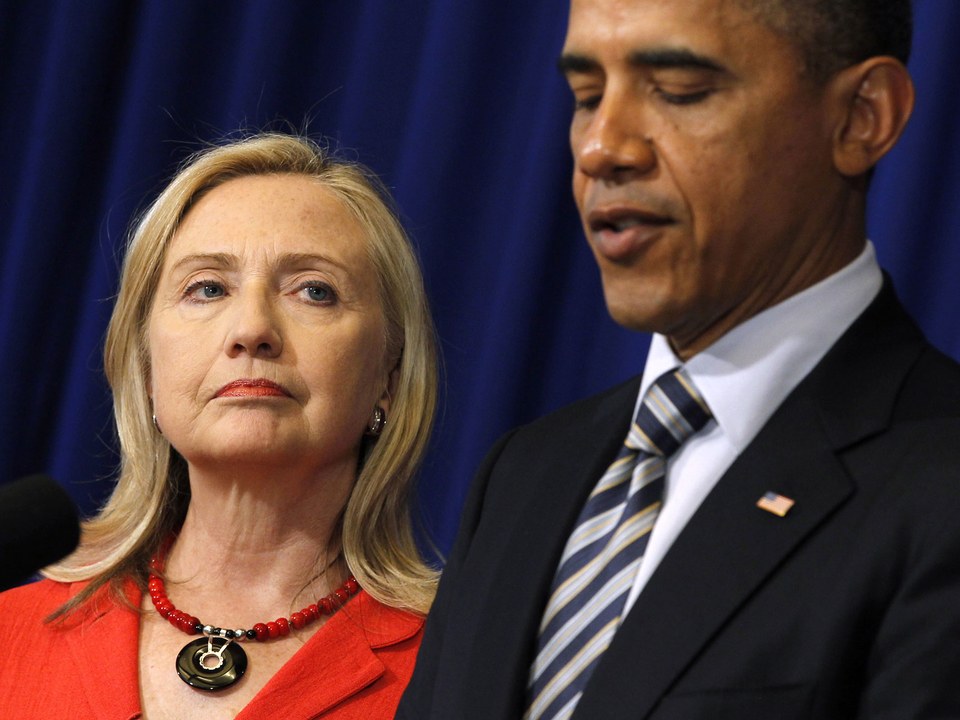
Hillary Clinton and Barack Obama

There were plenty of signs that Obama was a pretty typical leftist authoritarian. Everything we knew about his ideology before he was elected should have told us that he was in favor of big government, and opposed to private businesses and families. If there was a conflict between liberty and government overreach, then Obama could be counted on to come down on the side of big government.

Here’s a reminder from The Federalist about why we shouldn’t be surprised by what was revealed in the House Intelligence Committee memo.

Excerpt:

Remember Frank VanderSloot? He was one of eight Mitt Romney donors that an Obama campaign website targeted in April 2012, listing each by name and condemning them for the crime of having donated to Obama’s opponent. The post described VanderSloot as a “wealthy individual” with a “less-then-reputable record.”

It didn’t stop with this public shaming of a private citizen. As the Wall Street Journal’s Kim Strassel later noted, the Obama campaign’s site was a clear signal to harass and intimidate Romney donors, which is exactly what happened:

Twelve days later, a man working for a political opposition-research firm called an Idaho courthouse for Mr. VanderSloot’s divorce records. In June, the IRS informed Mr. VanderSloot and his wife of an audit of two years of their taxes. In July, the Department of Labor informed him of an audit of the guest workers on his Idaho cattle ranch. In September, the IRS informed him of a second audit, of one of his businesses. Mr. VanderSloot, who had never been audited before, was subject to three in the four months after Mr. Obama teed him up for such scrutiny.

The last of these audits was only concluded in recent weeks. Not one resulted in a fine or penalty. But Mr. VanderSloot has been waiting more than 20 months for a sizable refund and estimates his legal bills are $80,000. That figure doesn’t account for what the president’s vilification has done to his business and reputation.

Using the IRS to target political enemies was nothing new for the Obama administration in 2012. In Obama’s January 2010 State of the Union address, he infamously disparaged the U.S. Supreme Court—to the justices’ faces—for its ruling in Citizens United. He claimed the ruling would “open the floodgates for special interests” to influence elections—by which he meant conservative groups. He returned to this theme again and again in subsequent speeches, warning that Citizens United would enable shadowy organizations, maybe even foreign-controlled corporations, to infiltrate our politics with “dark money.”

Obama’s message was clear: these conservative advocacy groups should be targeted. The IRS got the message, and from 2010 to 2013 it systematically targeted conservative nonprofits applying for tax-exempt status. If your group had “tea party” or “patriots” in its name, the IRS came after you. Hundreds of individuals and groups, mostly comprised of private citizens with moderate means, were subjected to exhaustive and expensive IRS audits. The feds demanded detailed donor and member information, reading lists, and in some cases the contents of prayers offered at meetings. The applications were held up for years.

Last October, the IRS signed a consent decree in federal court admitting that it targeted conservative groups. But of course nothing ever happened to those responsible. The IRS official at the heart of the targeting scandal, Lois Lerner, retired with a full pension and no disciplinary action was ever taken against any IRS employee. When the scandal broke in 2013, Obama feigned outrage, calling the agency’s behavior “outrageous” and assuring the public that the IRS should be “held fully accountable.”

But of course the IRS was simply responding to Obama’s openly expressed suggestion that these groups were suspicious and improperly engaged in campaigning. Obama didn’t have to issue a direct order to get the IRS to do his political dirty work, he just had to make himself clear.

And it wasn’t just the IRS persecuting conservative groups. The Obama administration also went after religious people – people of moral character and conscience.

More:

The same sort of politicization and abuse of power unfolded throughout the executive branch under Obama. Consider the contraceptive mandate. The Affordable Care Act invested the U.S. secretary of Health and Human Services with enormous power over the country’s health insurance markets, including the ability to define what sort of contraceptive coverage employers had to provide. Employers with strong religious objections to contraception and related abortifacients, like Hobby Lobby and the Little Sisters of the Poor (an order of Catholic nuns who care for the poor elderly), were effectively told by the Obama administration to shut up and violate their faith.

In both of those cases, Obama’s Justice Department went all the way to the Supreme Court to try to force those employers to comply with the dictates of the HHS secretary. That Obama’s Justice Department failed in both cases shouldn’t diminish the fact that both HHS and DOJ carried on a highly politicized campaign against religious conservatives who refused to go along with federal rules stemming from Obama’s signature legislative accomplishment.

On this blog, I wrote many times about the fascist activities of the Holder DOJ and then the Lynch DOJ, after his departure. Basically, the Obama administration thought that it was perfectly reasonable to weaponize the entire federal government – from IRS, to EPA, to HHS, and beyond – against their political opposition. Both the Republican party, and also private citizens, private businesses and private charities.