
Walt Russell explains how to read the Bible effectively

Bible study that hits the spot

Dr. Walt Russell’s book on the subject of interpreting the Bible is called “Playing With Fire: How the Bible Ignites Change in Your Soul“. I like that book, but I found four articles that summarize the main points of the book so people can understand how to read the Bible at a high livel.

Here is part one which talks about how postmodern relativism is at odds with discovering the original intent of an author.

Excerpt:

Twenty-four year-old “Janet” (not her real name) was angry at my emphasis on seeking to discover authors’ intentions when we read their texts. She was an evangelical Christian and a second grade teacher in a public school. She prided herself in helping her 20 students learn to love literature. She would read them a story as they gathered around her, and then ask each child, “What does the story mean to you?” She prodded them to come up with their own unique meanings. With such strong encouragement, the class of 20 would eventually have 20 different meanings for the one story. Janet sensed that I was a naysayer about such “love of literature.” Pouring a little emotional gasoline on the fire, I said, “Janet, you’re certainly doing your part to insure that these 7 year-olds will never recover from a radically relativistic view of meaning!” Now I had her full attention.

Here is part two which talks about the importance of knowing the genre of a text before you try to interpret it.

Excerpt:

“INDIANS SLAY TIGERS!” — the newspaper headline virtually screams out at you. The thought of something being slain is repulsive. You’re gripped by a mental image of southern India’s Bengal tiger. You imagine its beautiful face, its stripes and piercing eyes. Then your image is shattered by the sudden blast of a high-powered rifle. You see the exquisite creature writhe in pain, fall gracelessly in its tracks and die. Having read no further than the headline, you feel sick, as if you’ve witnessed something tragic.

But should you feel this way? The slaughter of an endangered species — especially one as magnificent as the Bengal tiger — is horrifying, no doubt. But suppose you failed to notice that the headline “INDIANS SLAY TIGERS!” appeared in the sports page of the morning paper. Clearly enough, it now refers to different Indians, different Tigers and a different manner of slaying than you originally thought. And is it really that tragic that the Cleveland Indians badly beat the Detroit Tigers in a major league baseball game last night? Not unless you’re a long-suffering Detroit Tigers’ baseball fan. But how do you now know that the headline is about baseball and not tiger-slaying in India? You look at the words “INDIANS SLAY TIGERS” and you know exactly what each word means. When you combine these words, how can they not mean exactly what you first thought they did — that Indians slay tigers? Answer: because their meanings are communicated (as the meanings of all words are) through genres!

Here is part three which talks about the importance of reading the context of a verse before you try to interpret it.

Excerpt:

“Never Read a Bible Verse!” That’s the title of a little booklet my friend and Christian radio personality, Gregory Koukl, has written to help people read the Bible well. What great advice. “That’s right, never read a Bible verse. Instead, always read a paragraph — at least.” But the current is flowing the other way in our popular sound-bite culture. Not to be left out (or left behind!), the Church has its own version of sound-bite culture: verse-bite culture. In verse-bite culture we take a sentence or sentence-fragment from a biblical paragraph, memorize it out of context, write it on a little card, put it on a billboard, a plaque, a rock, etc. Somehow we think that just because this little chunk of Scripture has a verse number in front of it, it was meant to be a free-standing unit of thought. Nothing could be further from the truth.

Apart from the fact that chapter and verse divisions weren’t added to the New Testament text until 1560 — long after the New Testament’s inspired authorship — there is a more important reason for never reading just a Bible verse, and instead reading at least the paragraph that contains it.

Here is part four which talks about the importance of applying the words of the Bible to your life.

One verse that is often misinterpreted is missing from the articles, but present in the STR lecture. It’s Philippians 1:6 that says “6 being confident of this, that he who began a good work in you will carry it on to completion until the day of Christ Jesus”. Russell says in the lecture that this promise is specifically intended for the church in Philippi, to whom Paul is writing, not necessarily to all Christians. He is giving them a promise just after directly referring to their good work in supporting him in his ministry. Some verses are just not meant for us, and the context reveals it.
What if you only had four minutes to defend Israel’s attack on the Canaanites?

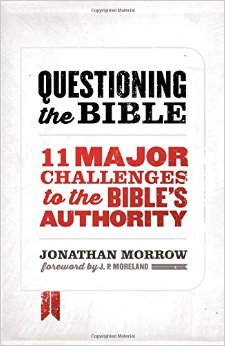
Questioning the Bible by Jonathan Morrow
“Questioning the Bible” by Jonathan Morrow

Jonathan Morrow is giving you just four minutes to respond to a well-known challenge to belief in the Christian God.

Can you handle it?

If not, here is a podcast to help you get ready.

Description:

Is the God of the Old Testament violent and bloodthirsty? Did God really command genocide? Why did Israel attack the Canaanites? These are just a few of the tough questions I tackle in this episode of the think Christianly podcast. Learn how to respond to one of the most challenging and emotional objections to Christianity in under 10 minutes.

Summary:

  • quotes Richard Dawkins to set up the objection
  • response: does God have the authority to give and take life?
  • response: after the Fall, things in the world are not the way they are supposed to be
  • response: Old Testament commands for the Jews to judge other nations are specific to them in that time
  • response: “genocide” and “ethnic cleansing” are not accurate descriptions of the attack on Canaan
  • response: the attack on the Cannanites takes place in the context of redeeming the whole world

Here is the Christian Post article he was interviewed for, where he had to answer:

Jonathan Morrow, author of Questioning the Bible: 11 Major Challenges to the Bible’s Authority, says readers are often perplexed by Old Testament scripture because “sometimes we just picture a God where anger and love can’t co-exist.” Yet he explains, “We all have seen people who have been taken advantage of and that makes us angry [because] we love them. So those emotions can co-exist.”

[…]Along that same line, Morrow clarifies that God’s instructions to the Israelite army in Deuteronomy 20 to destroy the people occupying the land of Canaan is “about judgment, not genocide.”

“The Bible teaches clearly that all people are sinful and in rebellion, kind of living in open rebellion against God, and God is just to judge anyone,” says Morrow. “But in this particular case with the Canaanites, there’s several things going on there, but one of those things was the wickedness of the people which was well documented – child sacrifices to Moloch and others, and bestiality and a lot wickedness.”

He says this judgment was necessary because “Israel’s national survival was crucial so that the Messiah – we would know Jesus as the Messiah – and God’s saving purposes of redemption to the world could one day be born because if the Messiah was supposed to come through the lineage of Israel and Israel co-mingled with this wicked people and was ultimately destroyed, that promise of hope and blessing to the whole world could not have been realized.”

[…]Morrow recognizes that Old Testament questions are particularly challenging. “We live in a sound bite culture and so this is one of those questions where it kind of gets thrown out for people, why does God command genocide, and that’s really easy to say and then it takes some time to respond to because there’s some context.”

Morrow says his sound bite answer is: “These passages are about judgment; they’re not about genocide.”

However, he encourages believers to find out the asker’s real interest in this question. “I would ask them, you know, it sounds like this is a pretty emotional question for you, why is that. Let them talk about it some so you can better understand because that’s the goal. We’re not just trying to win an argument; we’re trying to understand and help people.”

It the asker is after truth, Morrow advises Christians to “ask them … are you interested in kind of walking through and getting kind of messy about looking at the evidence for this because I’d love to share that with you, and sometimes they’ll go, ‘yeah, that’ll be great.'”

Other times, Morrow says, the asker is simply looking for “space and distance from God and this question allows them to put space between them and God.”

By the way, Morrow and McDowell’s basic apologetics book – “Is God Just a Human Invention?” – is my first pick when mentoring new people in apologetics.

UPDATE: J.W. Wartick has reviewed the 11 Questions book on his blog.

William Lane Craig explains how Christianity explains evil and suffering

A long journey through the night

A lot of people in the West complain too much about any little suffering they have to experience. But sometimes, when a very harsh suffering is felt by someone who has tried to follow Jesus, an explanation is necessary. I found something very good on the Reasonable Faith web site, written by Dr. William Lane Craig.

He makes the following points:

  1. We are not in a good position to assess the probability of whether God has morally sufficient reasons for the evils that occur.
  2. The Christian faith entails doctrines that increase the probability of the co-existence of God and evil.
  3. Relative to the full scope of the evidence, God’s existence is probable.

I’ve written before about point #1, in which Dr. Craig’s describes the limitations of human knowledge that make it hard for us to know for certain that a specific evil or suffering does not have a good reason for God to allow it. And I’ve written about #3, in which Dr. Craig makes some arguments for God’s existence. But #2 might be new to some of you, so let’s look at that.

He makes four sub points in section 2 about Christian doctrines that make the existence of evil and suffering more reasonable.

  • 2. a)The chief purpose of life is not happiness, but the knowledge of God.
  • 2. b) Mankind is in a state of rebellion against God and His purpose.
  • 2. c) The knowledge of God spills over into eternal life. 
  • 2. d) The knowledge of God is an incommensurable good.

My favorite one is 2. a), so let’s look at that one. He says:

2. a. The chief purpose of life is not happiness, but the knowledge of God. One reason that the problem of evil seems so puzzling is that we tend to think that if God exists, then His goal for human life is happiness in this world. God’s role is to provide comfortable environment for His human pets. But on the Christian view this is false. We are not God’s pets, and man’s end is not happiness in this world, but the knowledge of God, which will ultimately bring true and everlasting human fulfillment. Many evils occur in life which maybe utterly pointless with respect to the goal of producing human happiness in this world, but they may not be unjustified with respect to producing the knowledge of God. Innocent human suffering provides an occasion for deeper dependency and trust in God, either on the part of the sufferer or those around him. Of course, whether God’s purpose is achieved through our suffering will depend on our response. Do we respond with anger and bitterness toward God, or do we turn to Him in faith for strength to endure?

You know, I always get confused when I see Christians trying to follow the script of the world and trying to make themselves feel good with consumer purchases, travel, fun experiences, showing off to others, etc. When I read the story of Jesus, it’s pretty clear that the normal Christian life, if the person is following Jesus at all, is about suffering the disapproval and opposition of non-Christians while you remain faithful and obedient to God. Today, there’s probably no better example of this than defending unborn children from adult selfishness. Although, defending born children from selfish adults who seek to deprive children of their biological mother and father is pretty bad, too. Nobody is going to like you for restricting their fun (i.e. – abortion, divorce, adultery, homosexuality, etc.), but being willing to take the heat from non-Christians for the sake of promoting what God thinks is right is true Christianity. It’s what Jesus would do.

Anyway, the one I’ve been thinking about more lately is 2. d), where Dr. Craig writes this:

2. d) The knowledge of God is an incommensurable good. To know God, the source of infinite goodness and love, is an incomparable good, the fulfillment of human existence. The sufferings of this life cannot even be compared to it. Thus, the person who knows God, no matter what he suffers, no matter how awful his pain, can still say, “God is good to me,” simply by virtue of the fact that he knows God, an incomparable good.

I sometimes feel pretty stressed out about Americans who were born in conservative states, raised by two married Christian parents, attended Christian schools and youth groups, and then abandoned their faith for atheism as soon as they hit college. It really bothers me how people who had all these advantages turned their backs on God, and they’re ungrateful for all their blessings. They show no curiosity about God – they don’t want to know him. But when you read the gospels to see what Jesus has to say about these sorts of people, it’s very comforting. He really sees the problem, and he is on the side of the little guy who has to struggle to be faithful and obedient to God. The Bible has nothing to say to people who are able to feel happy and successful apart from God. It speaks to people who are struggling to follow God. Even when things are difficult, Jesus speaks to the problem of being an alien and a stranger in a world that turns its back on him.