Meet four heroes of the D-Day invasion of Normandy on June 6th, 1944

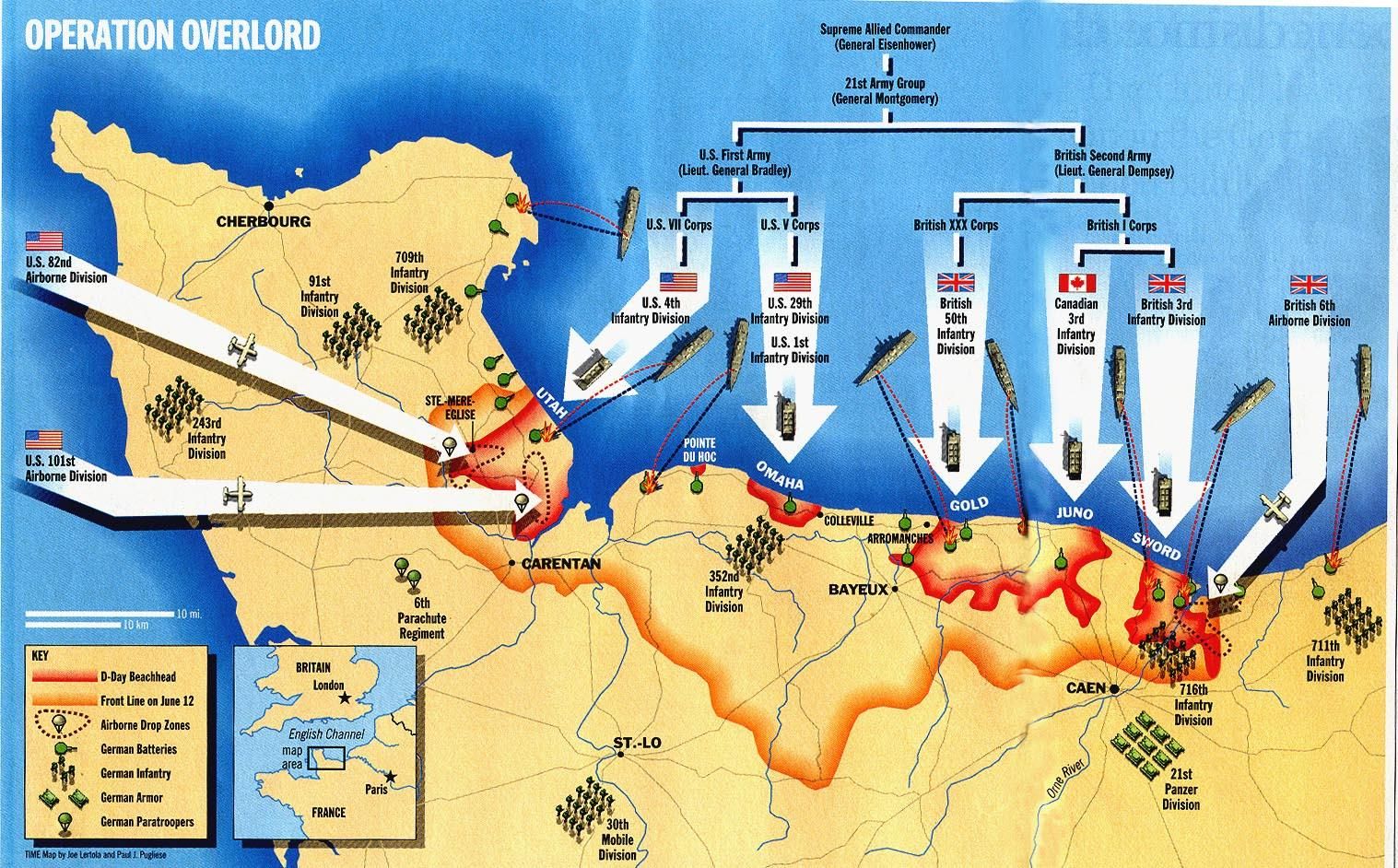
Map of D-Day landings (click for larger image)
Map of D-Day landings (click for larger image) (courtesy of Time magazine)

I thought it might be a good idea to write up something about D-Day in order to help people understand some of our military history, and to put the spotlight on some real heroes. I don’t regard artists, athletes, dancers, singers, actors, or other celebrities as heroes. It really alarms me that so many people know more about these fake heroes than they do about real ones.

Weakness emboldens aggressors

For one thing, many people don’t understand how British and American libertarian isolationism made World War 2 into a much bigger mess than it needed to be. As historian Victor Davis Hanson explains in the lecture I linked below, the Allied nations were much stronger and better equipped than the Axis nations before the war started. The Axis nations developed better weapons after the war started. But Germany and Japan didn’t think that the Allied nations would do anything if they were aggressive. We know this from their writings and correspondence. They thought that British and Americans were just too scared of war to stop them.

Germany and Japan tested their hypothesis out by re-arming and annexing territory from their neighbors. Britain and America were led by libertarian isolationists, so they didn’t fight back. The aggressors correctly understood that libertarian isolationists didn’t have the will to oppose them, even if they were weaker than the Allies. But the more they re-armed and annexed territory, the stronger they became. The Allied nations waited too long to confront them. And that’s why World War 2 was much harder to win than it needed to be.

Here’s a very good lecture about the causes of World War 2 by an actual military historian, Victor Davis Hanson:

So, that’s the first point I wanted to make: libertarian isolationism causes wars. Although libertarians claim to oppose war, they actually cause war, due to their weakness in the face of evil. So who stops wars? People who favor a strong defense, and show a willingness to fight back against aggression are the ones who REALLY oppose wars. This is called “peace through strength”, and you can see it in action in the Cold War, where Ronald Reagan defeated the Soviet Union by making their aggression costly.

Heroes of D-Day

My second concern was to promote the real heroes of D-Day, over the fictional heroes of movies, fiction, music, dancing, sports, and other entertainment nonsense.

Here are the four heroes I chose:

  • Major John Howard
  • Lieutenant Colonel Benjamin Vandervoort
  • Brigadier General Norman Cota
  • Major Richard Winters

Let’s take a look at each of them.

John Howard

Major John Howard led elements of the British 6th Airborne Division to take two vital bridges southeast of Sword beach. He did this in order to prevent German socialist counterattacks coming from the east. After they took the bridges, they had to repulse German tanks with nothing more than their useless PIAT (Projector Infantry Anti-Tank) grenade launchers. The PIAT was nothing more than a grenade launcher powered by a coiled spring. It was very inaccurate, and only effective to 50 yards. But that’s all the British paratroops had to stop tanks, and they made it work. You can read about him in this book by Stephen E. Ambrose, entitled: “Pegasus Bridge: June 6, 1944“. This New York Times article tells the story in brief. He also is played by Richard Todd in the famous movie “The Longest Day“.

Benjamin Vandervoort

Lt. Col. Ben Vandervoort served with the 82nd Airborne Division. I read about how he lead an infantry attack against German Tiger tanks (!) and infantry in Stephen E. Ambrose’s book “Citizen Soldiers: The U.S. Army from the Normandy Beaches to the Bulge to the Surrender of Germany“.  Ben Vandervoort broke his ankle during the D-Day landing, but he insisted that the medic just “lace it up tight” so that he could supervise the attacking and holding of Ste. Mere Eglise, southwest of Utah beach, against a vastly superior enemy force.  This article tells about how he defended against elite German SS infantry and heavy Tiger tanks at Trois-Ponts, during the Battle of the Bulge. He was outgunned and outnumbered 20 to 1, and had just a few lightly-armed soldiers, two weak 57mm anti-tank guns and some bazookas. He is portrayed by John Wayne in the famous movie “The Longest Day“.

Norman Cota

Brig. General Norman Cota is my favorite person in World War 2. At 51 years old, he nevertheless landed at  D-Day, and rallied terrified Army Rangers to follow him up the bluff, by telling them that Rangers ought to lead the way. “Rangers Lead The Way” later became the motto of the Army Rangers. He always led from the front, demonstrating how to attack a German machine gun position in a farmhouse to a group of American soldiers who were pinned down. He actually grabbed a bunch of grenades and led the assault team against a heavy machine gun! You can read about him in this short article and in Stephen E. Ambrose’s “D-Day: June 6, 1944: The Climactic Battle of World War II“. He is portrayed by Robert Mitchum in the famous movie “The Longest Day“.

Richard Winters

Major Richard Winters served in the 101st Airborne Division. Winters led an assault against a superior force of heavy machine guns and 105mm field guns. His tactics were so brilliant that they are still studied at West Point today. You can see Richard Winters and Carwood Lipton in the HBO “Band of Brothers” series, or read this book by Stephen E. Ambrose entitled “Band of Brothers: E Company, 506th Regiment, 101st Airborne, from Normandy to Hitler’s Eagle’s Nest“, which is the basis for that series.

I hope this convinces you that military heroes are far more important than the “heroes” of fiction and entertainment. It’s alarming to me that people invest more and have more respect for characters in Hollywood science fiction movies, and other such make-believe nonsense. We need to be rooted in reality. In reality, men who fight and die fighting evil to protect your freedoms are the real heroes. People who take military history seriously are able to give respect and gratitude where it is due – a very important part of being a mature, moral human being.

The link between single mother welfare, fatherlessness, poverty and crime

Does government provide incentives for people to get married?
Government pays people welfare not to get married before having kids

What is the root cause of criminal behavior? This article by sociologist W. Bradford Wilcox, who points out the link between fatherlessness and crime.

The article appears in National Review, now available on the AEI web site.

Wilcox writes:

From Adam Lanza, who killed 26 children and adults a year ago at Sandy Hook School in Newtown, Conn., to Karl Pierson, who shot a teenage girl and killed himself this past Friday at Arapahoe High in Centennial, Colo., one common and largely unremarked thread tying together most of the school shooters that have struck the nation in the last year is that they came from homes marked by divorce or an absent father. From shootings at MIT (i.e., theTsarnaev brothers) to the University of Central Florida to the Ronald E. McNair Discovery Learning Academy in Decatur, Ga., nearly every shooting over the last year in Wikipedia’s “list of U.S. school attacks” involved a young man whose parents divorced or never married in the first place.

[…]The social scientific evidence about the connection between violence and broken homes could not be clearer. My own research suggests that boys living in single mother homes are almost twice as likely to end up delinquent compared to boys who enjoy good relationships with their father. Harvard sociologist Robert Sampson has written that “Family structure is one of the strongest, if not the strongest, predictor of variations in urban violence across cities in the United States.” His views are echoed by the eminent criminologists Michael Gottfredson and Travis Hirschi, who have written that “such family measures as the percentage of the population divorced, the percentage of households headed by women, and the percentage of unattached individuals in the community are among the most powerful predictors of crime rates.”

Why is fatherlessness such a big deal for our boys (almost all of these incidents involve boys)? Putting the argument positively, sociologist David Popenoe notes that “fathers are important to their sons as role models. They are important for maintaining authority and discipline. And they are important in helping their sons to develop both self-control and feelings of empathy toward others, character traits that are found to be lacking in violent youth.” Boys, then, who did not grow up with an engaged, attentive, and firm father are more vulnerable to getting swept up in the Sturm und Drang of adolescence and young adulthood, and in the worst possible way.

So where do fatherless children come from? It turns out that government programs incentivize women to make them.

Dr. Michael Tanner of the libertarian Cato Institute explains how welfare causes fatherlessness in his testimony to Congress:

Welfare contributes to crime in several ways. First, children from single-parent families are more likely to become involved in criminal activity. According to one study, children raised in single-parent families are one-third more likely to exhibit anti-social behavior.(3) Moreover, O’Neill found that, holding other variables constant, black children from single- parent households are twice as likely to commit crimes as black children from a family where the father is present. Nearly 70 percent of juveniles in state reform institutions come from fatherless homes, as do 43 percent of prison inmates.(4) Research indicates a direct correlation between crime rates and the number of single-parent families in a neighborhood.(5)

As Barbara Dafoe Whitehead noted in her seminal article for The Atlantic Monthly:

The relationship [between single-parent families and crime] is so strong that controlling for family configuration erases the relationship between race and crime and between low income and crime. This conclusion shows up time and again in the literature. The nation’s mayors, as well as police officers, social workers, probation officers, and court officials, consistently point to family break up as the most important source of rising rates of crime.(6)

At the same time, the evidence of a link between the availability of welfare and out-of-wedlock births is overwhelming. There have been 13 major studies of the relationship between the availability of welfare benefits and out-of-wedlock birth. Of these, 11 found a statistically significant correlation. Among the best of these studies is the work done by June O’Neill for the U.S. Department of Health and Human Services. Holding constant a wide range of variables, including income, education, and urban vs. suburban setting, the study found that a 50 percent increase in the value of AFDC and foodstamp payments led to a 43 percent increase in the number of out-of-wedlock births.(7) Likewise, research by Shelley Lundberg and Robert Plotnick of the University of Washington showed that an increase in welfare benefits of $200 per month per family increased the rate of out-of-wedlock births among teenagers by 150 percent.(8)

The same results can be seen from welfare systems in other countries. For example, a recent study of the impact of Canada’s social-welfare system on family structure concluded that “providing additional benefits to single parents encourages births of children to unwed women.”(9)

The secular left in this country believes that fathers need to be separated away from their children, and that’s why they support welfare programs that redirect money from husbands in intact families to single mothers. They believe that fathers are harmful because they set boundaries on children, and judge them and punish them when they act immorally. To the secular left, boundaries, judgments and punishments on children are bad, and must be stopped. So how can the secular left discourage men from marrying and teaching their own children morality? Well, they can tax married men, and they can give the money to single mothers.

Not only is crime caused by fatherlessness, but poverty is. as well.

Here is Dr. Robert Rector of the Heritage Foundation to explain:

Census data and the Fragile Families survey show that marriage can be extremely effective in reducing child poverty. But the positive effects of married fathers are not limited to income alone. Children raised by married parents have substantially better life outcomes compared to similar children raised in single-parent homes.

When compared to children in intact married homes, children raised by single parents are more likely to have emotional and behavioral problems; be physically abused; smoke, drink, and use drugs; be aggressive; engage in violent, delinquent, and criminal behavior; have poor school performance; be expelled from school; and drop out of high school.[19] Many of these negative outcomes are associated with the higher poverty rates of single mothers. In many cases, however, the improvements in child well-being that are associated with marriage persist even after adjusting for differences in family income. This indicates that the father brings more to his home than just a paycheck.

The effect of married fathers on child outcomes can be quite pronounced. For example, examination of families with the same race and same parental education shows that, when compared to intact married families, children from single-parent homes are:

  • More than twice as likely to be arrested for a juvenile crime;[20]
  • Twice as likely to be treated for emotional and behavioral problems;[21]
  • Roughly twice as likely to be suspended or expelled from school;[22] and
  • A third more likely to drop out before completing high school.[23]

The effects of being raised in a single-parent home continue into adulthood. Comparing families of the same race and similar incomes, children from broken and single-parent homes are three times more likely to end up in jail by the time they reach age 30 than are children raised in intact married families. [24] Compared to girls raised in similar married families, girls from single-parent homes are more than twice as likely to have a child without being married, thereby repeating the negative cycle for another generation.[25]

Finally, the decline of marriage generates poverty in future generations. Children living in single-parent homes are 50 percent more likely to experience poverty as adults when compared to children from intact married homes. This intergenerational poverty effect persists even after adjusting for the original differences in family income and poverty during childhood.[26]

People on the left claim that poverty causes crime, but they don’t look for the root cause of poverty. The root cause of poverty is the decline of marriage, which produces fatherless children.

What can Christians learn from the bravest naval aviator at the Battle of Midway?

I have been reading lots of books about the World War II battles in the Pacific theater lately, and I wanted to write a post about one of the heroes I found who was the most compelling to me. You may have seen him in the old 1976 Midway movie or the new 2019 Midway movie. But neither movie tells the full story. The man I am talking about is Lt. Commander John C. Waldron.

John Waldron was the leader of the torpedo bomber squadron on the Hornet. This squadron was composed of outdated and slow Devastator torpedo bombers, armed with the Mark 13 Mod 1 torpedoes, which malfunctioned about 90% of the time.

I found an article on the Federalist that tells the story of John Waldron:

Now there are countless men and woman who deserve to be singled out for their valor, but with the 75th anniversary of the Battle of Midway just around the corner, I thought it would be appropriate to call your attention to one of the bravest men who ever lived. A man who, knowing he was facing certain death, led the first attack against the Japanese aircraft carriers and played a direct role in what would be a decisive victory for the United States, and a defeat from which Japan would never recover. That man was Lt. Commander John C. Waldron.

Now for those who don’t know, the Battle of Midway was the turning point in the Pacific theater. The Japanese had an elaborate plan that involved attacking the U.S. base on Midway Island in order to lure the Americans into a battle which the Japanese High command felt their experience and tactics would overwhelm and annihilate the American fleet. With no significant U.S. naval presence, Hawaii and the entire West Coast would be at risk of invasion. But the Americans broke the Japanese code and set a trap of their own – hoping to destroy their enemy’s carriers and thereby establish U.S. dominance in the Pacific. And that was exactly what happened : The U.S. fleet surprised the Japanese, sank their four carriers, and took the first real step to winning the Second World War.

John Waldron was 42 years old when the USS Hornet steamed towards Midway on June 1st, 1942. Born and raised on a reservation in South Dakota, he had never seen the ocean until he attended the Naval Academy. It wasn’t long after he graduated that he moved into naval aviation. He had been assigned to be the squadron leader of the Hornet’s torpedo bombers in late 1941 and had been drilling his men tirelessly ever since. Waldron had the reputation of a tough as nails, no-nonsense commander. Not surprising, since Waldron was a direct descendant of the warriors from the Oglala Lakota tribe – part of the Great Sioux Nation. The tough skin he developed came from decades of derision from his peers over his meager beginnings, and from the racism directed at his Native American heritage. Waldron didn’t care what anyone thought of him – all he wanted to do was fight for his country. He was a natural leader and his men would follow him into the gates of Hell, which, as fate would have it, is exactly what they would do in the upcoming battle.

On the morning of June 4th, the Americans were ready to spring their trap, but in the preflight briefing aboard the Hornet there was a problem. Stanhope Ring, who was in command of the carrier’s air group, directed his pilots to head northwest of the last reported position of the Japanese fleet. Waldron disagreed with this decision, feeling that they should head in the exact direction of that last sighting. He wasn’t shy about expressing this opinion, much the displeasure of Ring. Waldron continued to lobby his superior officer several times after the briefing ended, but to no avail.

The Federalist article doesn’t talk much about Stanhope Ring, but the book I just finished called “The Battle of Midway” by Craig L. Symonds did. Ring was a very tall, good-looking, and white officer who had breezed up the chain of command thanks to his good looks and confident manner. He loved to show off for cameras, and pull rank on subordinates. He was too proud to admit that Waldron was right in front of the other pilots.

More:

The air strike force took off from the deck of the Hornet – fighters, dive bombers, and the 15 planes in Waldron’s torpedo squadron. This force would be joined in the air by similar strike forces from the other U.S. carriers – the Yorktown and the Enterprise. Shortly after the Hornet’s air group was airborne, Waldron couldn’t contain his anger anymore. He broke radio silence to tell Ring that they were headed in the wrong direction. He repeated that comment and Ring issued a terse reply that he was in charge of this group and to stay the hell off the radio. Waldron waited a couple of minutes before replying “The hell with you” and peeled his squadron off and headed due west, where he felt the Japanese fleet was.

Less than an hour later, Waldron was proved right. He had led his squadron on a direct line to the enemy. Waldron broke radio silence again to signal to Ring that he had found the fleet, but Ring and the rest of the Hornet’s planes were too far away to hear. So now, Waldron was faced with a brutal decision. If he went in to attack, he would do so without any fighter protection, and they’d be totally at the mercy of the Japanese fighters. To make matters worse, the U.S. planes (Douglas Devastators) were hopelessly outdated aircraft – their top speed was about a third of what the Japanese fighters could do. They had hoped to get the newer Grumman Avengers, but the Hornet had left Pearl Harbor before they had arrived from the mainland. All of this meant that Waldron and Torpedo 8 were looking at a suicidal attack run. […]Waldron got on the radio again and told his men “We will go in. We won’t turn back. Former strategy cannot be used. We will attack. Good luck!”

And with that, the planes of Torpedo 8 closed up their formation and bore down on the Japanese fleet, some seven miles distant.

The Japanese fighters quickly pounced on the Americans, who were going in low and slow – the only way torpedo bombers can attack. One by one the planes from Torpedo 8 were shot down. […]Every single plane in Torpedo 8 was destroyed and not one torpedo hit a Japanese ship.

Not only were the torpedo bombers of John Waldron’s VT-8 (Hornet) shot down, but two more waves led by Eugene Lindsey VT-6 (Enterprise) and Edward Massey VT-3 (Yorktown) were also repulsed without a hit.

More:

History might have viewed Waldron’s attack as more insane than brave, and utterly pointless….except for what happened next. Shortly after his failed attack, the torpedo squadron from the Enterprise attacked the fleet – and right after that the torpedo squadron from the Yorktown. Both of those squadrons had devastating casualties as well (10 of 14 planes lost and 10 of 12 respectively) without inflicting any damage on any Japanese ship. But these three attacks in succession drew the Japanese fighter cover down so low, that it left their carriers exposed to dive bomber attacks. It also burned up a lot of fuel for the fighters, who now needed to land before they could continue their defense of the fleet. The attacks also forced the Japanese carriers into defensive maneuvers, so they were unable to land any planes or launch any for a strike on the American carriers.

In addition to using up their fuel and coming down to low altitude, the Japanese CAP (combat air patrol) fighters also used up most of their dangerous 20 mm ammunition. They mostly had much weaker 7.7 mm ammunition remaining when the dive bombers from the Enterprise and Yorktown arrived.

More:

As the Japanese were trying to compose themselves after the three fierce but harmless attacks, the American dive bombers from the Enterprise and Yorktown arrived and quickly struck. Within minutes, three of the Japanese carriers were in flames – the heart of the Imperial Navy had been gutted.

[…]The other planes from the Hornet never found the Japanese ships. Ring kept his planes flying in that northwesterly direction until they were too low on fuel to keep going. They returned to the Hornet with their full payload of bombs.

[…]Now, there were a lot of heroes that day – some who lived and some who died, but the valor that John Waldron displayed in defying orders he knew were wrong and then attacking the enemy when he knew it meant certain death, place him on a special level. His actions directly helped the Americans win this crucial battle, which turned the tide of the war in the favor of the United States. He got the Navy Cross for his actions that day, but it seems astonishing to me that he wasn’t awarded the Medal of Honor – he is definitely worthy of it.

You can learn more about the Battle of Midway in this helpful video:

So, here is what I wanted to say about this.

John Waldron was not properly equipped by his organization to make a difference at Midway. His planes were too old and slow, his torpedoes almost never worked. His leader was an arrogant, incompetent coward who prevented him from leading others to find and attack the actual targets. The only way he could do something to his enemy was to disobey orders and go off on his own. If he had lived, he probably would have been court-martialed for insubordination. After Waldron was shot down, every single one of the men in his squadron continued their attack until they too were all shot down. Everyone watching must have thought “what a waste of effort”. It was only later that it became evident to all that what he did was necessary for the second wave to succeed.

This plaque at the United States Naval Academy Club honors the three commanders of the torpedo bomber squadrons:

Plaque honoring the Torpedo Squadron commanders at Midway
Plaque honoring the Midway torpedo bomber squadron commanders

According to the Family Research Council, the plaque reads:

The torpedo attacks of Waldron, Lindsey, and Massey had followed hard upon each other by luck. What was not luck, but the soul of the United States in action, was the willingness of the torpedo plane squadrons to go in against hopeless odds. This was the extra ounce of martial weight that in a few decisive minutes tipped the balance of history.

When I read this story, it immediately occurred to me that this is the problem that serious Christians are facing today. Parents and pastors are not equipping young people to actually make a difference. Instead of finding and fighting the real targets: atheism, radical feminism, communism, etc., all our forces have been sent on wild goose chases, so that now “Christians” are actually trying to promote the priorities of the secular left, e.g. – global warming, wealth redistribution, affirming sexual immorality, open borders, critical race theory, etc.

The few of us who actually know how to do our jobs are poorly equipped. We are prevented from leading by organizations that are focused on feelings rather than results. We can only hope that our decision to attack against hopeless odds somehow paves the way for a second wave to succeed. It has happened before, and that’s why we should be brave and continue to engage our opponents using tools that work (philosophy of religion, evidential apologetics, scientific research, historical evidence, chastity, sobriety, self-control, good stewardship of our educations, careers and finances, effective charitable giving, self-sacrificial love, etc.).